America's
Cup redux (3)
I'm
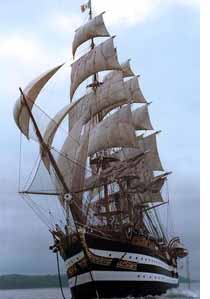
disappointed. I wanted to enter my boat, shown here below! Actually,
this is the Amerigo Vespucci, the "tall ship" used by
the Italian navy as a training vessel.
|
 Well,
it didn't happen. In late November, all of Naples was glued to the
tube for the announcement--THE announcement--live, direct from Switzerland.
The Swiss were about to make their decision as to the site of their
2007 defense of the America's Cup, a major regatta (also--for you
landlubbers-- known as a boat race). Well,
it didn't happen. In late November, all of Naples was glued to the
tube for the announcement--THE announcement--live, direct from Switzerland.
The Swiss were about to make their decision as to the site of their
2007 defense of the America's Cup, a major regatta (also--for you
landlubbers-- known as a boat race).
The
mayor of Naples was shown on the screen, her eyes closed, holding
up double-barrelled crossed fingers just for luck. Here it came!---"Valencia!"
Boo-hiss. Disappointed mayor. Charges of favoritism. We wuz robbed.
Crossed fingers swiftly converted to another hand gesture that I
would not think of describing to your genteel sensitivities.
The
regatta, had it happened, would have meant the construction of a
new, world-class boat harbor in Bagnoli.
The entire area was--and remains--scheduled for rejuvenation anyway,
and work has already started on that ambitious project. The ugly
steel mill--an incredible piece of industrial blight--is being torn
down. A new fair grounds, Science City, is already open. The regatta
and boat harbor would have been a major shot in the arm, true, but
work shall continue--without or without the boat race.
Books
about Naples
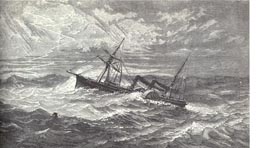
This engraving of the Quaker City was the frontispiece in the first
edition of Mark Twain's The
Innocents Abroad.
|
 I have a rather eclectic collection
of books about Naples: archaeolgy, history, music— whatever
strikes my fancy, really. It's not a huge collection, but it is
stuffed with many of those tiny and ephemeral pamphlets that come
out all the time about the "Caves of Naples," "The Customs
of Naples," "The This & That of Naples." Maybe a few hard ones,
such as The Major-Minor Shift in the Neapolitan Song as
a Manifestation of the Existentialist Dichotomy in the Popular Psyche,
(OK, I made that one up.) I have a few standard works such as Acton's
The Last Bourbons of Naples, and I am an absolute sucker
for passages about Naples in 19th century works such as Mark
Twain's The Innocents Abroad. I have a rather eclectic collection
of books about Naples: archaeolgy, history, music— whatever
strikes my fancy, really. It's not a huge collection, but it is
stuffed with many of those tiny and ephemeral pamphlets that come
out all the time about the "Caves of Naples," "The Customs
of Naples," "The This & That of Naples." Maybe a few hard ones,
such as The Major-Minor Shift in the Neapolitan Song as
a Manifestation of the Existentialist Dichotomy in the Popular Psyche,
(OK, I made that one up.) I have a few standard works such as Acton's
The Last Bourbons of Naples, and I am an absolute sucker
for passages about Naples in 19th century works such as Mark
Twain's The Innocents Abroad.
Occasionally,
I get on the internet just to see what is out there in used book
shops, not because I am necessarily going to buy, but I might. I
have found a couple of good volumes that way about, for example,
the American reaction to Garibaldi's invasion of the Kingdom of
Naples, and Antonio Pace's great book, Benjamin Franklin
and Italy.
So,
just for fun, I looked a bit today. There is nothing like a used–book
store, even if it's only in cyberspace. Right off the bat, I see
something I want:
H.M.S.
" Hannibal " at Palermo & Naples, During the Italian Revolution,
1859–1861. With Notices of Garibaldi, Francis II., & Victor
Emanuel, by Admiral Rodney Mundy. London : "John Murray. 1st
edition, 1863. 8vo.365pp. Frontispiece engraving & map. Some
pencil annotation throughout. Inner hinges very slightly strained.
Top & bottom of spine, edges & corners rubbed, original
cloth lightly marked, else very good copy." Unfortunately, the price
is US$233.35. I don't want it that bad. Sometimes the National Library
in Naples has these things in the original English as well as an
Italian translation. I'll check that one.
Maybe
I am setting my sights too high. Ah, $1.39! That's more like it.
Let's see: Devil's Daughter, by Catherine Coulter. "New York,
NY, U.S.A. 1985. Mass Market Paperback. Good. Spine lines/edge rubs/clean
Tight Pgs. Book Description: Golden-haired hellion Arabella goes
adventuring to Naples, Italy to solve the mystery of her father's
missing ships and cargoes. But soon she discovers that the man behind
the thievery is an enemy from her father's past. A man she shouldn't
love, but can't resist..". Well, I'm sure it's a fine book,
but I had to go to the OED just to find out what a "hellion" is—a
troublesome or mischievous person. No.
 And
here is John Horne Burn's classic, The Gallery, about the
seamy kaleidescope of Neapolitan life at the end of WWII played
out in the famous Galleria Umberto.
(I understand that the book is about to be republished.) I read
it once upon a time but don't own it. For $1.95, this is a definite
maybe. And
here is John Horne Burn's classic, The Gallery, about the
seamy kaleidescope of Neapolitan life at the end of WWII played
out in the famous Galleria Umberto.
(I understand that the book is about to be republished.) I read
it once upon a time but don't own it. For $1.95, this is a definite
maybe.
As
a sheer curiosity piquer, here's one by the great Polish science-fiction
wroter, Stanislaw Lem: The Chain of Chance. London: Mandarin
Paperbacks, 1990. Softcover. Very Good. 5" x 7 3/4". Remainder stripe
on bottom of book. "...In Italy, a number of people have died mysteriously.
They tend to be foreign, male, middle-aged and to have some connection
with Naples. But there the resemblances end and even Interpol have
bemusedly closed their files. However, a former astronaut turned
private detective agrees to duplicate the exact itinerary of one
of the victims in an attempt to decipher the links in an increasingly
mystifying chain of coincidence.." 179pp." Three dollars. Mark that
one. That's a keeper, especially since "... foreign, male, middle-aged..."
reminds me of someone I know.
I
don't know about the next one. The Very Daring Duchess by
Miranda Jarrett. "... formulaic romance between a conservative Naval
officer and an exotic arts dealer. After winning a victory against
the French army, Captain Edward Ramsden, the unwanted fourth son
of the Duke of Harborough, and a fellow officer decide to explore
Naples and enjoy its diversions. Their first stop is the illustrious
Signora Francesca Robin's studio d'artista, an eclectic museum containing
a number of bogus art pieces as well as a large display of lewd
paintings... The story escalates with the promise of intrigue and
sexual tension but, unfortunately, Jarrett packs her tale with maudlin
dialogue and clichè commentary. Although Jarrett's sex scenes
are steamy and descriptive, her characters are little more than
cardboard..." Three dollars and forty–two cents. Too steep—sexual
tension and steam notwithstanding.
Here's
one that is actually intriguing: A woman, a man, and two kingdoms:
the story of Madame d'Epinay and the Abbot Galiani, by Francis
Steegmuller. Madame d'Epinay was Rousseau's patron. She set him
up in a gloriously free and bucolic country estate where he could
feel like a noble savage. ("Garçon, a bit more curare on
my spear-point, please.") Ferdinando Galiani (1728-1787) was
one of the great minds of the Neapolitan Enlightenment and the author
of some important works in economics. He was also the ambassador
of the Kingdom of Naples in France in the 1760s. It is entirely
possible that he and madame d'Epinay had something going, but I
don't know. I don't even know if I want to know.
Oh,
no. Here's a mistake. Even worse--it's bald-faced baloney (that's
disgusting!): Marriage Italian Style, by Arnold Hano. "...Basis
for spicy 1964 Sophia Loren film... whore's efforts to get longtime
lover and womanizer to marry her and stay true..." That, of course,
is totally wrong. The "basis for Sophia Loren's spicy 1964...etc."
was the stage-play Filomena Marturano by Eduardo
de Filippo.
How
about The Bay of Noon, by Shirley Hazard. "... NY: Picador,
2003. Trade Paperback. Near Fine/No Jacket. Reprint. 8vo - over
7¾" - 9¾" tall. 181 pp. A young Englishwoman working
in Naples, Jenny comes to Italy fleeing a history that threatened
to undo her. Binding tight, text clean...". I think I know that
woman. Tight binding, clean text. That's her.
Here
it is! This is the one I want. One of the classics in its genre:
Illustrated Excursions in Italy, by Edward Lear: "London:
S. & I. Bentley, Wilson & Fley for Thomas M'Lean, 1846.
2 volumes, folio. (14 1/2 x 10 5/8 inches). Half-titles, 2pp. publisher's
advertisments at back of vol.II. Titles with wood-engraved vignettes,
55 fine tinted lithographic views by Lear, printed by Hullmandel
& Walton, 2 lithographic maps, hand-coloured in outline, 2 leaves
engraved sheet music at back of vol.I, 53 wood-engraved vignettes
after Lear and R. Branston. (Some spotting). Original green cloth,
blocked in gilt and blind. Modern green cloth box, green morocco
lettering piece. A fine complete set of Lear's magisterial record
of his travels through Italy. The first volume covers Lear's tours
through the Abruzzi region, 'or three Northern provinces of the
kingdom of Naples' (p.1). He made three excursions between July
1843 and October 1844, recording in both words and pictures the
most memorable and pictureque of the scenes he encountered. In the
preface he notes that object of the work was 'the illustration of
a part of Italy which.. has hitherto attracted but little attention.
With the exception of [two other works].. I am not aware of any
published account of the Abruzzi provinces in English; and the drawings
with which the following pages are illustrated are, I believe, the
first hitherto given of a part of Central Italy as romantic as it
is unfrequented' (preface). The second volume, with much briefer
text than the first, includes views 'of places in the States of
the Church - most of them within easy reach of visitors to Rome;
yet, with the exception of Isola Farnese, Castel Fusano, and Caprarola,
..seldom seen by Tourists' (Preface). Lear notes in both volumes
that the drawings 'are Lithographed by my own hand from my sketches'.
And
it is only $ 9,500. Here—to make that redundantly transparent—nine–thousand
five–hundred dollars.
I think
I'll go back and check on Jenny of the tight binding and clean text.
Bovio,
Libero (1883-1942)—
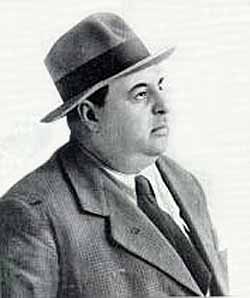 Together
with Ferdinando Russo and Salvatore Di Giacomo, Libero Bovio was at the heart
of the great rebirth of Neapolitan dialect poetry and theater at
the beginning of the 20th century. His unusual first
name—"Libero" (Free)—apparently is traceable to the
anti-monarchist sentiments of his father, a philosophy teacher.
Father also envisioned a medical career for his son, and though
Libero, indeed, entered medical school, he is said to have fainted
at the sight of all those cadavers and body parts during his first
anatomy lesson. So much for the future Dr. Bovio. Together
with Ferdinando Russo and Salvatore Di Giacomo, Libero Bovio was at the heart
of the great rebirth of Neapolitan dialect poetry and theater at
the beginning of the 20th century. His unusual first
name—"Libero" (Free)—apparently is traceable to the
anti-monarchist sentiments of his father, a philosophy teacher.
Father also envisioned a medical career for his son, and though
Libero, indeed, entered medical school, he is said to have fainted
at the sight of all those cadavers and body parts during his first
anatomy lesson. So much for the future Dr. Bovio.
Plaque
on the entrance to Bovio's home on via Duomo. It reads (in Neapolitan
dialect): "I am Neapolitan. If I cannot sing, I will die."
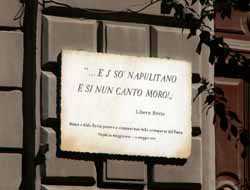 To
pursue his passion for dialect poetry and theater, he took odd jobs
at newspapers and then went to work in the export office of the National
Museum. He then became director of "Canzonetta," a small publishing
concern dedicated to the music of Naples. A
collection of his dialect comedies appeared in 1923 and his collected
poems were published in 1928. He is primarily remembered for his lyrics
to some 600 Neapolitan songs, set to the music of the great Neapolitan
song writers of his day. Among his best remembered lyrics are "Reginella,"
'O paese d' 'o sole" and, in 1925, the ultimate emigrant tear-jerker,
"Lacreme napulitane," a song that describes the drama of the
immigrant Neapolitan in America, far from home and hearth at Christmas.
The opening line of the refrain—"E nce ne costa lacreme st'America
a nuie napulitane..." (roughly, "How many tears this America has
cost us Neapolitans...") set to a keening oriental minor melodic line
by Francesco Buongiovanni, are among the best known lyrics in the
entire repertoire of the Neapolitan Song. Bovio's
home in Naples was quite a watering-hole for literati of the
day. You can even see the manuscript of a song composed by Puccini,
himself. The maestro was sitting at Bovio's piano and decided to knock
out a tune. He called Bovio over to write Neapolitan lyrics; the manuscript
on display bears both the handwritten music by Puccini and Bovio's
lyrics. Stories
that circulate about Libero Bovio indicate that he was very well-liked
and possessed of humor and good-natured wit. He supposedly had his
horse-drawn coach stop one morning so he could alight and answer an
urgent call of nature in the shadow of a building. He was approached
by a policeman: To
pursue his passion for dialect poetry and theater, he took odd jobs
at newspapers and then went to work in the export office of the National
Museum. He then became director of "Canzonetta," a small publishing
concern dedicated to the music of Naples. A
collection of his dialect comedies appeared in 1923 and his collected
poems were published in 1928. He is primarily remembered for his lyrics
to some 600 Neapolitan songs, set to the music of the great Neapolitan
song writers of his day. Among his best remembered lyrics are "Reginella,"
'O paese d' 'o sole" and, in 1925, the ultimate emigrant tear-jerker,
"Lacreme napulitane," a song that describes the drama of the
immigrant Neapolitan in America, far from home and hearth at Christmas.
The opening line of the refrain—"E nce ne costa lacreme st'America
a nuie napulitane..." (roughly, "How many tears this America has
cost us Neapolitans...") set to a keening oriental minor melodic line
by Francesco Buongiovanni, are among the best known lyrics in the
entire repertoire of the Neapolitan Song. Bovio's
home in Naples was quite a watering-hole for literati of the
day. You can even see the manuscript of a song composed by Puccini,
himself. The maestro was sitting at Bovio's piano and decided to knock
out a tune. He called Bovio over to write Neapolitan lyrics; the manuscript
on display bears both the handwritten music by Puccini and Bovio's
lyrics. Stories
that circulate about Libero Bovio indicate that he was very well-liked
and possessed of humor and good-natured wit. He supposedly had his
horse-drawn coach stop one morning so he could alight and answer an
urgent call of nature in the shadow of a building. He was approached
by a policeman:
Oh,
Don Libero—it's you! You know I have to write you up for that."
"I know. I couldn't hold it. So how much is the fine?"
"Two lire and fifty cents."
"Fine," says Bovio, handing the cop a five-lire note.
"Five? I can't change that."
Bovio looks up at his coach-driver and says, "Get
down here and take a leak. Help the officer out."
Camorra,
the
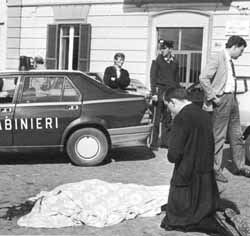 I
have no profound sociological insight to offer on the persistence
of organized crime, the camorra (the Neapolitan Mafia) in
Naples, but I offer this from The Galaxy, an Illustrated Magazine
of Entertaining Reading, a journal published in New York from
1866 to 1878 by Sheldon and Company. Among contributors to the very
first issue were heavyweights such as William Dean Howells, Henry
James, Bayard Taylor and Anthony Trollope. I
have no profound sociological insight to offer on the persistence
of organized crime, the camorra (the Neapolitan Mafia) in
Naples, but I offer this from The Galaxy, an Illustrated Magazine
of Entertaining Reading, a journal published in New York from
1866 to 1878 by Sheldon and Company. Among contributors to the very
first issue were heavyweights such as William Dean Howells, Henry
James, Bayard Taylor and Anthony Trollope.
In
May of 1868, the journal ran an article by G.W. Appleton entitled
"The Camorra of Naples." The first paragraph was:
| The
name of Naples has for many years been synonymous with all
that was evil. Mendacity and crime had attained here to proportions
which exceeded the aggregate villainy of half a dozen other
Italian towns. Overt, fearless, defiant, all dominant, these
causes had earned for the Neapolitans a sinister reputation,
which, as a people, they never merited. Aside from an ungovernable
rapacity, and a propensity for imposing upon the ignorance
and good nature of strangers, which all possess in common,
the inhabitants of Naples are essentially as little predisposed
to criminal acts, perhaps, as those of any other large city.
On the contrary, no people in the world, probably, ever suffered
with such patient endurance the tyranny of organized crime
as themselves. The existence, until within a few years, in
their midst, of a secret society, which…had for its
object the spoliation of the weak, and the appropriation by
violence of the results of honest toil…not only paralyzed
the very energies of the people, but sapped the foundation
of their integrity, and infused in them a spirit of retaliation
and reprisal… This society was known as the “Camorra”
of Naples, and it seems simply incredible that an organization,
which aimed so successfully at the industry of a whole city;
thrusting its thousand hands into the pockets of king and
peasant alike, in total disregard of the requirements of law
and order; scrupling not even at bloodshed, when its purpose
demanded it; guilty, in short, of every enormity in the whole
gamut of crime, should so long have been permitted to exist,
unassailed and triumphant. |
There
follow long descriptions of the origin of the camorra, descriptions
of involvement in smuggling and general leech-like attachment to
all affairs public and private—what amounts to a shadow state,
really.
The
article is glowingly in the past tense: "…The existence until
within a few years…This society was known as the camorra…should
so long have been permitted to exist…etc." Written as it was,
not long after the unification of Italy in 1860, the article is
glowingly optimistic. It closes with this:
| To
Victor Emanuel [1820-78, the first king of united Italy] is
due the overthrow of this monstrous iniquity…the most
notorious of the leaders were apprehended and thrown into
prison…and, in a short period, five or six thousand
were lodged in prison or banished [from] the kingdom…
and now, from Pozzuoli to Portici not one of these miserable
creatures is to be seen, and Naples, purified, redeemed, free
from…the terrors of the Camorra, has, for once in its
history, a legitimate claim upon the good opinion and respect
of the world. |
That,
from the Ministry of "Hope springs eternal…".
I can't
help wondering if this "G.W. Appleton" is, indeed, George Webb Appleton
(1845-1909), the British fiction writer. He would have been 23-years
old when he wrote the article. A good age for optimism.
Cervantes
in Naples
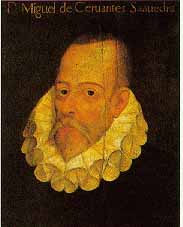 The street named via Cervantes is near the port,
probably an exciting place to be back in the early 1570s when Cervantes
was in the Spanish vice-realm of Naples in his rough–and–tumble
days as soldier and struggling author. Inscribed on a plaque
at the beginning of that street is a passage from his poem, Journey
to Parnassus. It speaks of "...Naples the illustrious...the glory
of Italy, famed in the world...the mother of nobility and the land
of plenty..." The street named via Cervantes is near the port,
probably an exciting place to be back in the early 1570s when Cervantes
was in the Spanish vice-realm of Naples in his rough–and–tumble
days as soldier and struggling author. Inscribed on a plaque
at the beginning of that street is a passage from his poem, Journey
to Parnassus. It speaks of "...Naples the illustrious...the glory
of Italy, famed in the world...the mother of nobility and the land
of plenty..."
Miguel
de Cervantes Saarvedra (1547-1614) fled Spain in 1568 to avoid the
ghastly punishment of having his hand amputated for wounding someone
in a fight. He fled to Rome and a job as a domestic servant, a post
he left in 1570 for the life of a common soldier. In 1571 he went
aboard the Marquesa, a ship in the Holy Roman fleet and sailed
from Messina to engage the Turks at the great Battle of Lepanto,
one of the most important naval engagements in the history of Europe.
By all accounts, Cervantes fought well; he spent the next few years
in the Neapolitan vice–realm in the garrisons in Palermo and
Naples. He sailed from Naples in 1575 to return to Spain and was
captured by Berber pirates and held for ransom. He lived through
years of hell in prison in Algiers, failing in four attempts to
escape, finally being ransomed and freed in 1580.
Picasso's
Don Quixote
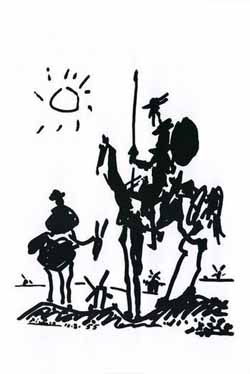 As
a writer, Cervantes struggled unsuccessfully through much of the
rest of his life. He applied for various jobs, even in Spanish possessions
in the Americas but was turned down for one reason or another. The
bulk of his work was published in the last ten years of his life.
Indeed, he started to write Don Quixote while in debtors'
prison in 1600. The first part was published in 1605. As
a writer, Cervantes struggled unsuccessfully through much of the
rest of his life. He applied for various jobs, even in Spanish possessions
in the Americas but was turned down for one reason or another. The
bulk of his work was published in the last ten years of his life.
Indeed, he started to write Don Quixote while in debtors'
prison in 1600. The first part was published in 1605.
With
the publication of Don Quixote, Cervantes achieved the success
that had eluded him for so long. In terms of posterity, thus, he
had made it, but his contemporaries were not so sure. In 1608 he
was passed over for inclusion in a group of Spanish poets invited
to go to Naples with the new viceroy, the Conde de Lemos. Journey
to Parnassus (cited above) was the result of that snub. Cervantes
had been denied the pleasure of returning to Italy, to Naples, the
land of his exuberant youth, so he invited himself. That is, the
long poem is written under a pseudonym, and it invites "Miguel de
Cervantes" to Parnassus (Naples), the mythological home of poets
and musicians. It is a somewhat tedious critique of other poets,
and it is not widely read.
The
place of Cervantes is now secure in the history of our literature.
He is a byword, whereas those who got that invitation are forgotten.
Cervantes is even secure against the jibe of his great contemporary,
Lope de Vega (1562-1625), who was apparently stupid enough to say
that "no one would so stupid as to praise Don Quixote."
Christ
Church
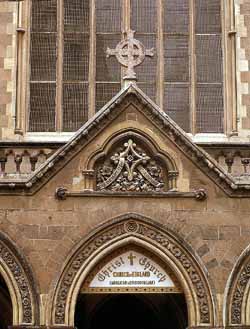 When
the King Ferdinand and Queen Caroline were forced to flee the city
of Naples--first by the revolution of 1799 and then by the forces
of Bonaparte in 1805--they managed to hole up and survive quite nicely
on the island of Sicily, well protected by the British fleet. Yet,
in spite of this monarchy-saving help from the English, the Bourbons
were intransigent when it came to allowing members of the Church of
England the luxury of a bit of land on which to build a church. Indeed,
the only non-Roman Catholic church in Naples was the Greek
Orthodox church, the presence of which goes back to the mid-1400s. When
the King Ferdinand and Queen Caroline were forced to flee the city
of Naples--first by the revolution of 1799 and then by the forces
of Bonaparte in 1805--they managed to hole up and survive quite nicely
on the island of Sicily, well protected by the British fleet. Yet,
in spite of this monarchy-saving help from the English, the Bourbons
were intransigent when it came to allowing members of the Church of
England the luxury of a bit of land on which to build a church. Indeed,
the only non-Roman Catholic church in Naples was the Greek
Orthodox church, the presence of which goes back to the mid-1400s.
The
Bourbons, thus, denied all requests from the Anglican community
in Naples for permission to build a church, both before those conflicts,
as well as afterwards, when the monarchy was restored by the Conference
of Vienna in 1815. For many years, the British community held church
services on the premises of the British legation, housed in Palazzo Calabritto at the beginning of the Riviera
di Chiaia.
That
all changed in 1860 when Giuseppe Garibladi, after the conquest
of the Kingdom of Naples by forces under his command, granted the
request and gave them the land, near Piazza San Pasquale, one block
from the Riviera di Chiaia and the Villa Comunale, the large public
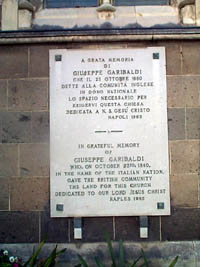
gardens. The gift was--in the words of Garibaldi inscribed on a
plaque [the one in the photo, below, is not the original] on the
premises of Christ Church in Naples:
| "...a
very small return for such benefits received from them in
support of the noble Italian cause..." |
 Thus, the gift of land was
for services rendered by those English who had raised money for
the cause of Italian unity and those who had actually fought with
Garibaldi's troops. It may also, according to some, have been one
more way for Garibaldi, anti-clerical and particularly anti-Papal,
to needle the Pope a bit. Thus, the gift of land was
for services rendered by those English who had raised money for
the cause of Italian unity and those who had actually fought with
Garibaldi's troops. It may also, according to some, have been one
more way for Garibaldi, anti-clerical and particularly anti-Papal,
to needle the Pope a bit.
After
some bureaucratic quibbling over the fact that there was already
a cavalry barracks on the land, the deed was finally ratified by
the Italian government on August 10, 1861. The church was to be
all English: the architectural firm was Thos. Smith of Hertford
and London; the stone was from Malta; and all the furniture came
from England. The mosaic behind the altar, however, was by Saviati
of Venice. The foundation stone was laid on December 15, 1862 and
the completed church was consercrated on March 11, 1865 by the Right
Reverend Dr. Sanford, first Bishop of Gibraltar.
Christ
Church has continued ever since--except for a break of three years
during WWII--to serve the needs of the considerable English community
in Naples as well as the less permanent, but sizeable, contingent
of British forces from the NATO community in Naples. It also serves
the American Episcopalian community.
As
an interesting sidelight, Garibaldi had earlier visited Britain
to raise money for his campaign to invade the Kingdom of Naples.
In Coventry, he is said to have planted and dedicated three oak
trees with the words, "May they be struck down by lightning if ever
my country declares war on this country." The story says that when
Mussolini declared war on Britain some 80 years later, one of the
oaks was struck.
[I
have drawn some of this information from an article by Pamela
Payne that appeared in The Lion Magazine in September, 1992.
She, in turn, credited a booklet by Miss Winifred F. Allen.]
Churches—small,
old, closed
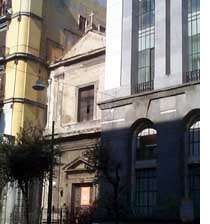 I harbor
no illusion that I will ever discover— much less write about—all
of the little churches in Naples that are abandoned and falling
apart. But sometimes I see one set incongruously in the middle of
the modern city, and it stirs my urge to know more. I harbor
no illusion that I will ever discover— much less write about—all
of the little churches in Naples that are abandoned and falling
apart. But sometimes I see one set incongruously in the middle of
the modern city, and it stirs my urge to know more.
Via Depretis is the avenue between Piazza
Municipio (the site of the city hall) and Piazza della Borsa
(the stock exchange). Like all such straight, broad thoroughfares
in that section of Naples, it is the product of the massive reconstruction
called the risanamento, a 30-year
project of the late 19th and early 20th century.
A smaller, yet important, wave of construction took place in Naples
during the 1920s and 30s and produced those mastodons of Fascist
Art Deco such as the main post office, the passenger terminal at
the port of Naples, and all of the municipal and provincial government
buildings on or near Piazza Matteotti.
Another such monolith is the telephone exchange about halfway along
via Depretis. It gleams and towers over the rest of the neigborhood;
indeed, it and the large risanamanto
building a few yards away could do an excellent car-crusher
number on the tiny edifice caught in the middle, the church
of San Giacomo degli Italiani (photo). The small church is
closed, dilapidated and non-descript—yet, for what it's worth—it
managed to survive two great waves of purposeful demolition and
construction in the last century and even various random waves of
destruction in the form of the aerial bombardments of the Second
World War.
The church was a remake in the 1570s of a nearby church of the same
name that disappeared as part of Spanish construction in the 16th
century. The original church was from 1328 and was the seat of the
Order of the Knights of St. James. The appellation "degli Italiani"
(of the Italians) may have been to distinguish it from another church—more
familiar to Neapolitans and, indeed, still a functioning church—San
Giacomo degli Spagnoli. Or, says another theory, it was to honor
sailors from Pisa ("Italians" as opposed to "Neapolitans") whose
fleet rested in the port of Naples for a while on the way home from
a victory over the Saracens further south in 1327. The façade
of the present church incorporates the portal from the 1500s as
well as a crest comprised of a shell, sword, and cross, the symbol
of the Order of St. James. The church was left standing intentionally
during the risanamento and was reconsecrated in 1901. I have
been unable to find out if it served as a church after the giant
building was put up next door. I suspect that it was closed during
that period and simply never reopened.
Composers,
other
 Elsewhere
in these entries I have dealt with some prominent names in the world
of Naples and music, primarily composers from the 18th and 19th centuries
(see entries for Bellini, Cimarosa, Donizetti,
Paisiello, Pergolesi, Rossini,
and A. Scarlatti. Also see the entry,
Comic opera and Mozart). For the sake
of completeness, I should add a few more names of those who formed
what is generally called the "Neapolitan School" in the 1700s. Some
of them (in chronological order of date of birth) are: Elsewhere
in these entries I have dealt with some prominent names in the world
of Naples and music, primarily composers from the 18th and 19th centuries
(see entries for Bellini, Cimarosa, Donizetti,
Paisiello, Pergolesi, Rossini,
and A. Scarlatti. Also see the entry,
Comic opera and Mozart). For the sake
of completeness, I should add a few more names of those who formed
what is generally called the "Neapolitan School" in the 1700s. Some
of them (in chronological order of date of birth) are:
Francesco
Durante 1684–1755
Leonardo Vinci 1690–1730
Leonardo Leo 1694–1744
Niccolò Piccinni 1728–1800
Francesco
Durante's father was employed by the S. Onofrio conservatory,
so Francesco came to his musical training at the same institution
quite naturally. He then studied in Rome but returned to Naples
to lead the S. Onofrio conservatory. By 1728 he was the head of
another conservatory in Naples, the Neapolitan Conservatorio
dei Poveri di Gesù Cristo. He served there for 10 years,
resigned and then headed the Neapolitan Conservatorio di S. Maria
di Loreto. (All of these various conservatories were fused into
a single institution by the French when Murat
ruled Naples in the early 1800s.) Durante was primarily known as
a composer of sacred music and was at mid-century the most respected
teacher of music in Naples. Pergolesi and Paiseiello were among
his illustrious students.
Anyone
named Leonardo Vinci must have needed a real sense of humor.
Presumably, this brought young Leo into the then new discipline
of the Neapolitan Comic Opera after an education at the Conservatorio
dei Poveri di Gesù Cristo. His first work was a comic
opera called Lo cecato fauzo (fauzo is Neapolitan
for "false"—here it is good to remember that most of these
delightful works were, in fact, written in Neapolitan and not in
Italian). The Blind Faker might be an appropriate translation,
but I have never seen an English translation. (I have never seen
the original opera, either.) It opened at the Teatro dei Fiorentini
in Naples in 1719.
Although
his name has been historically overshadowed in the comic opera by
Pergolesi and, later, Cimarosa and Paisiello, at the time—the
1720s—Vinci ruled the world of comic opera in Naples. Interestingly,
his Li zite’ngalera [Old Maids in Prison] (!), from
1722, is the earliest surviving score of a Neapolitan comic opera,
composed and performed well before Pergolesi's La Serva Padrona,
the work that is now viewed historically as having started the great
popularity of the Neapolitan musical commedia throughout Italy and elsewhere. Vinci
also composed serious opera for theaters elsewhere in Italy and,
indeed, was one of the musicians (besides Sarro, A. Scarlatti, and,
later, Piccinni–see, below) to have a hand at writing music
for Metastasio's Didone abbandonata, the work that brought
literary merit back into Italian opera after decades of doggerel.
Vinci died relatively young and, according to some sources, may
have been poisoned as the result of an illicit love affair. [Note
to myself: try to find the raw, unexpurgated version of Old Maids
in Prison !]
Leonardo
Leo was a student at the one Neapolitan conservatory not yet
mentioned in this entry, the Conservatorio S. Maria della Pietà
dei Turchini and the only one that still survives as a functioning
church. (See music conservatory
for details of the religious origins of the Naples conservatories.)
He was a successful composer and church organist by his early 20s
and then turned to writing comic opera, as well. When A. Scarlatti
died in 1725, Leo replaced him as the first organist of the viceregal
chapel. He composed serious works for theaters in Italy as well
as for the court of Spain. In Naples, in 1739, he became the head
of the conservatory where he, himself, had studied. He is remembered
as a teacher and an innovator, concerning himself with reforming
church music as well as the orchestra of the royal opera.
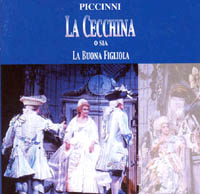
Somewhere,
Mozart is supposed to have remarked that he wanted to compose comic
opera as good as that of Niccolò Piccinni "even though
I am only a German." Indeed, between 1760—the year of Piccini's
first great success, the comic opera La Cecchina ossia La buona
figliola (Cecchina or the Good Daughter)—and the coming
of the generation of composers such as Cimarosa in the 1780s, no
Italian composer was held in higher esteem throughout Europe than
Piccinni. La Cecchina was the most popular work of its kind
for years in Italy. The libretto is by Goldoni and is an adaptation
of Pamela, or Virtue Rewarded by Samuel Richardson.
Verdi, himself, said that La Cecchina was "the first true
comic opera". The work belongs to the larmoyant school—"tear-jerker"—popular
in the mid-1700s (and ever since?)—a young, delicate, orphaned
heroine against the fates. Musically, Verdi held it in such high
esteem because it was more than just a rollicking thigh-slapper;
it showed Piccinni's flair for the minor, plaintif song set, uncharacteristically,
in a comic piece, not unlike, say, Donizetti's later "Una furtiva
lacrima" in L'elisir d'amore. There is even a virtuoso
bit of angry soprano, a stylistic precursor, some say, to Mozart's
"Queen of the Night" in The Magic Flute.
Piccinni
was a prolific composer of symphonies, sacred music, chamber
music, and opera (some estimates claim he wrote as many as 300 operas).
His prolificness extended to biology, as well; he had seven children
and was so concerned for their wellfare and security that he accepted
a well–paying appointment at the court of France in 1776.
He represented one–half of the debate raging in Paris between
the Italian style of music and the influential school of Gluck.
Thus, it was the "Piccinnists" versus the "Gluckists," although Piccinni
and Gluck, themselves, apparently never encouraged feuding between
their respective claques. Piccinni returned to Naples in 1791 when
the drivers of the French Revolution cut off his stipend. In Naples,
he was thought to harbor revolutionary badthink and was placed under
house arrest for four years. At the end of his life, he returned
to France, where he died in 1800. The music conservatory in Bari,
Italy—his birthplace—is named for him.
Piccinni's
reputation was eclipsed—as was the entire genre of the Neapolitan
comic opera—by the subsequent shift in cultural tastes in
Europe—the outbreak of Romanticism—so perhaps this is
a good place to stop. I could have mentioned Francesco Provenzale
(1624-1704), the first Neapolitan composer of opera, very few of
whose works survive, but a great influence on the next generation;
or Niccolò Porpora (1687–1768), primarily known as
a teacher—indeed, one of Haydn's teachers and the voice teacher
of Farinelli, the great castrato. Or Niccolò Jommelli, (1714-74),
the greatest symphonic innovator of his day, whose ability to use
and even invent orchestral resources to carry text was praised by
Metastasio. Or the strange case of Johann Adolf Hasse
(1699–1783), the Austrian who came to Naples to study with
A. Scarlatti and became, I think, the only foreigner in the "Neapolitan
School" and one of Metastasio's important collaborators. The fact
that I have crammed all of these fine musicians into a single entry
as "Other Composers," is, I am aware, an injustice. It was a convenience
for me to do so and certainly reflects only upon my own limited
tastes. So, I invite you to go find a CD of Piccinni's La Cecchina,
which I have just done, and have a listen—which I have also
just done. It's fine. (I couldn't find Old Maids in Prison.)
Cypress
Grove
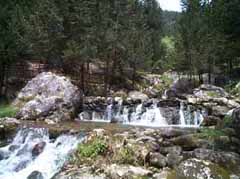 Like most, you have probably said,
"if you've seen one coniferous gymnosperm, you've seem them all."
(Alas, how many moments have we wasted over that single phrase!)
Yet, on the premises of the little church of the Madonna
of the Cypresses just above the town of Fontegreca not too far from
Caserta in the mountains of the Matese area of Italy, there is a
grove of such trees that you must see. Like most, you have probably said,
"if you've seen one coniferous gymnosperm, you've seem them all."
(Alas, how many moments have we wasted over that single phrase!)
Yet, on the premises of the little church of the Madonna
of the Cypresses just above the town of Fontegreca not too far from
Caserta in the mountains of the Matese area of Italy, there is a
grove of such trees that you must see.
The Matese is one of the areas in Italy where you go to get
away from it all. "It" has been in and out of the area many times
over the millennia: there are Roman and Samnite ruins, medieval
castles (such as the nearby Castello di Prato Sannita), and
much more recently, the armies of WWII swept past to converge ferociously
on nearby Monte Cassino. Yet the area has always managed to restore
itself, to live up to the inscription, from the book of Isaiah,
on the wall inside the tiny church:
| "The
glory of Lebanon shall come to you, The cypress, the pine, and
the box tree together, To beautify the place of My sanctuary;
And I will make the place of My feet glorious." |
And that shows you just how much you know about Lebanon. Forget
the cedars. Come see the cypresses. I know that Isaiah says that
they will come to you, but you have to meet them halfway. That point
is in the 200–acre cipresseta
(cypress grove, pictured above) that climbs both slopes above a
cascading stream on the grounds running up from and beyond the church.
The origins of the religious sanctuary are in the eighth century,
and the cyprus grove has been the object of traveller curiosity
and then botanical interest since the 1600s. The stream is fed by
the Sava river higher up in the valleys of the Apennines.
Apparently, the particular
species of cyprus on the premises of this now protected park is
unique in Europe. Girolamo, the gentle and jovial caretaker of the
grounds—the gentleman who keeps the water-mill running!—says
that no one knows how the trees got there and that they are not
members of the species Cypressus Sempervirens, common elsewhere
in Italy and apparently brought originally by the Etruscans, whom
even Girolamo does not remember. Sempervirens, or one of
its cousins, even provided the wood for the gates of Constantinople,
which lasted 1,100 years. Here endeth the lesson in historical dendrology
for today.
Ferdinand
IV (a sidelight)
I enjoy
browsing in old journals. I mean old journals—the kind
that let you read about persons before they grow up to be "history."
Here is something I found in an issue of The North American Review
from January 1816, only the second year of existence of that distinguished
publication. It is a kind of character sketch of Ferdinand IV of
Naples (who would shortly become Ferdinand I of the Kingdom of Two
Sicilies) right after he had been restored to his throne after Napoleon's
defeat and the subsequent Restoration mandated by the Congress of
Vienna. The item appears to be a reprint from The Journal,
although I haven't yet managed to figure out which journal—probably
a British publication of the day. The writer pretty much confirms
other contemporary and subsequent descriptions of the king as being
affable and stupid. A lunkhead. That view is much kinder than some,
such as this sentence from a much later (1911) description of Ferdinand
in the Encyclopedia Brittanica: "...Ferdinand died on the
4th of January 1825. Few sovereigns have left behind so odious a
memory. His whole career is one long record of perjury, vengeance
and meanness, unredeemed by a single generous act..."
"THE
KING OF NAPLES (The North American Review, Jan. 1816)
Ferdinand
4th is in his fifty-sixth year; in his person he is tall
and straight, rather thin than corpulent, his face is very
long, his hair and eyebrows white, and his countenance on
the whole far from comely, but lighted up by an expression
of good nature and benignity that pleases more and lasts
longer than symmetry of features. His manners are easy,
his conversation affable, and his whole deportment (princes
will pardon me if I presume to mention it as a compliment)
that of a thorough gentleman.
With
regard to mental endowments, nature seems to have placed
him on a level with the great majority of mankind, that
is, in a state of mediocrity, and without either defect
or excellency; a state the best adapted to sovereign power,
because the least likely to abuse it. If one degree below
it, a monarch becomes the tool of every designing knave
near his person, whether valet or minister ; if only one
degree above it, he becomes restless and unintentionally
mischievous, like the Emperour Joseph; and if cursed with
genius, he turns out like Frederick, a conquerour and a
despot. But the good sense which Ferdinand derived from
nature required the advantages of cultivation to develop
and direct it; and of these advantages he was unfortunately
deprived, in part perhaps by the early absence of his father,
and in part by the negligence or design, first of his tutors,
and afterwards, of his courtiers.
Being
raised to the throne in the eighth year of his age, and
shortly after left by his father under the direction of
a regency, he cannot be supposed to be inclined, nor they
capable of compelling him, to application. The result has
been as usual, a great propensity to active exercises, and
an aversion to studious pursuits. The ignorance which follows
from these habits is such as to extend to articles, known
among us to every person above daily labour, and it not
unfrequently shews itself in conversation, and betrays his
majesty into mistakes that sometimes startle even well-trained
courtiers. Thus, mention being accidentally made in his
presence of the great power of the Turks some centuries
ago, he observed, that it was no wonder, as all the world
were Turks before the birth of our Saviour.
Upon
another occasion, when the cruel execution of Louis 16th,
then recent, happening to be the subject of conversation,
one of the courtiers remarked, that it was the second crime
of that kind that stained the annals of modern Europe; the
King asked with surprise, where such a deed had been perpetrated
before; the courtier replying, in England. Ferdinand asked
with a look of disbelief, what King of England was ever
put to death by his people? The other of course answering,
Charles 1st; his Majesty exclaimed, with some degree of
warmth and indignation, ‘ No, Sir, it is impossible,
you are misinformed ; the English are too loyal and too
brave a people to be guilty of such an atrocious crime.’
He added ‘depend upon it, Sir, it is a mere tale trumped
up by the Jacobins at Paris to excuse their own guilt by
the example of so great a nation; it may do very well to
deceive their own people, but will not I hope, dupe us.’
"
|
There
is other material on Ferdinand in the log entries in vol. 1 for
The Bourbons (1) and Eleonora
Fonseca Pimentel.
Fersen
(villa)—on Capri
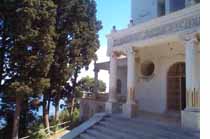 Only
the ambidextrous, such as myself, can parry the charge of being
so unabashedly gauche ("left," as the French say) as to sit
in the fine restaurant of a 4-star hotel overlooking the sea on
the Isle of Capri while reading Mark Twain's Roughing It. Only
the ambidextrous, such as myself, can parry the charge of being
so unabashedly gauche ("left," as the French say) as to sit
in the fine restaurant of a 4-star hotel overlooking the sea on
the Isle of Capri while reading Mark Twain's Roughing It.
Guilty as charged. It's not that you can't find roughness on Capri.
On the contrary, you can indeed take rough hikes and get tired and
lost, or take rough swims and get tired and dead. One of the roughest,
cruelest stories I know about Capri goes back only a few years:
a leaky tub captained by one of those human vermin who traffic in
desperate refugees from Asia and Africa sailed up along the imposing
cliffs on the southern flank of Capri. Captain Scum then got his
huddled masses up out of the hold where they had been stowed. "Look,"
he told them. "There they are—the White Cliffs of Dover. England!
I have kept my promise. All you have to do is swim ashore from here
and you're home free." They weren't, of course, as they found out
after straggling up onto the beach and starting to enquire of local
fishermen about train connections to London.
All that, of course, is of little concern to the average Capri-goer
in this age of mass tourism, addicted as we are to the galaxy of
starred hotels (both four and ill) that now abound on the island.
However, tourism in a more gracious age—say, the early 1900s—gave
those graced with enough money the liberty of indulging other addictions
and lifestyles: cocaine, bizarre Romanesque orgies, and 15-year-old
boys, all of which held in thrall the life of Jacque d'Adelsward
Fersen (1880-1923) the gentleman for whom the strangest house on
the island is named, the Villa Fersen.
Fersen, according to some sources, was the great–grandson
of one Hans Halex de Fersen, a Swedish officer who was Marie Antoinette's
lover. In any event, Jacque was born in Paris and by the time he
was 22 had inherited great wealth, served in the French army and
published poetry. He travelled widely in Europe, including a number
of trips to Capri. In 1903, on the eve of his engagement in France
to a young woman named Blanche, he was arrested for "corrupting
the morals of minors." The charge was based on an accusation by
a servant whom Fersen had discharged and who testified that Fersen
had presided, in the company of the underaged, over orgies and black
masses. Fersen was sentenced to six months in jail.
The scandal destroyed Fersen's engagement and the diplomatic career
that had awaited him. He left France for good and moved to Capri,
where he decided to build his retreat, a pseudo-Classical pleasure
palace on a speck of land just below the eastern height and the
sprawling ruins of the villa Tiberius, a pleasure palace in its
own right, two thousand years earlier.
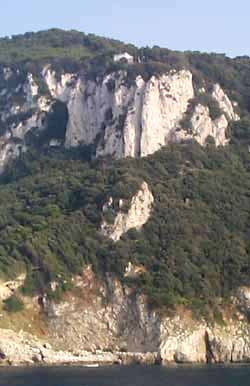 Approaching
Capri from the port of Naples, the Villa Fersen is a white speck
clinging implausibly, magically to the side of the cliff hundreds
of feet above the sea at the far eastern end of the island. It is
set—certainly because Fersen was looking for seclusion—at
one of the remotest spots on the island. The villa was finished
in July of 1905 and officially named "Villa Lysis" for a disciple
of Socrates mentioned in one of Plato's dialogues. Fersen had many
of the extravagant furnishings brought from Paris, had the phrase
Amori et dolorum sacrum ("Sacred to love and pain") inscribed
over the entrance, and in general cleared the decks for full-scale
debauchery quite in keeping with the climate of the times on Capri
(see the log entry on Krupp and Capri).
Most bizarrely, Fersen ordered that the construction materials for
his new house be carried into place only by women. (He'd show old
Blanche What's-Her-Name!) In spite of the official name, everyone
knows the building as "Villa Fersen" and even sign posts use that
name as they point you along your way. Approaching
Capri from the port of Naples, the Villa Fersen is a white speck
clinging implausibly, magically to the side of the cliff hundreds
of feet above the sea at the far eastern end of the island. It is
set—certainly because Fersen was looking for seclusion—at
one of the remotest spots on the island. The villa was finished
in July of 1905 and officially named "Villa Lysis" for a disciple
of Socrates mentioned in one of Plato's dialogues. Fersen had many
of the extravagant furnishings brought from Paris, had the phrase
Amori et dolorum sacrum ("Sacred to love and pain") inscribed
over the entrance, and in general cleared the decks for full-scale
debauchery quite in keeping with the climate of the times on Capri
(see the log entry on Krupp and Capri).
Most bizarrely, Fersen ordered that the construction materials for
his new house be carried into place only by women. (He'd show old
Blanche What's-Her-Name!) In spite of the official name, everyone
knows the building as "Villa Fersen" and even sign posts use that
name as they point you along your way.
Fersen continued to write poetry and novels and to keep younger
male companions. In 1910, the police broke in on some particularly
weird goings-on at Villa Fersen and Jacque had to leave the island
for a while. He spent much of the Great War in a hospital in Naples
trying to recover from cocaine and opium addiction. He returned
to his villa after the war and a few years later intentionally administered
himself a lethal overdose of cocaine. His intelligence, wealth,
poetic gifts, life-style, vices and ultimate tragedy invite comparison,
in the minds of some, to the life of his English contemporary, Oscar
Wilde.
The villa went to Fersen's sister, Germaine. Later, in the 1940s,
it was acquired by a distant cousin of Fersen and became somewhat
of a cultural "salon" and watering hole for Italian intellectuals
such as Alberto Moravia and Else Morante. In the 1950s it was again
sold, this time to the owner of the famous Hotel Quisisana; plans
to develop the villa as an exclusive hotel came to naught. Eventually,
in the 1980s, a "Lysis Association" was founded to protect the villa,
and the Ministry of Culture then acquired the property and set about
restoring the premises as an historical monument. The villa was,
however, sold once again to a wealthy and elderly Italian-American,
Armando Campione who died almost immediately thereafter. In 2001,
Villa Fersen was acquired by the City Council of Capri and restoration
as a cultural center is still going on.
At present (2004) the premises are open, and the villa has been
structurally restored and is sound. As yet, there are no furnishings,
but the interior is painted, cleaned, and is primed to receive whatever
the city council decides. It is a spacious two-story mansion with
panoramic terrace balconies at both levels; there are at least a
dozen large rooms, including those in the large basement. It is
all set in abundant greenery and overlooks the bay of Naples as
if sharing watch over the eastern approaches to the bay with the
old tower on Punto Campanella at the tip of the Sorrentine peninsula
just across the narrow straits. A plaque put in place near the entrance
to the villa pays homage to French writer Roger Peyrefitte (1907–2000),
author of The Exile of Capri, a biography of Fersen.
Gambrinus
(Caffè )
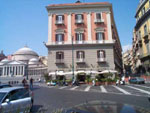 Naples
is a city that prides itself on coffee—nay, believes itself
to be the sole arbiter of what sets a magnificent brew apart from
the swill they serve in the rest of the world. Naples even has its
own, special Neapolitan coffee percolator, a three-piece contraption
that requires three-ring dexterity to turn upside down (or maybe it's
rightside up) at just the right moment during the brewing process. Naples
is a city that prides itself on coffee—nay, believes itself
to be the sole arbiter of what sets a magnificent brew apart from
the swill they serve in the rest of the world. Naples even has its
own, special Neapolitan coffee percolator, a three-piece contraption
that requires three-ring dexterity to turn upside down (or maybe it's
rightside up) at just the right moment during the brewing process.
For such
a city, Naples was tardy—the late 1700s—in coming to the
idea that one could actually set up little coffee bars along the by–ways
and maybe serve some sweets and pastries in the process. Such places
were common in the rest of Italy in the late 1600s. Yet, the Neapolitans
made up for lost time; by the mid–1800s there was scarcely a
short stretch of street in Naples without a little coffee bar of some
sort. That tradition continues to this day. Some are holes in the
wall, and some are opulent. Indeed, calling the Caffè Gambrinus
a coffee bar is like calling St. Peter's Cathedral a church; you're
right, but the crime of paucity of description borders on a capital
offence.
The Caffè
Gambrinus is on the ground floor of the large building that houses
the Naples Prefecture at Piazza Plebiscito.
One entrance is on that large square, itself; the main entrance is
on Piazza Trieste e Trento (still known to many as Piazza San Ferdinando,
named for the church on that square). Gambrinus is a few yards away
from the Royal Palace, the San Carlo opera
house, and the Galleria Umberto.
It is at the beginning of two of the most famous streets in Naples:
via Toledo (also known as via Roma) and via Chiaia, the main street
that joined the downtown area of 1900 to the western part of the city.
Gambrinus, thus, was the crossroads where music, art, and politics
came together in the late 1800s to sit together and have a coffee
and maybe a brandy or two. In other words, a watering-hole for intellectuals.
Gambrinus
was born as, simply, il Gran Caffè on its current
premises in the 1860s. By the 1890s, with the great rebuilding of
Naples, the risanamento, in full swing, it turned into the
Caffè Gambrinus, using the name of the "patron saint of beer,"
that name deriving—according to one plausible etymology—from
Jan Primus (John I), a 13th–century Burgundy prince. Thus, Gambrinus,
like other establishments of its kind was and remains a place where
you do more than just drink coffee.
The premises
consist of a main bar and pastry section plus six adjoining rooms,
all of which are showcases of fin de siècle fashion,
that 1890s wave of sophistication and world-weariness. The rooms are
all vaulted and display in white bas relief various scenes from mythology.
The walls are lined with thin, classical columns and reliefs of statuary,
and there is ample use of large mirrors to increase light and the
illusion of space. The mirrors alternate with equally large paintings
of outdoor Neapolitan life of the day, not precise tromp l'oeil,
but at least creating the pleasant sensation that you are looking
out at the bay of Naples, a coast-line, fishermen, fashionably overdressed
women strolling along the street, and even one of the ultimate in
1890s decadence—a woman smoking a cigarette! Neapolitan decadence
of the 1890s is round and plump, not to be confused with the gaunt
English decadence of the same period; all the women in these paintings,
especially the smiling peasants, have 40 pounds on anything Aubrey
Beardsley ever came up with.
Gambrinus
was closed in 1938 under the flimsy pretext that the noise was keeping
the prefect and his wife—who lived in the same building upstairs—awake
at night. In reality, all those artists, politicians, and writers
had created their own little hotbed of discussion, the noise from
which was keeping Fascist government officials awake on the eve of
WW2. The establishment reopened in the 1950s.
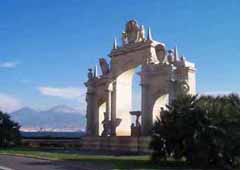 This magnificent fountain is also known as the "Immacolatella".
Both names derive from two of the locations that have been home to
the fountain during its many travels. (Being moved is a risk you take
if you are a fountain in Naples. Click
here for another example.) The fountain was sculpted in the early
1600s and is the work of Michelangelo Naccherino (1559-1622) and Pietro
Bernini (1562-1629). It was first located near the Royal Palace near
a statue of "The Giant," recovered from the ruins of Cuma. In 1815
the fountain was moved to the port of Naples to be in front of the
Immacolatella, the old quarantine
station. It was then moved near the Carmine church at Piazza Mercato;
then to the gardens on the square of San Pasquale a Chiaia;
then finally, in 1905, when the new seaside road was finished during
the "risanamento" of Naples
the fountain was moved to its present location (see photo) at the
pituresque curve beween via Partenope and via Nazario Sauro not far
from the Castel dell'Ovo. This magnificent fountain is also known as the "Immacolatella".
Both names derive from two of the locations that have been home to
the fountain during its many travels. (Being moved is a risk you take
if you are a fountain in Naples. Click
here for another example.) The fountain was sculpted in the early
1600s and is the work of Michelangelo Naccherino (1559-1622) and Pietro
Bernini (1562-1629). It was first located near the Royal Palace near
a statue of "The Giant," recovered from the ruins of Cuma. In 1815
the fountain was moved to the port of Naples to be in front of the
Immacolatella, the old quarantine
station. It was then moved near the Carmine church at Piazza Mercato;
then to the gardens on the square of San Pasquale a Chiaia;
then finally, in 1905, when the new seaside road was finished during
the "risanamento" of Naples
the fountain was moved to its present location (see photo) at the
pituresque curve beween via Partenope and via Nazario Sauro not far
from the Castel dell'Ovo.
Amid
the three rounded arches and above and on the sides of the fountain,
besides the main basin adorned with marine life, the work is decorated
with caryatids holding a cornucopia, as well as with the coats of
arms of the city and of the Spanish vice-realm.
The
Bernini involved with this fountain is, by the way, not the
Bernini of the great colonnade of St. Peter's in Rome. That would
be Giovanni Lorenzo Bernini (1598-1680). This Bernini--Pietro--was
his father.
Gladstone's
pamphlet on Naples
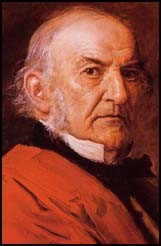 The
entry on Nisida and Carlo Poerio
makes reference to William Gladstone's Letters to the Earl of
Aberdeen on the State Prosecutions of the Neapolitan Government,
the publication of which in pamphlet form in 1851 exposed the horrendous
conditions in Neapolitan prisons of the day. The letters, too, were
a general condemnation of the absolutist Bourbon monarchy. The
entry on Nisida and Carlo Poerio
makes reference to William Gladstone's Letters to the Earl of
Aberdeen on the State Prosecutions of the Neapolitan Government,
the publication of which in pamphlet form in 1851 exposed the horrendous
conditions in Neapolitan prisons of the day. The letters, too, were
a general condemnation of the absolutist Bourbon monarchy.
I came
across a review of Gladstone's pamphlet in an 1851 issue of Littell’s
Living Age, a New York journal that specialized in reprinting
material from foreign journals. The reprint, in this case, is from
The Spectator, a prominent journal of British liberalism.
The
review is in the "Through the eyes of..." section of Around
Naples in English. Click here to
read that review.
hand
gestures (books) and Andrea de Jorio
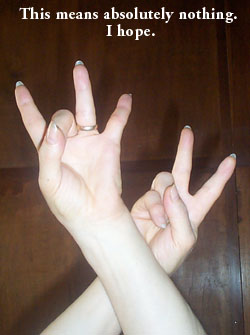 Every
few years, another locally published, small-press book comes out
about Neapolitan hand gestures. These gestures are a bit of local
culture that charms the rest of the world; after all, everyone knows
that "Italians talk with their hands." (That, of course, is wrong;
southern Italians talk with their hands. Northern Italians,
by comparison, lumber about as if they're auditioning for Invasion
of the Crippled Skiers). Indeed, there are entire dictionaries
hidden and not so hidden in every Neapolitan hand wave, knuckle
turn, lip smack, and finger waggle. Every
few years, another locally published, small-press book comes out
about Neapolitan hand gestures. These gestures are a bit of local
culture that charms the rest of the world; after all, everyone knows
that "Italians talk with their hands." (That, of course, is wrong;
southern Italians talk with their hands. Northern Italians,
by comparison, lumber about as if they're auditioning for Invasion
of the Crippled Skiers). Indeed, there are entire dictionaries
hidden and not so hidden in every Neapolitan hand wave, knuckle
turn, lip smack, and finger waggle.
One such volume, for example, is Comme te l'aggia dicere? (Neapolitan
dialect for "How can I explain this to you?"). The secondary title
is in Italian: Ovvero l'arte gestuale a Napoli (Or the Art
of the Gesture in Naples). It is by Bruno Paura and Marina Sorge
(1999. ed. Intra Moenia, Naples). It has 138 pages, with emotion
and message listed alphabetically—"scorn," "approval," "you
must be crazy!" etc.—all accompanied by photographs or drawings.
Comme te l'aggia dicere? has replaced older volumes, now
out of print, and will itself be replaced in a few years when someone
else comes out with a new one. Even foreign language guide-books
to Naples now generally contain a few pages of pictures and explanations
of gestures. (Even if your reading extends, alas, only to t-shirts,
you can get those, too: silk-screened front and back with Neapolitan
hand gestures plus explanatory captions.)
All this is helpful. Suppose, for example, you loosen your enraged
grip on the steering wheel just enough to raise the index and little
finger to that driver of the car that has just cut you off. Yes,
you may think you are simply expressing your solidarity with the
"Longhorn" football team from the University of Texas, but that
benighted soul in the other car (who is totally ignorant of college
sports in the US) will understand your gesture as a suggestion that
his wife, the lovely woman next to him in the front seat and the
mother of his children, is betraying him, and he will be honor-bound
to run you off the road and have his own good-old college try at
taking your life.
If the authors of these books have bibiliographies, they never plug
the competition, that is, other recent books similar to their own.
They all, however, do cite the graddaddy of all such books about
Neapolitan gestures, a volume you will not find in your run-of-the-mill
bookshop: La mimica degli antichi investigate nel gestire napoletano,
by Andrea de Jorio (“The Mimicry of Ancient Peoples Investigated
through Neapolitan Gestures”). It was published in 1832 and
drifted into obscurity for many years. In his book The Italians
(1964), Luigi Barzi mentions it and laments the fact that so little
has been written about the language of gestures. Since 1964, of
course, formal studies of sign languages and general body language
have become part and parcel of the disciplines of linguistics, communications,
and anthropology. Entire curricula are devoted to the semiotics
of gestures, so it is natural that de Jorio's book should have made
a comeback, which, indeed, it has. The book has been republished
in Italian three times in recent years,1964, 1979, and 2002. All
of the reprints are photographic copes of the original edition plus
explanatory notes.
The volume also appeared recently (2000) in a scholarly and annotated
English translation by Adam Kendon as Gesture in Naples and Gesture
in Classical Antiquity (Indiana University Press). There are
at least two fine reviews of the English translation that I know
of, both of which praise the original as well as the erudite translation,
which includes an 80-page essay/introduction. The first review is
"The Neapolitan Finger" by Joan Acocella; it appeared in the The
New York Review of Books in the year 2000 and then in 2002 in
Sign Language Studies, a journal published by Gallaudet University.
The other review is by Giovanna Ceserani of Princeton University;
it appeared the Bryn Mawr Classical Review in 2003.
De Jorio (1769-1851) was born on the tiny island of Procida,
a brief sail from the mainland, ancient Cumae and that treasure
trove of Greco-Roman mythology known as the Phelgrean Fields. It
was also a time when the archaeological sites at Pompeii and Herculaneum
were opening up. De Jorio became a canon at the Naples cathedral
but was born to be a classical scholar and archaeologist. He wound
up as curator of the Royal Bourbon Museum, now the National Archaeological
museum. His purpose in writing about gestures, he said, was to show
the continuity between the classical world and the modern one. Look
at the hand gestures on these old vases, he said. They are the same
ones we use today.
Unlike today, such body language was not particularly interesting
to scholars of the early 19th century. It might even
have been amusing to the Grand Tourists of the day and even have
fit into the broad stereotyping of Neapolitans that travellers from
Goethe to Mark Twain indulged in (after perhaps one whole carriage
trip down the Riviera di Chiaia): the confusion, noise, clatter,
color, and the bizarre juxtaposition of pompous one-horse dukes
and abject beggars. Maybe the frantically gesticulating locals fit
their preconceptions—frantic hand-gibberish or something like
that (which the gestures, of course, are not).
De Jorio was no doubt proud to present his compendium
as part of classical studies, direct from Naples, one of the hubs
of Magna Grecia, the site of important archaeology in the study
of ancient Rome, and one of the centers of classical scholarship
in Europe. Yes, German scholars of the same period had swarmed through
the southern Italian peninsula, but if you thought northern Italians
couldn't move, wait till you see German professors not move. What
would they know about hand gestures?
Installation
Art '04
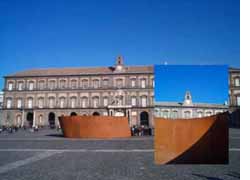 This year's ritual installation of art in Piazza Plebiscito
features a work entitled "Naples," by the master of massive minimalism,
San Francisco artist Richard Serra (1939-). It is a large spiral
(already called "Contraception of the Gods" by those who view with
some disdain the city's unabashed dedication to this kind of display).
Entering into the giant orange scuplture of curved and bending steel
plates, you spiral in, leaning in and out with the curves of the
walls, to the center, where you can look up and see the clock tower
on the facade of the royal palace (see photo and insert). The individual's
perception as he navigates the deceptive geometry of this small,
tilted space set in the larger space of the square, itself, is what
gives validity to the work, says the artist. Clearly, to be a private
experience--to be at all touched by the suggested metaphor of yourself
in a similarly skewed private life-space set in the space of the
world at large--the wandering in and out is best done slowly and
alone and not as part of a curious herd elbowing their way in and
out--unless, of course, you spend much of your time elbowing your
way through life wondering what it's all about. That, too, is possible. This year's ritual installation of art in Piazza Plebiscito
features a work entitled "Naples," by the master of massive minimalism,
San Francisco artist Richard Serra (1939-). It is a large spiral
(already called "Contraception of the Gods" by those who view with
some disdain the city's unabashed dedication to this kind of display).
Entering into the giant orange scuplture of curved and bending steel
plates, you spiral in, leaning in and out with the curves of the
walls, to the center, where you can look up and see the clock tower
on the facade of the royal palace (see photo and insert). The individual's
perception as he navigates the deceptive geometry of this small,
tilted space set in the larger space of the square, itself, is what
gives validity to the work, says the artist. Clearly, to be a private
experience--to be at all touched by the suggested metaphor of yourself
in a similarly skewed private life-space set in the space of the
world at large--the wandering in and out is best done slowly and
alone and not as part of a curious herd elbowing their way in and
out--unless, of course, you spend much of your time elbowing your
way through life wondering what it's all about. That, too, is possible.
The
work bears an amazing resemblance to Serra's earlier "Torqued Ellipses,"
done in 1996, separate curved plates of towering steel, which, to
the untrained maximalist eye--with a bit of imagination--might be
fit together into a spiral.
Leopardi, Giacomo (1798-1837)
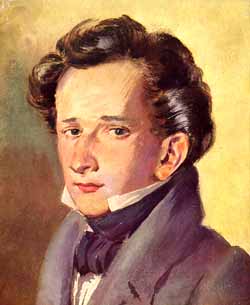 As the narrow-gauge Circumvesuviana railway wends
its way east along the coast from the city of Naples in the direction
of the Sorrentine peninsula, it passes through a number of small
stations on the slopes of Vesuvius. Two of the stations have
to do with the life of this, Italy's greatest Romantic poet. One
station is named, simply, "Leopardi" and the other "Ginestre"
(the Italian name for the broom plant, the yellow-flowered shrub
that grows abundantly on the slopes, and, as well, the title of
a remarkable poem by Leopardi). If this so-called "poet of melancholy"
ever found any relief at all in his terribly unhappy life, perhaps
it was here, in and near Naples. As the narrow-gauge Circumvesuviana railway wends
its way east along the coast from the city of Naples in the direction
of the Sorrentine peninsula, it passes through a number of small
stations on the slopes of Vesuvius. Two of the stations have
to do with the life of this, Italy's greatest Romantic poet. One
station is named, simply, "Leopardi" and the other "Ginestre"
(the Italian name for the broom plant, the yellow-flowered shrub
that grows abundantly on the slopes, and, as well, the title of
a remarkable poem by Leopardi). If this so-called "poet of melancholy"
ever found any relief at all in his terribly unhappy life, perhaps
it was here, in and near Naples.
There
are few child prodigies in literature. Presumably, meaningful reflections
on the human condition come from having a few years under your belt--time
to love, struggle, wander and let those experiences set for a while,
a process less necessary to early greatness in music and mathematics.
Thus, we are amazed at Rimbaud and Mary Shelley writing fine literature
at the age even of 19 or 20.
Leopardi
is in that unusual group. By the age of 16, he was a Latin and Greek
scholar; and by 18 he had written lasting poetry. His natural precociousness
was no doubt helped along by being a recluse for the first 20 years
of his life, holing up in his father's vast library, teaching himself
the classics as well as modern European languages. He suffered both
from poor eye-sight (that got worse as he grew older) and by a deformity
of the spine, a lifelong source of pain, physical as well as social.
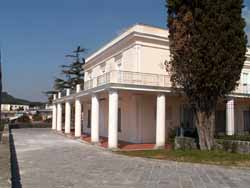 He
spent time in his home town of Recanati in central Italy as well
as in Rome and Florence. Then, in 1833, he moved to Naples to keep
the company of Antonio and Paolina Ranieri, brother and sister,
whom he had met in Rome. He then moved a number of times in Naples.
The cholera epidemic of 1835 caused him to move farther out of the
city, winding up at Villa Ferrigni, now called the Villa delle
Ginestre (photo); it is near the small knoll upon which perches
the monastery of Sant' Alfonso. Vesuvius looms directly above, and
Leopardi's final home is, indeed, near both of the modern train
stations mentioned above, named in his honor. It is here that he
wrote that 1,800 years had passed "...since the peopled places disappeared,
crushed by fiery might, and the peasant busy at his vine...still
lifts his eyes suspiciously to the fatal peak..." (in the prose
translation of George Kay from the Penguin Book of Italian Verse,
published in 1958). He
spent time in his home town of Recanati in central Italy as well
as in Rome and Florence. Then, in 1833, he moved to Naples to keep
the company of Antonio and Paolina Ranieri, brother and sister,
whom he had met in Rome. He then moved a number of times in Naples.
The cholera epidemic of 1835 caused him to move farther out of the
city, winding up at Villa Ferrigni, now called the Villa delle
Ginestre (photo); it is near the small knoll upon which perches
the monastery of Sant' Alfonso. Vesuvius looms directly above, and
Leopardi's final home is, indeed, near both of the modern train
stations mentioned above, named in his honor. It is here that he
wrote that 1,800 years had passed "...since the peopled places disappeared,
crushed by fiery might, and the peasant busy at his vine...still
lifts his eyes suspiciously to the fatal peak..." (in the prose
translation of George Kay from the Penguin Book of Italian Verse,
published in 1958).
If
by melancholy we mean something like wistfulness, a longing
for a happier past or even an unachievable ideal state, then much
of Leopard's poetry is not even that. It is simply bleak. He writes
of his own loneliness and of nature as a "betrayer" and "a
brutal force." He writes of the "infinite vanity of everything."
So if his friendship with the Ranieris made him as happy as he could
ever be, maybe all we are saying is that he liked the Neapolitan
sherbet and sweets, or that he got a kick out of trying to guess
lottery numbers, or went to San Carlo (to fill in his total lack
of musical culture), or "worshipped from afar" Paolina Ranieri.
(She apparently--as a term of endearment, one hopes--referred to
him as "il mio gobbetto"--my little hunchback.) Not
much, but at least it is something.
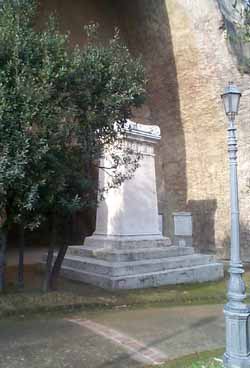 Leopardi
died in 1837. At the time, it was rumored that he had in fact died
from cholera, but that seems not to have been the case. His remains
were entombed in the small church of San Vitale and then moved to
a small space (photo) near the Mergellina entrance to the ancient
Roman tunnel that connected Naples with the western part of the
bay. A monument marks his tomb; it is near the purported last resting
place of fellow poet, Virgil. Leopardi
died in 1837. At the time, it was rumored that he had in fact died
from cholera, but that seems not to have been the case. His remains
were entombed in the small church of San Vitale and then moved to
a small space (photo) near the Mergellina entrance to the ancient
Roman tunnel that connected Naples with the western part of the
bay. A monument marks his tomb; it is near the purported last resting
place of fellow poet, Virgil.
Because
of the quality--or even lack--of translations, Leopardi is not as
well known in the English-speaking as he should be. Translators
of poetry, of course, run the risk, as they say, of "losing
poetry in the translation" and, at the other extreme, of "gaining
poetry"--of writing a beautiful poem that is too original to really
be called a translation. I know that Ezra Pound, Robert Lowell,
and Robert Bly have translated some of Leopardi into English. My
favorite English translation is of a poem written at the graveside
of a woman. Her image has been cut into the tombstone. Leopardi
says to the image:
"Tal
fosti: or qui sotterra
Polve e scheletro sei. Su l'ossa e il fango
Immobilmente collocato invano,
Muto, mirando dell' etadi il volo
Sta, di memoria solo
E di dolor custode, il simulacro
Della scorsa beltà.
Ezra
Pound's translation of these first few lines is:
"Such
wast thou,
Who art now
But buried dust and rusted skeleton. Above the bones and mire,
Motionless, placed in vain,
Mute mirror of the flight of speeding years, Sole guard of grief
Sole guard of memory
Standeth this image of the beauty sped. "
That
strikes me as perfect.
 I live
near a street in Naples that will never change its name. This is remarkable,
since the roller–coaster of historical and social change plays
games with Neapolitan urban nomenclature like you wouldn't believe.
Via Roma used to be Via Toledo (or maybe it's the other way round);
Via Gramsci used to be Via Helena; even the street I live on—named
for Victor Emanuel II, the first king of united Italy—was originally
named for Queen Maria Theresa of Naples in 1850 when the street was
built. I live
near a street in Naples that will never change its name. This is remarkable,
since the roller–coaster of historical and social change plays
games with Neapolitan urban nomenclature like you wouldn't believe.
Via Roma used to be Via Toledo (or maybe it's the other way round);
Via Gramsci used to be Via Helena; even the street I live on—named
for Victor Emanuel II, the first king of united Italy—was originally
named for Queen Maria Theresa of Naples in 1850 when the street was
built.
The
lucky, namechangeless thoroughfare I speak of is Via Maria Cristina
di Savoia. She was born in 1812 and died in 1836, a tragically brief
life. She was from the royal house of Savoy, the dynasty that eventually
came to rule united Italy later in the century. Maria Christina
was exceptionally devout and would have entered a convent but for
family pressure to marry her off in one of those arranged cross–dynastic
affairs that European royal houses used to think were so advantageous.
In 1832 she was forced into a marriage with King Ferdinand II of
Naples, obviously as a means to cement relationships between the
northerners (Savoy) and southerners (Bourbon). Her husband was King
"Bomba," (bomb), so–called for his suppression of revolutionaries
in Sicily in 1848. He was the next–to–last king of Naples.
Their son, Francis, would be the last king. She died two weeks after
giving birth to him. Her husband's second wife was Maria Theresa,
the original eponym of my street.
In
her brief life in Naples, Maria Christina was totally devoted to
benevolent works, actively promoting expansion of crafts, small
industry, and institutions to provide for the poor. She was also
responsible for mitigating her husband's tendency to hand out death
sentences. She quickly became the focus of admiration—even
adulation—of the people. She was easily the most beloved queen
in the long history of the Kingdom of Naples. In short, she was
a saint. Not metaphorically, either. At her death, a cult sprang
up around her and her episodes of intercession (to use the Roman
Catholic terminology). The process to canonize Maria Christina began
in 1859 and she was beatified in 1872. I think she is the only queen
(or king) of Naples to be so honored. She rests in the Church of
Santa Chiara.
Metastasio
in Naples
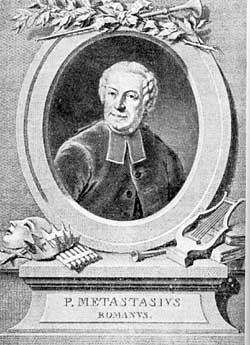 The
"What-If" school of history is as futile as it is fun, so it's hard
to say what might have happened to Italian opera if young Pietro
Trapassi had not moved to Naples to study law. Trapassi is better
known as "Metastasio." He was born in Rome in 1698 and died in Vienna
in 1782. He is primarily remembered for his libretti, text
of such quality that it revitalized Italian opera. The
"What-If" school of history is as futile as it is fun, so it's hard
to say what might have happened to Italian opera if young Pietro
Trapassi had not moved to Naples to study law. Trapassi is better
known as "Metastasio." He was born in Rome in 1698 and died in Vienna
in 1782. He is primarily remembered for his libretti, text
of such quality that it revitalized Italian opera.
When
the first operas started to play on Italian stages in the early
1600s, they were monuments to the admonition of Vincenzo Galilei
(1520-1591--he is the father of the astronomer, Galileo) to
other Florentine poets and musicians of the day not to let music
get in the way of the story. "Singing should be just barely distinguishable
from speaking," he said. However, such was the melodic and
harmonic eloquence of such giants as Monteverdi and then the Neapolitan,
Alessandro Scarlatti, that a century later the pendulum had swung
completely to the other extreme. By 1700, Italian opera was about
to expire from overwrought melody with banal and plotless
doggerel hanging off the music almost as an afterthought.
As
a child, Metastasio was "discovered" by two literary patrons. The
boy, from a modest family, was taken with wandering the streets
of Rome and improvising poetry for passers-by, a feat so impressive
that the patrons convinced Trapassi's father to give them custody
of the child so that he might have an education worthy of his talent.
Renamed "Metastasio" (a Greek form of his real name), the boy stayed
in Rome for a few years, studying the classics--and producing at
the age of 12 (!) a translation of the Iliad into Italian
octave stanzas He continued his poetry improvisations so intensively
that his health suffered. His guardians took him to Naples in 1718,
where it was understood he would study law and put poetry aside,
at least for a while.
Metastasio's
name with those of Goldoni and Alfieri on the facade of San Carlo
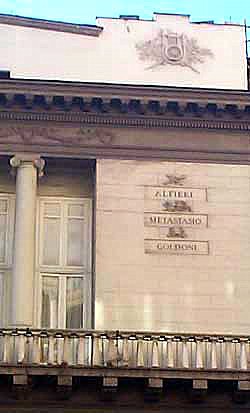 That
did not last long. Once in Naples, he began to wrote poetry again.
In 1722, he wrote, upon commission, a work for the Empress Elizabeth
of Austria (Naples was then in the middle of its brief existence
as an Austrian vicerealm). The work was entitled Gli orti esperidi
(The Gardens of Hesperides). It was set to music by Nicola Porpora
(1688-1768) one of the noted Neapolitan composers of the day. It
was an immediate success. Then, in 1724 Metastasio wrote Didone
abbandonata (Dido Abandoned), a work that Benedetto Croce called
"the beginning of the great change in the literary merit of Italian
libretti." It was set to music by Domenico Sarro and premiered at
the San Bartolomeo theater in Naples in 1724. Sources claim that
this first major libretto by Metastasio was more noteworthy than
the music; thus, it was set to music once again, this time by another
Neapolitan--and the most important Italian composer of his generation--Alessandro
Scarlatti (1660-1725) for subsequent performances in Venice and
elsewhere. It met with great success, and established text once
again as important in musical drama. That
did not last long. Once in Naples, he began to wrote poetry again.
In 1722, he wrote, upon commission, a work for the Empress Elizabeth
of Austria (Naples was then in the middle of its brief existence
as an Austrian vicerealm). The work was entitled Gli orti esperidi
(The Gardens of Hesperides). It was set to music by Nicola Porpora
(1688-1768) one of the noted Neapolitan composers of the day. It
was an immediate success. Then, in 1724 Metastasio wrote Didone
abbandonata (Dido Abandoned), a work that Benedetto Croce called
"the beginning of the great change in the literary merit of Italian
libretti." It was set to music by Domenico Sarro and premiered at
the San Bartolomeo theater in Naples in 1724. Sources claim that
this first major libretto by Metastasio was more noteworthy than
the music; thus, it was set to music once again, this time by another
Neapolitan--and the most important Italian composer of his generation--Alessandro
Scarlatti (1660-1725) for subsequent performances in Venice and
elsewhere. It met with great success, and established text once
again as important in musical drama.
Metastasio
took the time to study music in Naples, and was genuinely concerned
about the compatibility of music and text. He left Naples
in 1728 and eventually wound up in Vienna, but from his early works
in Naples, his destiny was sealed, and the legal profession lost,
no doubt, a learned professor of law or whatever else might have
been down that road for Metastasio. By the end of his life, not
only had his texts been set to music by some 400 different European
composers, but they were widely read for their literary value.
Morse,
Samuel
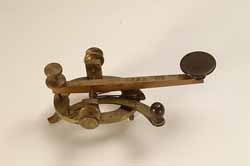 The
inventor of the telegraphic code that bears his name was a painter
and, as well, had a deep interest in politics. He toured Italy
in 1830 and 1831 in order to pursue his art. He viewed Roman Catholic
Italy as a nest of oppression, and, even worse, he didn't like pizza.
While in Naples, he apparently described pizza as ''a piece of bread
that had been taken reeking out of the sewer.'' The
inventor of the telegraphic code that bears his name was a painter
and, as well, had a deep interest in politics. He toured Italy
in 1830 and 1831 in order to pursue his art. He viewed Roman Catholic
Italy as a nest of oppression, and, even worse, he didn't like pizza.
While in Naples, he apparently described pizza as ''a piece of bread
that had been taken reeking out of the sewer.''
That
is one more reason to dislike Samuel Morse. First, the code. I had
to listen to Morse code for six hours a day for months while I was
in the army. I wound up having very bad dreams in which giant succubus
mosquitos danced on my ear drums taunting me with their incessant
beeping and whining. Second, Morse was a Copperhead defender of slavery.
Three, this thing about pizza.
Sam.
Three words: dah-dit-dah-dah dah-dah-dah dit-dit-dah
dit-dah dit-dah-dit dit
dah-dit dit-dit-dah dah dit-dit-dit
I don't
remember the exclamation mark.
Neapolitan
Mastiff
 I am not a dog owner, but if I were, I don't think I would have
a Neapolitan Mastiff. Yet, when I see them getting lots of air time
on TV, selling cellular telephones, I sit up, roll over, wag my tail,
and take notice. Apparently, this droopy, drooling, dewlapped, red-eyed,
overly-wrinkled, lumbering version of man's best friend is related
to the giant war dog, the Molossus, bred by Alexander the Great to
fight tigers and elephants. The books say they look "wistful" when
relaxed but have a "penetrating gaze" when they are about to rip out
the guts of anyone who looks at you (their master) the wrong way.
They were apparently bred to be as ugly as possible on the theory
that a thief on the verge of breaking into your home on the slopes
of Vesuvius would think twice about the undertaking upon seeing a
beast that looks like this. They were on the verge of extinction,
but since World War II have been making a comeback due to diligent
breeding. Now with all the money from TV advertising residuals, they
may be in a position to do genetic experiments of their own. I am not a dog owner, but if I were, I don't think I would have
a Neapolitan Mastiff. Yet, when I see them getting lots of air time
on TV, selling cellular telephones, I sit up, roll over, wag my tail,
and take notice. Apparently, this droopy, drooling, dewlapped, red-eyed,
overly-wrinkled, lumbering version of man's best friend is related
to the giant war dog, the Molossus, bred by Alexander the Great to
fight tigers and elephants. The books say they look "wistful" when
relaxed but have a "penetrating gaze" when they are about to rip out
the guts of anyone who looks at you (their master) the wrong way.
They were apparently bred to be as ugly as possible on the theory
that a thief on the verge of breaking into your home on the slopes
of Vesuvius would think twice about the undertaking upon seeing a
beast that looks like this. They were on the verge of extinction,
but since World War II have been making a comeback due to diligent
breeding. Now with all the money from TV advertising residuals, they
may be in a position to do genetic experiments of their own.
The ads
caught my notice because I heard a dog speaking Neapolitan dialect
on TV! He is usually in the company of a beautiful young woman, where
he dispenses a world-weary running commentary (in Neapolitan, of course)
on the futile efforts of young men to make friends with said babe,
his mistress. These problems, he advises, can be resolved only by
buying the new Italian Telecom cell-phone that gives you two numbers,
call-waiting, color TV, broad-band access to the Interpol server,
and blood transfusions. So far, young Neo (as dog lovers call them)
is into his eighth or ninth ad. In one of them, he even has Sophia
Loren as a co-star. The dirty dog.
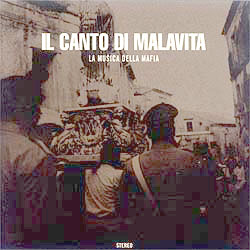 In
response to a query I have had as to whether there is such a
thing as "outlaw music" in southern Italy, the answer is 'yes,'
but it does seem strange that I should have to order a CD of
such music from a record company in Germany—but that seems
to be the case. In
response to a query I have had as to whether there is such a
thing as "outlaw music" in southern Italy, the answer is 'yes,'
but it does seem strange that I should have to order a CD of
such music from a record company in Germany—but that seems
to be the case.
I checked around the city of Naples today for a CD called Il
Canto di Malavita – La Musica della Mafia.
It is listed in catalogues as being available from Pias Recordings
in Hamburg. None of the Neapolitan stores I tried had it, though
it might be available "under the table" somewhere in town. A
website entitled www.malavita.com says, "The mere existence
of these Mafia songs and the fact that they can be bought freely
at markets throughout Calabria has led to heated and somewhat
polemic debates in Italy. Critics have stated that they think
it improper to sing the praises of those who live outside the
rule of law and that to do so is to glorify their way of life."
So, if I want to go prowl the flea-markets and music shops in
Calabria, I might find it. "Bought freely" is an interesting
oxymoron.
First, a few comments about the Italian terminology. Malavita
is the general Italian term for the criminal underworld, from
unaffiliated street punks to "organized crime"—"the mob".
Technically—though foreign usage does not respect this
distinction (the title of that CD was supplied by the German
company)—mafia refers only to Sicily; the Neapolitan branch of the same
activity is called la camorra; south of Naples and down
through the rough hills of Calabria to the end of the "boot"
of Italy, the term is 'ndrangheta. The CD in question
is, thus, music about Calabrian outlaws, the 'ndrangheta.
The term "outlaw music," itself, invites confusion because it
is not clear if one is talking about music by outlaws
or music about outlaws. I am not sure if Robin Hood or,
more recently, Jesse James, ever composed music about themselves,
but I suspect they did not. Certainly, in English literature
the most romantic manifestation of the outlaw ballad was by
Alfred Noyes (1880-1959), who toed the narrow line of the law
enough to attend Exeter College in Oxford and for a while serve
as Professor of Modern English Literature at Princeton University.
He wrote The Highwayman, a portion of which—long
slid down between the sofa cushions in my head—now resurfaces
as
The
wind was a torrent of darkness among the gusty trees,
The
moon was a ghostly galleon tossed upon cloudy seas,
The
road was a ribbon of moonlight, over the purple moor,
And
the highwayman came riding, up to the old inn-door.
I
check and see that I have fused the last two lines into one;
there should be an extra "... And the highwayman came riding-riding-riding."
(Not bad, though, for ageing synapses!) I had, of course,
totally forgotten the most dramatic and Robin-Hoody part at
the end:
Back, he spurred like a madman, shrieking a curse
to the sky,
With
the white road smoking behind him and his rapier brandished
high!
Blood-red
were his spurs i' the golden noon; wine-red was his velvet coat,
When
they shot him down on the highway,
Down like a dog on the highway,
The
southern Italian music on the CD mentioned above is, however,
authentically Calabrian. The pieces range from historical ballads
about the origins of the 'ndrangheta to songs praising
omertà—the code of silence. There is no
doubt that they glorify life outside of the law. The CD sold
well in Germany and France. Part of the criticism by Italian
critics who have reviewed the CD is that foreigners are too
willing to accept the self-serving descriptions of the music
by the people who recorded it originally.
If these people ever were Robin Hoods, say the
Italian critics, those days are long gone. Today, they kill
judges, kidnap, sell drugs, run prostitution rings, shake down
the middle-class, and rake off great wads of money from public
works boondoggles. They do not steal from the rich and give
to the poor. They steal from everybody and keep it.
Cicco
Scarpello—known by his stage name, Fred Scotti—was
one of the performers of this outlaw music of Calabria. One
evening in April, 1971, he was shot to death in the street.
He had apparently been trying to seduce the woman of one of
those criminals he liked to sing about. With or without lace
at his throat, he was indeed shot down like a dog on the highway.
Find your own message.
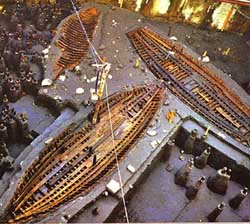 Roman
boats beneath Piazza Municipio Roman
boats beneath Piazza Municipio
The
palimpsest nature of urban Naples has been made even more evident
by the recent discovery (January 2004) of the ancient port of
Roman Naples. They have always known it was down there somewhere.
It turned out to be just about where reconstructions of the
city as it was during the first century a.d. had presumed it
to be—right beneath what is now Piazza Municipio, adjacent to the Angevin Fortress,
the Maschio Angioino, 100 yards or so in from the modern
coastline and way down beneath the manmade landfill and rubble
of 2000 years of history and the natural accumulation of 2000
years of mudslides and other geology.
Construction
for the Piazza Municipio station of the new underground train
line had already unearthed more recent items, bits of structures
that were plowed under in the 1890s to rebuild the square; then
they found the old (meaning 400 years) outer walls of the nearby
fortress. Now, beneath all that, archaeologists have brought
to light a 30–foot Roman vessel and abundant pottery,
sure signs that this was the Roman port. The expectation had
been that they would find something sooner or later as the subway
builders continued to dig and move east along the line of the
old Roman (and Greek) wall. The next station down the line at
Piazza Nicola Amore, still under construction, has now yielded
the remains of an impressive imperial villa.
Obviously,
there is much left to be uncovered. This leaves archaeologists
ecstatic; people who have to get to and from work, however,
have mixed feelings. They are already impatent with subway construction
that is months behind schedule. Workers doing the actual building
of the new train line are also uncertain about this turn of
events; whenever history and the needs of the modern city come
into conflict—as they do quite often in Naples—those
who dig and build generally have to stand aside and lean on
the their shovels until the archaeologists get finished mumbling
and cataloguing. In the case of a 30-foot wooden boat that has
to be delicately excavated, at least some workers may be sent
home—laid off—for a while.
Scarfoglio,
Edoardo (1860–1917)
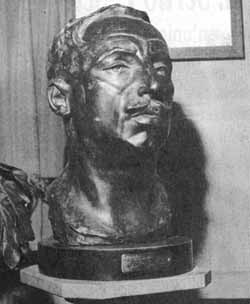 The
direct language of the literary movements known as "Realism"
and "Naturalism" of the late nineteenth and early twentieth
centuries was the result of many political and social processes.
Among these were the growth of a middle class, the rise in literacy,
and the theories of Marx and Darwin, which called for exacting
statements and description. This "democratization" of
literature—the need to write about and for new social
classes (and old ones not written about before), to write about
the real lives of real people in the plain, unadorned language
of everyday life—led to Zola, Verga, Stephen Crane, Dreiser,
and D.H. Lawrence. The
direct language of the literary movements known as "Realism"
and "Naturalism" of the late nineteenth and early twentieth
centuries was the result of many political and social processes.
Among these were the growth of a middle class, the rise in literacy,
and the theories of Marx and Darwin, which called for exacting
statements and description. This "democratization" of
literature—the need to write about and for new social
classes (and old ones not written about before), to write about
the real lives of real people in the plain, unadorned language
of everyday life—led to Zola, Verga, Stephen Crane, Dreiser,
and D.H. Lawrence.
Such
directness occurs late and rather suddenly in Italian literature.
Edoardo Scarfoglio was from Paganica in Abruzzo but lived and
worked in Naples much of his life. He was among those
Italian writers who started to write short fiction (the novella)
in the late 1800s and then longer fiction, novels, a form ignored
before then by Italian authors, largely bound, as they were
(until Manzoni), to classical literary forms. Scarfoglio was
successful early in life; he was in his 20s when he could be
said to have "made it" as a writer of short, realist fiction,
particularly with the publication of The Trial of Phryne
in 1884.
For
whatever reason—perhaps because journalism was the natural
vehicle for everyday language—he gave up "literature"
and dedicated the rest of his life to journalism. He married
the most prominent Italian woman writer of the day, Matilde
Serao. Together they founded a number of newspapers, among
which was Il Mattino, still the largest Neapolitan daily.
Together, they moved Naples out of the backwaters and into the
mainstream of Italian journalism; they provided space for some
of Italy's fine talent of the day by serializing such writers
as D'Annunzio.
Scarfoglio's
narrative skills are best seen in the novella, mentioned above:
The Trial of Phryne. It is a retelling—set in small-town
Italy of the late nineteenth century—of the trial of Phryne,
a Greek courtesan from the fourth century, b.c. She was on trial
for blasphemy. Her life was at stake and ultimately saved by
her lawyer's appeal to the Greek concept that the Good, True,
and Beautiful were inseparable and that such a Beautiful defendant
must, therefore, be Good and True. She bared her breasts to
the jury and was roundly and firmly acquitted. Sociologists
use this episode to speak of such things as the rhetoric of
silence in women's judicial supplication and rhetoric as a "craft
of logos," where technique determines outcome, emerging as an
indeterminate act outside Western definitions of rhetorical
process. The rest of us think of it in terms of, "Listen, sweetheart—smile,
look beautiful, and keep your mouth shut."
Scarfoglio's
Phryne is a young village beauty by the name of Mariantonia,
guilty of poisoning her mother–in-law. Italians who have
not read Scarfoglio know the episode anyway from the film version,
one part of Alessandro Blasetti's 1952 episodic film, Altri
Tempi (Other Times), starring Vittorio De Sica as the lawyer
and Gina Lollobrigida as Phryne/Mariantonia. In his appeal to
the court, De Sica says, "Does not the law of our land state
that the mentally handicapped be acquitted? Why then should
such a physically endowed creature as this magnificent woman
beside me not be acquitted, too?"
As
a writer and literary critic Scarfoglio advocated the liberation
of Italian literature from French influence. As an editorialist,
he supported such things as Italian expansionism in Africa and
the Aegean in the 1890s. Indeed, one finds this reference to
him in a lengthy article on "The Italians in Africa" in a copy
of The Fortnightly Review from October, 1896:
| Signor
Scarfoglio, the editor of Il Mattino of Naples,
is the great advocate for the war policy. Perhaps it may
be the Spanish blood which flows in the Neapolitan veins,
leading to a certain want of judgment and carelessness
about consequences, which has made this aspect of the
case favorable to the Southern eyes, and secured for Signor
Crispi and his ambitious schemes for the glory of Italy
in Africa, at all hazards, the warmest support from the
South. |
That
was written by an Englishman during the heydey of British imperialism.
Clearly, what was sauce for the English goose was not meant
for the swarthy Italian gander.
Scarfoglio
had insatiable wanderlust, at one point lamenting his life as
a "hack journalist" and claiming that had been born to "hunt
elephants on the banks of the Omo and sail amidst the fissures
of the polar ice-pack." Aboard his vessel, Claretta,
he sailed at least to the eastern shores of Greece and coastal
Turkey. From his ship, he wrote Letters to Lydia, passionate
prose disclosing his affair with the actress Lydia Gautier.
He separated from his wife, Matilde Serao, in 1902 and died
in 1917.
Scarpetta,
Eduardo (1853-1925)
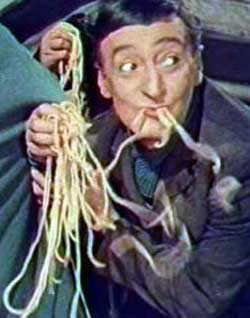 The
life of Eduardo Scarpetta, one of Naples' best-loved comic playwrights,
reads almost like one of his own many farces and romantic slapstick
comedies. His life was full of improbable situations and exaggerated
characters, of which he, himself, was one. Suffice it to say
that he is best-known as the father of three illegitimate children:
the De Filippos—Eduardo, Peppino, and Titina, who grew
up to be the most famous theatrical family of the 20th century
in Naples. Their mother —follow closely— was the
niece of Scarpetta's wife. He also had three legitimate children
with his own wife, unless one of them was really fathered by
Victor Emanuel II, King of Italy, as rumor had it. Ha! The plot
thickens. Or maybe thins; that could be any one of a number
of plays from Paris in the late 1800s in which there are always
fewer closets and beds than there are lovers trying to hide
in and under them. The
life of Eduardo Scarpetta, one of Naples' best-loved comic playwrights,
reads almost like one of his own many farces and romantic slapstick
comedies. His life was full of improbable situations and exaggerated
characters, of which he, himself, was one. Suffice it to say
that he is best-known as the father of three illegitimate children:
the De Filippos—Eduardo, Peppino, and Titina, who grew
up to be the most famous theatrical family of the 20th century
in Naples. Their mother —follow closely— was the
niece of Scarpetta's wife. He also had three legitimate children
with his own wife, unless one of them was really fathered by
Victor Emanuel II, King of Italy, as rumor had it. Ha! The plot
thickens. Or maybe thins; that could be any one of a number
of plays from Paris in the late 1800s in which there are always
fewer closets and beds than there are lovers trying to hide
in and under them.
Scarpetta
did not come from a theatrical family but was on the stage by
the age of four. He worked almost exclusively at the San Carlino
theater in Naples, where he created a character that became
his stage alter-ego (say, in the same way that the Tramp
was synonymous with Charlie Chaplin): Felice Sciosciammocca,
a typical, good-natured Neapolitan, just trying to get
by. The name "Sciosciammocca" translates from Neapolitan to
"breath in mouth"—thus, with "Felice" (Happy) you get
something like open-mouthed, wide-eyed and perhaps a bit scatter-brained.
The character was a break with the traditional portrayal of
the Neapolitan streetwise Everyman and, as an implied stereotype,
draws immediate comparison to the well-known, historical Neapolitan
"mask" of Pulcinella. Scarpetta's character, however, has none
of the barbed wisdom of Pulcinella—nor was it meant to.
One story says that Scarpetta, as a child, was terrified by
an on-stage appearance of Pulcinella.
Scarpetta's
grandson, Mario, has commented that the figure of Sciosciammocca,
at the time, seemed to be more of what Naples was about (or
trying to be about) than did the darker character of Pulcinella.
Naples was no longer the capital of an old-line absolutist kingdom.
It had recently been taken up into united Italy; it had strivings
away from treachery and intrigue, and towards the cosmopolitan
and urbane. There was nothing of Pulcinella's cryptic mocking
behind Sciosciammocca's "mask" --no psychology. He wore no mask.
He was the light, modern, nineteenth-century Neapolitan male,
with not even a trace of the tragic Chaplinesque clown—in
a way, almost a throwforward to, say, something like Jack Lemmon's
character in Some Like it Hot.
Scarpetta
dedicated much of his early activity to translating into Neapolitan
the standard Parisian farce comedy of the day, such as Hennequin,
Meylhac, Labiche and Feydeau. His own original comedies comprise
some 50 works, the best-known of which is probably Miseria
e Nobiltà (Misery and Nobility) from the year 1888.
The work is well known, too, as a 1954 film featuring the great
Totò as Felice Sciosciammocca; the film also features
the young Sophia Loren. The plot, roughly, involves poverty-stricken
Felice and his friend, don Pasquale, masquerading as aristocratic
relatives of a young woman in order to get her parents approval
for a marriage to a young prince. The ploy works, of course,
and Felice and don Pasquale are rewarded. They splurge on a
feast, and the last scene in the film has Felice, don Pasquale,
and the rest of the famished family scrambling onto the kitchen
table to shove food into their mouths (photo, above). It is
this type of nonsensical slapstick that irked Scarpetta's intellectual
critics at the turn of the century. They wanted social commentary.
Scarpetta just wanted to make people laugh. He wrote his last
work in 1909 and passed away in 1925.
Solimena,
Francesco (1657-1743)
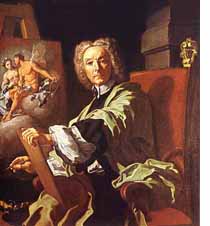 Along with his great predecessor,
Luca Giordano, Solimena is the
best-known painter of the Neapolitan Baroque.The easiest
painting by Solimena to find in Naples is in the Church of Gesù
Nuovo (located in the square of the
same name), but you might actually miss it if you go into
the church for the reason that you should go into a church.
That is to say, you have to go in and turn your back on the
faithful and look directly above the entrance to see the massive
and spectacular The Expulsion of Heliodorus from the Temple.
Even a graphic dunce such as myself (anti-references available
upon request!) notices Solimena's signature charateristics--light
and color, from the white charger in the middle to the splashes
of the bright blue robes. I don't know why artsy types of the
day didn't like it; perhaps it was too "busy" (it is indeed
jammed) or perhaps not sombre enough. Indeed, descriptions of
Solimena's works abound in vocabulary such as "golden light,"
"lovely harmonies of colour," "brilliant luminosity," "vibrant,
atmospheric light," etc. Along with his great predecessor,
Luca Giordano, Solimena is the
best-known painter of the Neapolitan Baroque.The easiest
painting by Solimena to find in Naples is in the Church of Gesù
Nuovo (located in the square of the
same name), but you might actually miss it if you go into
the church for the reason that you should go into a church.
That is to say, you have to go in and turn your back on the
faithful and look directly above the entrance to see the massive
and spectacular The Expulsion of Heliodorus from the Temple.
Even a graphic dunce such as myself (anti-references available
upon request!) notices Solimena's signature charateristics--light
and color, from the white charger in the middle to the splashes
of the bright blue robes. I don't know why artsy types of the
day didn't like it; perhaps it was too "busy" (it is indeed
jammed) or perhaps not sombre enough. Indeed, descriptions of
Solimena's works abound in vocabulary such as "golden light,"
"lovely harmonies of colour," "brilliant luminosity," "vibrant,
atmospheric light," etc.
Other of his works in Naples include The Massacre of the
Giustiniani at Chios, in the Capodimonte
museum; The Trinity, the Madonna and St Dominic,
in the sacristy of San Domenico
Maggiore; and various frescoes in the churches of San
Paolo Maggiore and San Domenico Maggiore. His self-portrait
(shown above) is in the Museum of
San Martino. He is responsible, as well, for the frescoes
on the ceiling of the royal bedroom in the Royal
Palace, put there to celebrate the marriage of Charles III
(the first Bourbon king of the then newly independent Kingdom)
Maria Amalia of Saxony in 1737. Solimena had a long and very
successful career and was, at the height of his powers, one
of the most sought-after painters in the Europe of his day.
Theaters,
First in Naples
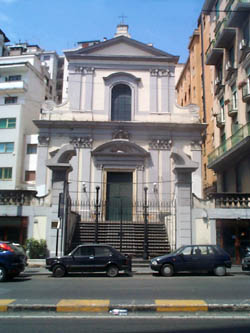 You
don't have to be an eagle–eyed observer to notice how
many old churches there are in Naples. That is not surprising
in a place where, according to some claims, in the year 1700
one out of every ten Neapolitans was a cleric. You
don't have to be an eagle–eyed observer to notice how
many old churches there are in Naples. That is not surprising
in a place where, according to some claims, in the year 1700
one out of every ten Neapolitans was a cleric.
Also
noticeable in Naples are the many old churches that are closed.
Some of them were holes in the wall even when they were built;
they certainly could not have served very large congregations.
But not all of the closed churches are small ones; there are
some very large houses of worship in Naples that are closed—for
example, the gigantic church of the Gerolamini in the historic
center of the city not far from the cathedral of Naples.
Less
impressive in size, but still noteworthy is the church of San
Giorgio dei Genovesi (photo) on via Medina between the
City Hall and the main police station. There is no longer even
a sign on the front to indicate the name of the church, although
there is a recent sign indicating that the premises are now
the site of something called the University Chapel. In any event,
I have never seen the building open. The church was built in
1587, which makes it old in the some places in the world but
not in Naples; it stands next to a church that was, in fact,
built 300 years earlier. For whatever its value has been to
the faithful over the centuries, San Giorgio dei Genovesi
is at least as interesting in the secular history of the
city, since it was built on the site of the very first commercial
theater in Naples.
When
the Spanish moved into Naples in 1500, making the city and all
of southern Italy part of the great Spanish Empire, they brought
with them their cultural institutions—for example, the
large church-run orphanages that trained children in music (the
first "conservatories"). Another example—the case, here—theaters:
venues where the first troupes of professional actors could
present themselves in the art of the comedy. The theater is
referred to in documents of the period (the mid-1500s) as, simply,
la commedia. (The later church on the same site was then
popularly called San Giorgo alla commedia vecchia [old
theater]. The theater was the professional home to acting troupes
from Spain "playing the provinces," and it provided a stage
for the improvised antics of the masked and costumed figures
in the then innovative Italian Commedia dell'arte. Such
characters included the famous Neapolitan stereotype character,
Pulcinella.
The
property where the la commedia stood was purchased by members
of the Genoese community in Naples for a new church. Then, in
the first decade of the 1600s, "show business" continued in
a new theater built to replace la
commedia. This was the Teatro dei Fiorentini,
an establishment that continued through the centuries of demolition
and rebuilding in the immediate area and even today still exists
in its more recent incarnation as a cinema and, now, of all
things, a Bingo hall. The other major theater from the same
period in Naples was the theater of San Bartolomeo, built in
1620 and redone in the 1640s in order to accommodate the first
performances of the "new music" from the north—early opera.
San Bartolomeo would then function until it was replaced by
the grand theater of San Carlo in 1737.
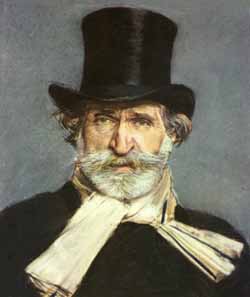 In
January, 2004, the San Carlo Theater
will put to right a bit of Bourbon censorship 145 years after
the fact. Opera-goers, used to seeing Un Ballo in Maschera
by Giuseppe Verdi, will be able to see the original version
with the original name, Gustavo III. I have heard that
the original has been done elsewhere, but no one I have spoken
to--none of my opera-addicted friends and relatives--has ever
seen that version. In
January, 2004, the San Carlo Theater
will put to right a bit of Bourbon censorship 145 years after
the fact. Opera-goers, used to seeing Un Ballo in Maschera
by Giuseppe Verdi, will be able to see the original version
with the original name, Gustavo III. I have heard that
the original has been done elsewhere, but no one I have spoken
to--none of my opera-addicted friends and relatives--has ever
seen that version.
The
first 20 years of Verdi's very long career as a composer were
between 1840-60, a period that corresponded to a period of great
social turmoil in the Kingdom of Naples. It is, thus, not surprising
that Verdi--one of the great voices for Italian unity--would
not get along very well with the absolutist Bourbon kings of
Naples.
At
least a few of Verdi's early operas were presented at San Carlo
almost as soon as they were composed: Oberto, conte di S.
Bonifacio; and a comic opera entitled Il finto Stanislao.
Then, Alzira, a piece set in Peru, actually premiered
in Naples in 1845. All of these were uncontroversial as to political
content and sailed by the censors in Naples with no problem.
All of those works have remained obscure to this day. (Alzira
did give Verdi, however, the chance to work with the greatest
Neapolitan librettist of the day, Salvatore Cammarano, author
of the libretti for a number of Donizetti's operas.Verdi and
Cammarano collaborated on three other works: The Battle of
Legnano, Luisa Miller, and Il Trovatore.)
Luisa
Miller premiered in Naples in 1849. To fulfill his contract
with San Carlo, Verdi had been planning an opera called Maria
de' Ricci, based on a medieval siege of Florence, very much
in keeping with his timely preoccupation with freedom and revolution.
The censors didn't want any part of any siege of any Florence,
so Verdi and Cammarano came up with Luisa Miller, based
on Schiller’s play, Kabale und Liebe.
It
is strange to me that the censors let Nabucco pass at
all, even after almost a decade. It was composed in 1840 and
played in San Carlo in 1848, the year of great revolutions throughout
Europe. The theme of liberty--indeed, even the unofficial national
anthym of early Italian unity, Va pensiero sull'ali dorate--
got by the censors. Maybe the far away and long ago setting
seemed as innocuous to them as Peru had seemed in Alzira.
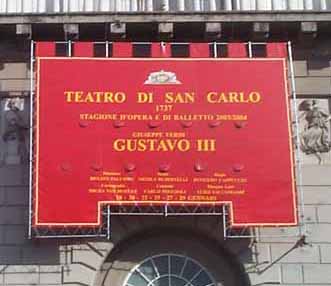 By 1857, Naples was only two
years away from being invaded by Garibaldi and taken up into
united Italy. The Bourbons were very defensive
about their monarchy. If the censors had not liked potential
revolution lurking in any of Verdi's earlier works, imagine
their reaction when Giuseppe showed up with a plan for an opera
called Gustavo III. It was a true story about the assassination
of that Swedish monarch in 1792, murdered by aristocratic conspirators
afraid of their enlightened king's potential open-mindedness
to the ideals of the French Revolution. An opera about regicide
(!) in a kingdom that had experienced three revolutions in the
previous 40 years? We don't think so. By 1857, Naples was only two
years away from being invaded by Garibaldi and taken up into
united Italy. The Bourbons were very defensive
about their monarchy. If the censors had not liked potential
revolution lurking in any of Verdi's earlier works, imagine
their reaction when Giuseppe showed up with a plan for an opera
called Gustavo III. It was a true story about the assassination
of that Swedish monarch in 1792, murdered by aristocratic conspirators
afraid of their enlightened king's potential open-mindedness
to the ideals of the French Revolution. An opera about regicide
(!) in a kingdom that had experienced three revolutions in the
previous 40 years? We don't think so.
Even
after Gustavo III had been watered down to Un
Ballo in Maschera and the European king had been turned
into a 17th-century govenor of Boston (!), the censors still
didn't like it; it had to premiere in Rome in 1859. Shortly
thereafter, what Neapolitan censors thought or didn't think
became moot--along with the rest of the Bourbon Kingom of Naples.
Verdi did manage a bit of on-the-spot revenge after the fall
of the kingdom. His Battle of Legnano opened the 1861
season in the new Naples of the new Italy.
The
traditional, non-Swedish Un Ballo in Maschera played
in 1862, but 2004 will be the first time that the original has
played in Naples. I have a feeling that any number of opera-goers
are going to walk by San Carlo, look up at the posters and say:
"Hmmmm, Gustavo III. Verdi. Gee, I never heard of that
one." * Who knows. Maybe this is a good sign. Riccardo, the
tenor, Count of Warwick and Governor of Boston can take a break
after all these years.
-------------------------
*San
Carlo is taking no chances. The posters tell you in fine print
that Gustavo III is the original version of Un
ballo in maschera, and that the opera was originally meant
to be premiered in Naples.
Viviani,
Raffaele (1888-1950)
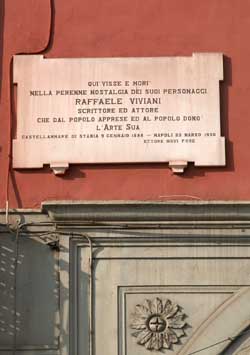 The
bread and butter of many Neapolitan dialect writers, actors and musicians,
especially in the early twentieth century, was portraying the seamy
reality of Naples, the hard-core world of petty crime, prostitution,
and poverty--the underclass grind. Raffaele Viviani stands between
Salvatore di Giacomo (1860-34) and Eduardo
de Filippo (1900-84) chronologically as well as stylistically,
his work generally having pretentions neither to the erudition of
the former nor the humor of the latter. Viviani is what critics call
"an autodidact realist," meaning he acquired his considerable skills
as an actor, playwright and musician at the school of hard knocks. The
bread and butter of many Neapolitan dialect writers, actors and musicians,
especially in the early twentieth century, was portraying the seamy
reality of Naples, the hard-core world of petty crime, prostitution,
and poverty--the underclass grind. Raffaele Viviani stands between
Salvatore di Giacomo (1860-34) and Eduardo
de Filippo (1900-84) chronologically as well as stylistically,
his work generally having pretentions neither to the erudition of
the former nor the humor of the latter. Viviani is what critics call
"an autodidact realist," meaning he acquired his considerable skills
as an actor, playwright and musician at the school of hard knocks.
Viviani
was born in Castellemare of a poor family. He appeared at the age
of 4 on the stage in Naples, lost his father at 12, and took over
the care of his mother and the rest of the family. By the age of 20,
he had a solid stage reputation throughout Italy. As a young actor,
he also played in Budapest, Paris, Tripoli, and throughout South America.
His plays are in the "anti-Pirandello" style; that is, they are less
concerned with the pyschology of people than with the lives they lead,
in this case the human stories of the common people of
Naples. Perhaps his best known work is "L'ultimo scugnizzo"
(The Last scugnizzo) (1931), scugnizzo being the underclass Neapolitan street
kid, who lives by his wits on the fringes of legality. In this case,
the "last scugnizzo" tries to adjust to a more normal adult
life, almost makes it, but reverts to his earlier self as a
result of a personal tragedy.
Viviani
was a good musician, as well, and composed songs and incidental music
for many of his earlier works. One such well-known melodrama
is "via Toldeo di notte," a work from 1918 in which Viviani
reprises some of his earlier melodies and even employs American cake-walk
and ragtime rhythms to tell the story of the "street people" of via
Toledo, the most famous thoroughfare in Naples. It is presented in
the form of a succession of songs with little or no linking dialogue
and with only a few instruments as accompaniment. Thus, it was a somewhat
anomalous form for Italian musical theater of the day. English terminology
has used "music drama" to describe such items. Viviani, himself, described
it as a "Commedia in un atto (versi, prosa e musica)."
The disastrous
Italian defeat at Caporetto in 1917 in WWI led to a reappraisal in
Italy of national values and a subsequent crackdown on such frivolities
as musical theater and vaudeville. This austerity led Viviani to concentrate
more and more on straight drama, a trend that he continued until the
end of life. During the Fascist era, he also had to contend with the
regime's hostility towards theatrical works presented in regional
dialects rather than the national standard language. Viviani persisted
and has been vindicated; all in all, however, he is not as well known
outside of Italy as he deserves to be. Jane House Productions will
present a US premiere of his Via Toledo di Notte at the CUNY
Graduate Center in New York in late 2004. A edition of the complete
theatrical works of Viviani was published by Guida in 1987.
[A plaque (photo, above) marks Viviani's home on
the Corso Vittorio Emanuele in Naples. As well, a nearby public park
was opened about 10 years ago and named in his honor.]
Women's
Journals in Naples in the 19th Century
 The
drive to encourage literacy among women in southern Italy started
under Ferdinand IV in the late 1700s. Certainly, there are a number
of examples of women poets and scholars at the Bourbon court from
that period, the most outstanding example of whom is Eleonora Fonseca Pimentel, classical scholar, poet,
and "Passionaria" of the Neapolitan revolution and Republic of 1799--a
role for which she paid with her life. The
drive to encourage literacy among women in southern Italy started
under Ferdinand IV in the late 1700s. Certainly, there are a number
of examples of women poets and scholars at the Bourbon court from
that period, the most outstanding example of whom is Eleonora Fonseca Pimentel, classical scholar, poet,
and "Passionaria" of the Neapolitan revolution and Republic of 1799--a
role for which she paid with her life.
With the coming of the French decade (1806-10) in Naples, the drive
continued, and the years leading up to the Risorgimento and
unification of Italy produced a number of publications in Naples,
some of them aimed directly at women. One of the best private libraries
in Naples, the Biblioteca Patria Storia (on the grounds of
the Maschio Angioino) is dedicated exclusively to local history—meaning
the city of Naples as well as the historic Kingdom of Naples.
Part of their collection is dedicated to those women's journals
published in Naples in the 1800s. I have taken what follows from the
library's descriptions of those journals.
Le cesta de' fiori per le dame (A Women's Flower Basket) was published
one time only in 1835. It was 98 pages of anecdotes, poetry, and stories,
some with the explicit theme of women's literacy, such as this excerpt,
which has the protagonist saying: "..great princes and men of distinction
owe their superiority to the first lessons they received from the
mothers...Give attention to the education of women if you want to
have men of courage. [...] When we say "education", we don't mean
music, dance, painting and foreign languages. [...]
We mean all their talents..."
Un Comitato di Donne (Women's Committee) (eleven
issues in 1848) was a political journal
dedicated to the constitutional struggles of the day. (In 1848, the
movement for constitutional reform swept much of Europe; in Italy,
it was the beginning of the Risorgimento, the move to unite
Italy.) The Comitato published articles and commentary about
the role of women in the move for Italian unity and independence,
including the need for women to participate actively in military action.
Il lume a gas (Gas lamp), published daily from November 1848 through
June 1849. It was originally dedicated to items of humor and human
interest and had with little or no political axe to grind. As the
constitutional questions in the south of Italy came to a head, however,
the paper took a moderate editorial stand in favor constitutional
government. It praised the role of women in the wars of liberation
going on in the far north of the Italian peninsula, but, strangely,
was sarcastic in dealing with that same role in the south. It printed
some satire aimed at the Comitato di Donne (above) and the
idea of squads of Neapolitan women actually bearing arms.
Il Sibilo was a "scientific, literary, artistic and industrial
journal", published weekly for the entire year of 1845. Each issue
consisted of eight pages of miscellany, including serialized stories,
human interest, and editorial emphasis on the importance of the education
of women.
Vittoria
Colonna was a literary and artistic journal for women published
in Naples in 1846 and 1847 "under the auspices of the Queen Mother".
Twenty-one issues appeared. The journal was inspired by and named
for the great Renaissance poet, Michelangelo's sketch of whom appears
at the top of this entry.
Then, later, during the last days of the Kingdom of Naples, there
appeared La donna italiana 1860, Gionaletto per le dame
(The Italian Woman 1860, a magazine for women). Only the first
issue from August 8, 1860, is extant, and it is not clear if subsequent
issues came out. The editorial thrust seems to have been the involvement
of women in the great patriotic battle then looming to unite Italy.
Commentary was addressed to "women of Italy", leading one to believe
that it was a pro-unity paper—and, thus, anti-Bourbon. From
the publication date, Garibaldi was only one month away from taking
Naples, tthe capital of the Bourbon kingdom; thus, there could not
have been much room for an anti-government magazine at the time. No
wonder it appeared only once.
|