©
2004 Jeff Matthews & napoli.com
Naples
today
Renaissance
in Naples: Proceed with Caution
| The
cornerstone of the "new Naples"—the cleaned-up square, Piazza
del Plebiscito, rescued from decades of service as a squalid
parking lot. |
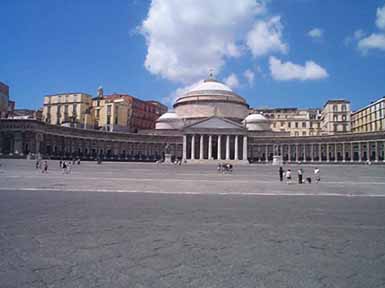 As
recently as the early 1990s, the old adage, "See Naples and Die"—meaning,
of course, that after the beauties of Naples, only Heaven, itself, might
have something to offer—was often cynically twisted on the
tongues of Neapolitan wags to "See Naples Before it Dies" and—ominously—"See
Naples and Get Killed". As
recently as the early 1990s, the old adage, "See Naples and Die"—meaning,
of course, that after the beauties of Naples, only Heaven, itself, might
have something to offer—was often cynically twisted on the
tongues of Neapolitan wags to "See Naples Before it Dies" and—ominously—"See
Naples and Get Killed".
Now, amidst
all the talk of a Neapolitan renaissance, the skeptics are still around,
to be sure. They are quick to warn you against bandying about phrases
such as "renaissance" too freely. Remember, they say, that even the
version with the capital "R," while boasting Leonardo and Michelangelo,
also had lots of corruption, murder, intrigue, and pestilence —not
unlike modern–day Naples, they say. Yet, in Naples, today, even
the skeptics are sitting up and taking notice. Things may be changing.
Maybe.
Change
in Naples has always meant building—tearing down the old to put
up the new. From the great passenger terminal at the port of Naples
to the main post-office, the city is still marked, for example, by the
gleaming façades of monolithic Fascist architecture of the 1920s
and 30s. The buildings were a cosmetic fix and now serve as reminders
of the giant egos of ideology and sit there like white elephants dozing
in the sun.
Before
that, Naples at the turn of the century was literally gutted in the
course of a decades-long splurge of urban
renewal. The broad streets and new buildings of 1900 are still there
and they are still impressive; yet, in retrospect, it is good to remember
that even that kind of mammoth renewal of the city's physical plant
was not enough to keep hundreds of thousands of Neapolitans—precisely
those who were supposed to benefit from the project—from emigrating
during that same period. Modern urbanologists have likened that particular
renaissance to treating cancer with plastic surgery. (Ironically, it
was the very gigantic nature of that decades–long urban renewal
that displaced thousands upon thousands of people, actually driving
at least some of them to leave Naples.)
Then, back
in the early 1800s, Napoleon set up his brother-in-law, Murat,
as king of Naples. Murat built entire new portions of the city, including
a Pantheon–like temple to Napoleon (now the Church
of San Francesco di Paola, seen in the photo, above) across from
the Royal Palace. Before that: the grand-daddy
of all urban renewal projects, the Spanish remake of the city in the
1500 and 1600s, including the so-called "Spanish
Quarter," one of the first examples in Europe of square blocks of
four and five-story apartment buildings.
None of
this, however, can be said to have worked—at least in the sense
of truly dealing with what ails Naples. First of all, the Naples that
generations of tourists have avoided for years is still very much there.
The city is a microcosm of all the social ills that any big city could
possibly be heir to. Petty theft is rampant, and organized crime is
tenaciously entrenched. The unemployment rate among working–age
males is said to run as high as 40% (!), and the city's two main universities
are homes for aging history and literature majors in no hurry to finish
school and swell the ranks of the jobless. Also, thousands of illegal
immigrants from Africa now strain the city's already overburdened
social services as they sneak into the city to find no jobs except peddling
knock–off leather bags, baseball caps, and bootleg CDs on the
street or offering to wash your windshield at stop-lights. Or, if they
are women, they may wind up with underpaid and undeclared jobs as an
au pair—or, worse, join the ranks of the African prostitutes
who line the ancient via Domiziana as it winds north out of the
city. These unfortunate souls join the ranks of native underclass—not
merely unemployed, but perhaps unemployable, one of the few bodies of
lumpenproletariat left in Europe, people with no skills
to sell.
Public
transportation is erratic, at best. (There are no schedules posted at
bus stops —"Be happy I got here at all," is the bus driver's standard
quip to complaining passengers.) A new subway line high up in the Vomero
section of the city opened its first six stations a few years ago after
a building time of seventeen years! (But, as the bus driver would say,
"At least it's open.")
The most
obvious ill is urban sprawl. There is scarcely a patch of greenery left
on the fabled Posillipo hillside overlooking the bay and the small island
of Nisida where Brutus plotted the assassination of Julius Caesar. Overbuilding
can only go so far before a city on a hill starts caving in (the
hill was quarried for centuries for building material and subterranean
Naples has been likened to a piece a Swiss cheese, a sponge, a
honeycomb—anything with lots of holes). Even a light rain in Naples
now typically opens another sink-hole somewhere in the city; one more
street then becomes useless, or one more house moves that much closer
to the beautiful Mediterranean. Construction boondoggles, too, are of
mythical proportions. On-ramps to the expressways in and around the
city can wind up half-finished or, even worse, finished and mysteriously
unopened. In some cases, unfinished overpasses started a decade ago
jut out of the landscape, arch over a highway, and then just stop in
mid-air, as if vanishing into another dimension. A two-mile stretch
of underground railway from the Mergellina section of town to
the San Paolo soccer stadium was built for the World Cup games
in Naples 13 years ago. It never opened. (Construction on it has resumed,
however, and the new plan calls for it to be incorporated in the city's
new metropolitana lines.)
The traffic
must be experienced to be believed. Neapolitan cabbies joke about going
to Calcutta and Cairo just to cruise around and relax. Gridlock is common,
and drivers will do anything to get out of one: drive on the sidewalk,
drive the wrong way, or leave their cars in traffic and walk. (After
all, why idle your engine when you pay four dollars a gallon for gasoline?!)
Now, add
to this litany of woe the important little things such as public health:
hepatitis is endemic (Neapolitans commonly eat shell-food cultivated
in beds set perilously near sewage outlets in the bay), and half a century
after the invention of a polio vaccine, it is not unheard of to see
young people with the withered limbs characteristic of that scourge.
In short, Naples seems to be much the same city that so many Neapolitans
have left over the years for a better life elsewhere.
What then
has changed? Well, for starters, another wave of construction
is rolling in. There is a new Civic Center going up on the east end
of Naples. It is a sparkling boom-town of steel-and-glass office buildings
and condos surrounded by spacious pedestrian malls and equipped with
restaurants, shops, and underground parking. Eventually, the complex
is meant to house all the municipal office space for the Naples of the
future as well as provide substantial living space for thousands. It
was also to be the home of NATO's new headquarters for the Allied Forces
Southern Europe (AFSOUTH). That plan has been scrapped for various reasons,
not the least of which is that this sparking satellite city is in the
worst part of town right next to the huge prison, Poggioreale. The current
occupancy of the finished office-space and apartments is still low.
Public
transport is improving, too. New busses—some of them the extra-long
version with that accordion bend in the middle—cautiously cruise
the streets as wary drivers try to maneuver all those extra new feet
of bus safely around—not over—corners and feet. And, in
a city that has raised the fender-bender to high art, the busses still
look pretty good.
Even the
new subway, the metropolitana, mentioned above, is inching its
way towards completion. With the most difficult part (on the Vomero
hill above the city) finished, the new stations down at sea-level are
in various stages of completion. Most problems now seem to be cultural
rather than anything else; that is, for example, the digging if front
of the old Angevin Fortress has uncovered the 16th century fortifications
of the fortress, and decisions have to be made about what to leave and
what to destroy. Similarly, excavations at Piazza
Dante and on the main road, Corso
Umberto, to the central train station, have uncovered bits and
pieces of the original Greco-Roman city. Here, archaeologists and engineers
have to come to a meeting of the minds—not always an easy thing
to do.
Safety
from crime in the city—the common lament of tourists and natives,
alike—is better because of a sledgehammer approach that is at
least holding its own. The streets are crawling with police, augmented
on occasion by flak–jacketed members of the regular Italian Army
who patrol the streets and are positioned in front of public buildings
and banks. In early June 2003, six of those floating mother-ships of
tourists were in the port of Naples at the same time. They disgorged
8,000 passengers into the heart of Naples. No doubt, a few had their
pockets picked or purses snatched or bought a genuine "Rolleks" or got
otherwise scammed. I doubt if any one of them was assaulted physically.
They sailed into an armed camp and probably felt safer for it.
All of
this is part of the new Naples. For Antonio Bassolino, mayor from 1993-2000,
it was only the beginning. His idea of a renaissance has at least as
much to do with restoring the cultural image of the city as it does
with new buildings. The historic center of Naples is, after all, one
of the select sites in Italy on the prestigious UNESCO World Heritage
List, a veritable What's What of places in the world that must
be preserved at all costs. That center is a square-mile
at the heart of the original city founded by the Greeks half a millennium
before Christ. It is an overlay record of many of the cultures and dynasties
worthy of mention in European history since that time, from the Romans
and Byzantines to the Normans and Hohenstaufens;
from the Hapsburgs and Bourbons to the
Bonaparte. Here are the streets where
Boccaccio and Thomas Aquinas walked. Here are to be found paintings
by Caravaggio and Sammartino's immaculate sculpture of the Veiled Christ. Naples is also one of the great
cities of music in Italy, the workshop of Bellini,
Donizetti and Rossini.
And the city is the logical jumping-off point for the rest of what grabs
your fancy on and near the Bay of Naples: Mt. Vesuvius, Pompeii, Capri,
Sorrento, Cuma, Amalfi, and the "Versailles of Italy," the Bourbon
Palace in nearby Caserta.
The first
obvious sign of change was the renovation of the huge Piazza
Plebiscito, site of the above-mentioned pharaonic tribute to
Napoleon. For years, the splendid columns and high dome had languished
in the presence of the squalid parking lot that the piazza had become.
Then, one day the cars disappeared and the piazza was transformed into
a spotless wide-open space adjacent to the Royal Palace and the San
Carlo Opera, an ideal place for tourists, Sunday strollers, photographers,
artists, jugglers, musicians, and anyone who just wanted to enjoy what
the city had to offer. It now regularly hosts enormous open–air
music festivals, and it showcases an occasional piece of outlandish
modern sculpture such as Mimmo Paladino's gigantic "Salt Mountain"—just
that, dotted with bits of machinery. (A local housewife was warned—but
not busted—for augmenting her household supply of salt by
helping herself to some of the artwork!)
The next
and biggest step in the rebirth of Naples was landing the G-7 conference
in 1994. Roads were repaved and buildings painted; the entire city went
through months of sprucing up for a two-week period during which Naples,
for the first time in living memory, actually became a cosmopolitan
city, an international center, a place worthy of saying that it had
once been the capital of a kingdom. The G-Seveners were treated to English-language
news broadcasts, and even the Neapolitan daily, il Mattino,
published a daily supplement in English for visitors. It was professional
and well-written, a welcome change from the past, when such efforts
read as if they had been written by someone's cousin who took one Berlitz
lesson in 1948.
At least
on the surface, the "renaissance," then, is working. Tourism is thriving
in Naples. Millions of visitors no longer just jump off to go somewhere
else. They hang around to enjoy a coffee or meal at a sidewalk restaurant,
or to visit one of the city's dozen or so museums, from the overwhelmingly
complete National Archeological Museum
to the recently opened National Railway Museum,
which houses Italy's first steam locomotives. Visitors go underground
to explore the original Roman aqueduct system,
or to view the most extensive paleo-Christian catacombs in Italy south of Rome, or to visit the
recently opened site beneath the Church of
San Lorenzo where the main crossroads of the original Greek city
have been laid bare. The city's main youth hostel, once a very lonely
place to spend a night, is jammed with backpacking kids from around
the world. In short, Naples is open and enjoyable.
Beneath
the surface, however, the skeptics remind us that there are questions
that have no easy answer. When Naples was the capital of its own Kingdom
of Naples—the entire southern half of the Italian peninsula plus
the island of Sicily—the economy of the city quite naturally centered
on the bureaucracies of running that kingdom. Those mechanisms became
redundant when Italy was unified in 1860. Since then, they have had
great difficulty adapting to running what is, essentially, just another
very large Italian city with middle–class aspirations and a would-be
industrial base. Unlike smaller cities, such as Venice and Florence,
that can, and do, live very well from tourism, there is no way that
Naples, hub of the most densely populated urban area in Europe is going
to convert to one giant service industry for tourism. That is simply
not going to happen.
Also, Italy's
highly-touted "clean hands" campaign, an anti-corruption and anti-crime
program begun in 1992, continues to sputter along as it attempts to
deal with the Camorra—the Neapolitan Mafia—which
has its finger in most of the economic pies in Naples. The most recent
flat tire on the wheel of Italian justice is a revision of law 513 that
covered testimony given by so-called pentiti (from "to be pentitent,"
thus, "those who are sorry"). These are ex-Mafiosi turned "stoolies"
who give state's evidence in exchange for money and a place in a witness
protection program. In the past, their testimony, given in private to
the Italian State Prosecutor's Office, has been valid evidence in subsequent
trials against the Mafia. Now, however, they must appear in a public
trial and repeat their testimony openly and before those who are on
trial. Their former colleagues in crime have let it be known that "those
who are sorry" will be even sorrier if they re-testify. The papers are
already speaking of a number of pentiti pentiti [sic]—
"those who are sorry they were sorry."
This is
discouraging to law-abiding Neapolitans, who live in a region of Italy
where there are 200 gangland murders a year. Neapolitans see one ex-Prime
Minister, Bettino Craxi, who was—until his recent death—in
well-heeled hiding in Tunesia, fighting extradition back to Italy on
charges of corruption; and they see, and are generally skeptical of,
ex-PM Giulio Andreotti's recental acquittal for alleged Mafia links.
Thus, any relaxation of the war on crime does nothing to foster trust
in the government.
Traditionally,
in Naples there has not been much of that trust to begin with. Naples
is a place where people still commonly proclaim that "only fools pay
their taxes," and there is no realistic estimate of the enormous amount
of untaxed "phantom" money in circulation. It is wealth based on everything
from the sale of contraband cigarettes and bootleg CDs to no-receipt
transactions with merchants. Even many doctors will let you pay less
if you don't ask for that official numbered government receipt that
documents the transaction for the tax collector.
This degree
of economic anarchy creates, paradoxically, a look of opulence in a
city where so many people say they have no money. Everyone seems to
be hustling something, and a normal weekday along via dei Mille,
a fashionable shopping thoroughfare, looks like Christmas on New York's
Fifth Avenue. People think nothing of dropping 150 dollars for a pair
of shoes or 200 for a sweater. And in a city that still has post-WWII
rent-controls in much of the downtown area—meaning you can still
pay as little as one-hundred dollars a month—if you want to buy
a flat overlooking the bay, it can cost a cool Manhattanish one-million
dollars.
So, if
the renaissance of Naples has breathed some new life into the city—and
it has—Enrico di Gennaro, 53, can be pardoned for his skepticism.
He is a street-sweeper who now leans on his long-handled whisk broom
as he glumly watches the latest wrinkle in renaissance come putting
down the street. It is a newfangled—for Naples—automatic
street-sweeper with the apt name, "Cleango," brightly emblazoned on
the chassis. It purrs easily in and out of the few cars left at curbside
in August along the Corso Vittorio Emanuele. The whirring circular
brush whisks away the meager litter of a city almost deserted by its
vacationing inhabitants. "Hah!" says Enrico. "Look at the stuff he's
missing. What's that machine going to do when people get back from holidays
in a few weeks and there are cars double-parked all over the place?
This is the steadiest job I've ever had, and now they want that, too."
He grumbles over and sweeps up after Mr. Cleango. Enrico wonders just
how much of the renaissance is going to trickle down.
Building,
illegal
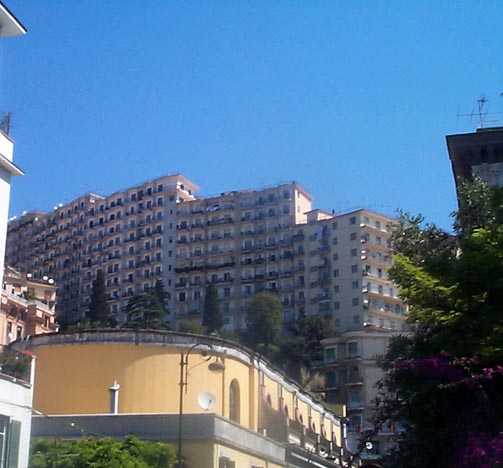
OK,
maybe this one wasn't illegal, but it should have been. It sits
on the Vomero hill overlooking the bay and is called the "Great
Wall of China" by locals.
|
 UOSAE
is the acronym for Unità operativa speciale antiabusivismo,
the special police unit that combats illegal building. Such construction
includes items such as an extra balcony put on a house, an entire floor
added to the top of a building, an entire house, and even, in some cases,
a gigantic luxury hotel on some bucolic coastline that was supposed to
be protected from the encroachment of “wild cement,” as the
Italian term has it. UOSAE
is the acronym for Unità operativa speciale antiabusivismo,
the special police unit that combats illegal building. Such construction
includes items such as an extra balcony put on a house, an entire floor
added to the top of a building, an entire house, and even, in some cases,
a gigantic luxury hotel on some bucolic coastline that was supposed to
be protected from the encroachment of “wild cement,” as the
Italian term has it.
The police
unit has a tough job. Their successes are spectacular, as in the case
of the recent demolition of a hotel along the Amalfi coast. UOSAE reports,
however, that in the summer of 2003 there were twice as many cases of
illegal construction (300) in Naples than just a year earlier. Of more
concern than just the numbers is the kind of building undertaken without
a permit. Most cases used to involve the clandestine garage or maybe
an additional balcony out back and away from the street. Now, entire
houses are going up, and they are not always that easy to spot. Much
of the land considered ideal for a house or villa is along the Posillipo
coast and hill or on the Camaldoli hill in back of the city, territory
that is still off the beaten track and hidden away from public view.
The city of Naples already employs squads of volunteers to walk around
and report back on what they find. The city now plans to employ satellite
technology—high–resolution spies in the sky to spot offenders.
The problem
is obviously not limited to the city of Naples. Quite the contrary.
Those with the money to do so might choose to build way out in some
God–and copforsaken, serene bit of wilderness. Who wouldn’t
want to live amidst the natural splendor of the Cilento and
Vallo di Diano national park, for example? Stopping “wild
cement” from spilling into that marvelous area is a new concern,
as the newspaper reports today.
It certainly
isn’t a new problem. You can stand and look at Corso Umberto,
the street that was the centerpiece of the risanamento—the
decades–long splurge of urban renewal in Naples at the turn of
the 20th century (see next entry)—and notice something odd. Almost
every one of those buildings along the entire mile of avenue on both
sides of the street has an added floor. What started out as a four-story
building turned into a five-story building in the years that followed.
Some of it was done after WW1 and some after WW2. Some of the added
stories were done well and are not easily distinguishable from those
of the original building. A few are sloppy and stand out. I can’t
believe they were all built legally.
Another
problem is the legal item called a condono—amnesty, pardon.
After the earthquake of 1980, there was such a rush to make sure that
people had places to live that the city legally forgave an awful lot
of unnecessary and illegal construction. That legal machinery is still
in place, resulting in the existence of skeleton buildings in various
places in the city, structures that were left half-finished, but which
cannot be demolished because the legal battle over a condono is
still going on.
"Risanamento,"
(Urban Renewal) of Naples (1); urbanology (8)
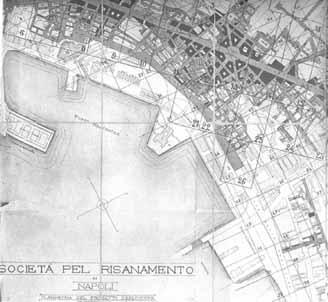
| By
1904, the date of this partial map of the port area of Naples, all
of the shaded areas represent new streets and buildings already
in place as part of the Risanamento. |
 Tearing
down the old to make room for the new has a long tradition in
Naples. The Romans probably felt very progressive when they cleared
away old Greek rock to make room for some real Roman masonry, and certainly,
fifteen-hundred years later, the Spanish had good reason to be proud
of themselves: they sundered ancient walls, built entire new quarters
for the populace, extended the fortifications of the city up to Sant'Elmo,
and built villa after villa along the western sea front of what would
one day be the part of town known as Chiaia. All in all, they planned
and brought off the renewal of the city on an impressively large scale. Tearing
down the old to make room for the new has a long tradition in
Naples. The Romans probably felt very progressive when they cleared
away old Greek rock to make room for some real Roman masonry, and certainly,
fifteen-hundred years later, the Spanish had good reason to be proud
of themselves: they sundered ancient walls, built entire new quarters
for the populace, extended the fortifications of the city up to Sant'Elmo,
and built villa after villa along the western sea front of what would
one day be the part of town known as Chiaia. All in all, they planned
and brought off the renewal of the city on an impressively large scale.
In the
late 1800s, Naples was again ready for just such an urban transformation.
Unfortunately, renewal of a city can be somewhat like cosmetic surgery
on a person: the immediate results may be pleasing, but whether or not
any real problems get solved is quite another question. Today in Naples
there is still great debate over the relative merits and faults of the
massive rebuilding of the city which took place between 1889 and 1918.
On January
15, 1885, the Italian legislature passed the Legge per il Risanamento
di Napoli—the Law for the "Cleaning Up" of Naples.
Here, risanamento means, literally, to "make healthy again."
It was a law passed after more than a decade of thought given to the
problem by urban planners, both local and national. The solution was
to be of the so-called 'Haussmann' type, referring to the urban planner
who had bull-dozed many of the slums of Paris a few years earlier in
order to make room for the future. It was in keeping with other projects
around the world at about the same time, plans that saw urban surgery
as the only way to save the patient: go in and cut out the infected
parts of the city. In many places, including Naples, this meant razing
entire quarters of the city. First came the difficult expropriation
process—clearing people off their property; then demolition;
and, finally, reconstruction. Neapolitans referred to the process as
sventramento—literally, "gutting."
In order
to understand what the risanamento accomplished—or
failed to accomplish—one has to understand the problems
that faced the city at the time. Annexation of the Kingdom of Naples
to the rest of Italy in 1860 (see Garibaldi)
brought severe problems to the city of Naples. For centuries, the city
had existed as the capital of a nation; it had been that nation's social,
cultural and administrative hub. Naples, at the time of unification,
was the largest center of services and administration in Italy. There
is some justification for bureaucracy when it has something to do—and,
indeed, Naples had a kingdom to take care of. However, when there
is suddenly nothing left to run, society becomes much worse than just
top-heavy with bureaucrats—it borders on collapse, or at
least severe decay. Naples was in that difficult position after the
unification: it was an ex-capital with nothing to do. In order to assume
some sort of a normal role as just another large Italian city, it would
have needed an industrial and commercial base—it had none,
or at least none that could compete effectively within a united Italy.
It would also need an able administrative class on a regional
level; yet, the ex-administrators of the Kingdom of Naples showed themselves
particularly clumsy in making the transition. Additionally, Naples was
beset by the inability, or unwillingness, on the part of its new boss,
the central Italian government, to deal with the problems of the South.
For a few
years after unification, Naples seemed to move ahead simply on bureaucratic
inertia. There were, after all, a number of municipal projects left
over from the Bourbons which could and should still be finished. Thus,
via Duomo was completed and opened to join the city center with the
port; the splendid corso Maria Teresa (today corso Vittorio
Emanuele) was finished to become one of the city's main east-west
roads, winding along above the city, halfway up the slope of the Vomero
hill; the Villa Comunale—the former Royal Garden—was
expanded.
There are
many other smaller projects, as well, which were carried out in the
first twenty years after unification. In a lighter vein, even the cable-car
up the slopes of Mount Vesuvius was opened in 1880, giving us all the
happy little tune, Funiculì, Funiculà,
composed especially for the occasion. Yet, as Alfonso Scirocco points
out in Storia di Napoli : "The good will of local civil servants
simply wasn't enough to do the job." Here, "the job" meant a number
of huge problems left outstanding when the Kingdom came to an end, but
problems that the Bourbon rulers had long known they would have
to be deal with if Naples was to prepare for the future. These problems
now belonged to the new federal government. Among these were: the expansion
of the port of Naples; the creation of new industry in what was essentially
an agrarian society; the creation of new residential areas, chiefly
in the areas of Posillipo and on the Vomero hill above the city; a transit
system; and new roads to connect the main railway station to the rest
of the city as well as to facilitate expansion to the east and west.
A formidable list.
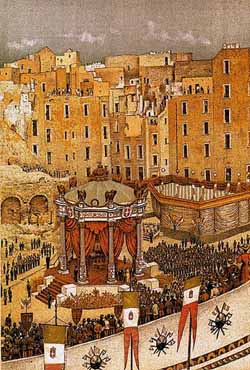
Francesco
Aversano and Matteo Zampella:
Inauguration of the Risanamento from Raffaele D'Ambra, Napoli Antica
1889.
 Nicola
Amore was elected mayor of Naples in 1884 and is generally viewed as
having been a capable and honest administrator. His job was made very
difficult by the outbreak of a cholera epidemic a few months after he
took office. The disease claimed 7,000 victims and left the city emotionally
devastated. Add to this the mass of literature written in the previous
decade about "the Neapolitan Problem," (Jesse White Mario's The Poverty
of Naples is a famous example among many) and by 1885 the city of
Naples seemed to have become almost a caricature of social ills: It
was squalid, ridden with disease and teeming with an underclass. It
was a bleak picture and one which many felt could be brightened only
by drastic means. Nicola
Amore was elected mayor of Naples in 1884 and is generally viewed as
having been a capable and honest administrator. His job was made very
difficult by the outbreak of a cholera epidemic a few months after he
took office. The disease claimed 7,000 victims and left the city emotionally
devastated. Add to this the mass of literature written in the previous
decade about "the Neapolitan Problem," (Jesse White Mario's The Poverty
of Naples is a famous example among many) and by 1885 the city of
Naples seemed to have become almost a caricature of social ills: It
was squalid, ridden with disease and teeming with an underclass. It
was a bleak picture and one which many felt could be brightened only
by drastic means.
It was
clear to everyone that the risanamento would mean ripping Naples
out of its past: monuments would be torn down, ancient popular sections
of the city would be radically transformed, if not altogether done away
with; and at least some priceless artistic treasures would be lost.
In short, Naples would be "guillotined" into the future, to use the
metaphor current among Neapolitan intellectuals of the late nineteenth
century. Interestingly, the majority of these persons—the
likes of Benedetto Croce—if not actually welcoming
the coming ax, viewed the risanamento as necessary. Contrary
views found little favor, except many years after the fact, views that
voiced the concern that the Risanamento had been a quick fix and not
rational urban renewal.
The results
of the risanamento are evident today. The broad boulevard named
Corso Umberto—called by
Neapolitans simply the rettifilo, the "straight line"—the
road that passes through the downtown area from Piazza della Borsa
to the train station is the most striking product of the risanamento.
It was achieved by clearing a wide, mile-long swath through the middle
of town. It got the job done, clearing the center of the city of terrible
slums and improving transit through the city along the new route. On
both sides of this broad boulevard, dozens and dozens of architectural
children of the risanamento were born: new offices, shops and
residences in high spacious buildings. Among these were the neoclassical
main building of the University of Naples and the imaginative configuration
of four identical buildings—called "the quadruplets" by
Neapolitans—occupying the four corners of Piazza Nicola
Amore. At the end of the rettifilo, the spacious Piazza
Garibaldi was created and surrounded by new buildings.
Further
to the west, across from the San Carlo theater, the area known as Santa Brigida
was transformed by the construction of the Galleria
Umberto; the area between the opera house and Piazza Municipio
was essentially reinvented by the presence of new buildings. Piazza
Municipio (City Hall Square), itself—the spacious area
between the port and the City Hall—came into being. In
order to lay it out, five centuries of castle fortifications, walls,
stables, barracks and just plain clutter had to be torn down.
The entire
section of Mergellina was transformed, as well, including the addition
of the new via Caracciolo, the spectacular seaside road reclaimed from
the sea in front of the Villa Comunale.
Additionally, the infamous bassi of Naples, vile cellar dwellings
in the most densely populated areas of town—nests of disease—were
cleaned up. Modern-day Naples is unimaginable without those changes
wrought a century ago. From that point of view, then, the worst criticism
of the risanamento—that it was a gigantic public
works boondoggle—is unjustifiably harsh.
The question
is whether or not even massive surgery on a city like Naples really
cut to the heart of the city's problems. For example, the new Corso
Umberto cut the downtown area in half, separating the port area and
the old Market Place from the rest of the city. Isolating the long wide
stretch of property along the port left that area free to decay even
further, something that clearly made the expansion of port facilities
more difficult. Another example: The decision to put a steel mill in
Bagnoli in 1904, thus ruining the ecology of what had been one of the
most beautiful coastlines in the Mediterranean, was staggeringly wrong.
It was part of a pattern of almost random urban sprawl that could not
have been worse if it had been malevolently planned. The effects of
this sprawl are quite evident today—Naples is overbuilt
with structures put up illegally; in many cases, it is construction
made easier by all those new roads.
The risanamento
is also interesting in that it failed to even undertake certain things
that, at least in retrospect, it should have—such as a
metropolitana, an underground rail mass transit system for the
city. Architect Lamont Young's plan for
just such a system now seems a brilliant one. It would have been given
Naples one of the first subway train systems in the world; yet, it was
not built, probably because it was part of a package deal to develop
Mergellina and Bagnoli in ways that were viewed as being too quaint
and Victorian at the time.
Aside from
quibbles over individual construction projects, the real question is
whether any kind of building project can really solve some problems.
The admittedly gratifying effect of a splendid new Gallery brought about
no change, for example, in the insufficient industrial base; new office
and shop space for the nascent white-collar class did not solve the
problem of housing shortages and staggering unemployment among the blue-collar
class; and, even worse, nothing was done about the absolutely no-collar
underclass, the lumpenproletariat—not merely unemployed,
but perhaps unemployable, possessing no skills to sell in the new century.
The risanamento
was officially ended by decree in 1918; yet, it had actually petered
out some years earlier, affected by a variety of things. A report published
at the turn of the century on the results of the first decade of the
risanamento was discouraging. It came to the unhappy conclusion
that something had already gone quite wrong; political infighting, rampant
favoritism, camorra (the Neapolitan mafia) and corruption had
made the campaign to remake Naples much less than it might have been.
In any event the Risanamento closed to mixed reviews. It is a
sad irony that the Risanamento of Naples coincided almost exactly
with the period of greatest emigration away from Naples by the very
persons who, at least on paper, were to have benefited from the rejuvenation
of their city.
[See, also,
here and here .]
Noschese,
Alighiero
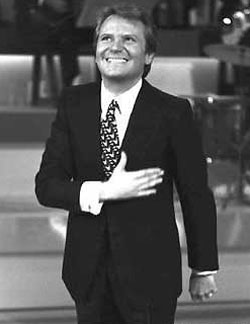 The
other day on TV, the RAI—the Italian state radio and television
agency—presented the first in a series looking back at 50 years
of television broadcasting in Italy. The
other day on TV, the RAI—the Italian state radio and television
agency—presented the first in a series looking back at 50 years
of television broadcasting in Italy.
One of
the most poignant moments was the portion dedicated to the work of Alighiero
Noschese, the Neapolitan who might have remained just another actor/comic
in a profession awash with actors and comics had it not been for his
uncanny ability to imitate others.
I can't
substantiate the anecdotes from his schooldays here in Naples—for
example, on the phone, "Hello, I can't come to school today. I am ill.
This is my daddy speaking."—but it wouldn't surprise me. A woman
I know who remembers Noschese as a high school student in Naples says
that he didn't stand out: he was courteous and easy to get along with,
but not the life of the party, not the person who just naturally seems
born to entertain and delight others—"anonymous" was the word
she used. That described him as an adult on the few occasions you got
to see him as himself and not in one of his comic sketches. Who knows
if that description was not at the heart of his ultimate tragedy?
He was
born in Naples in 1932. By the late 1960s and all during the 70s, Noschese
pretty much owned the field of imitating. It was one that he might be
said to have invented, at least for Italians. Before Noschese, it was
not at all common to watch comics get up and make fun of well-known
persons in public life. After Noschese, it was commonplace, as any young
comic/mimic in Italy will tell you. One of them said, in tribute to
Noschese, that "it was embarrassing to see someone with so much talent."
Perhaps
his secret was that he didn't make fun of so much as have
fun with the people he imitated. I can't imagine any of the prime
ministers of Italy, the heads of political parties, other actors, news
commentators—anyone at all—ever being offended. I saw him
once live on stage when he imitated Pope Paul VI. It wasn't in the least
offensive, and I'm sure the Pope would have loved it. Noschese "did"
all the prime ministers and politicians in Italy to perfection; as well,
his version of the great director Fellini was hilarious, as was his
imitation of the poet Giuseppe Ungaretti, whose excited, incoherent
readings of his own poetry on TV were funny enough in their own right.
Noschese did voices and body mannerisms to perfection and then spent
hours on make-up to wind up looking as much as possible like his target.
Noschese
took his own life in 1979. He was being treated for depression, and
I have heard that he was found dead in front of a statue of the Virgin
Mary. His suicide sent a wave of incomprehension through Italy—the
funny guy, the great mimic, why would he kill himself? Amateur analysts
speculate that his life was so devoted to imitating others that he had
no sense of self. Who knows.
San Gennaro
(4) —
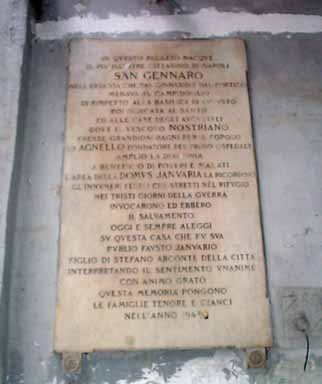 I would have thought that a city so devoted to its Patron
Saint would have his birthplace—at least the site traditionally
regarded as such—marked in some way other than with a simple plaque
in a rundown building. "Rundown" is probably not fair, since that condition
is hard to combat in a section of town where all the buildings are from
the 1400s and 1500s. There is only so much money to spend on religious
and cultural relics, and what there is normally goes into keeping
the larger well-known sites in shape: the Duomo, the church of Santa
Chiara, etc. I would have thought that a city so devoted to its Patron
Saint would have his birthplace—at least the site traditionally
regarded as such—marked in some way other than with a simple plaque
in a rundown building. "Rundown" is probably not fair, since that condition
is hard to combat in a section of town where all the buildings are from
the 1400s and 1500s. There is only so much money to spend on religious
and cultural relics, and what there is normally goes into keeping
the larger well-known sites in shape: the Duomo, the church of Santa
Chiara, etc.
Within,
then, the courtyard of a—let's say "old and non–descript"—
building, precisely, via San Gregorio Armeno 41, just off the
corner of via San Biaggio dei Librai (see the map
of the historic center of Naples—the house is adjacent to
number 27 on the map), there is a plaque (photo, above) identifying
the site as the home of the family of San Gennaro (St. Januarius) and
the birthplace of the saint. The building is appropriately called Domus
Januaria. The plaque was put in place in 1949.
The entire
area is in the heart of—better, over the heart of (since
that part of Roman Naples was buried in a mudslide in the sixth century
a.d.)—the historic center of Naples, and, indeed, is only about
70 yards downhill from the entrance to the excavated Roman market place
that now lies beneath the church of San Lorenzo. If you could dig straight
down within the courtyard of via San Gregorio Armeno 41—or
any other building in that area—you would run into the buildings
that were next–door neighbors of the Roman market place in the
days of San Gennaro, who was martyred in 304 a.d.
(See here
and here for other material about San Gennaro.)
"Eleonora"
(Fonseca Pimentel, Eleonora) (2)
Pathenopean Republic (1)
"Forsan
et haec olim meninisse juvabit"
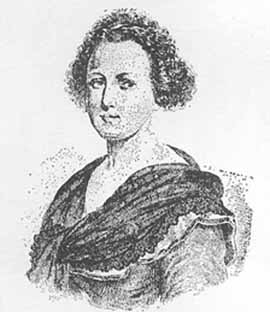 Failed
revolutionaries usually
wind up as footnotes in history books. Certainly, the period between
1789 (the beginning of the French Revolution) and 1805 (the year in
which Napoleon crowned himself emperor) is one of such turmoil in Europe
that it is easy not to see any but those who are larger than life. Eleonora
Fonseca Pimentel is one such overlooked person. She was a major figure,
but on a small stage, connected with the little known and failed
Neapolitan revolution and subsequent short-lived Neapolitan republic
of 1799. It was a sister of the French republic and one of many set
up in the 1790s in Europe, all of which—the Neapolitan version
included—have been relegated to the status of "also-rans"
in history. Failed
revolutionaries usually
wind up as footnotes in history books. Certainly, the period between
1789 (the beginning of the French Revolution) and 1805 (the year in
which Napoleon crowned himself emperor) is one of such turmoil in Europe
that it is easy not to see any but those who are larger than life. Eleonora
Fonseca Pimentel is one such overlooked person. She was a major figure,
but on a small stage, connected with the little known and failed
Neapolitan revolution and subsequent short-lived Neapolitan republic
of 1799. It was a sister of the French republic and one of many set
up in the 1790s in Europe, all of which—the Neapolitan version
included—have been relegated to the status of "also-rans"
in history.
Eleonora
was an unlikely revolutionary. She was born in Rome in 1751 of
Portuguese nobility and would be hanged in Piazza Mercato in
Naples in 1799 in a grotesque caricature of an execution. Her executioner,
Maria Caroline of Habsburg, Queen of Naples during the Neapolitan Revolution
was also born in 1751. That was also the decade of the great Lisbon
earthquake, about which an anonymous poet wrote lines as if describing
the dramatic events that would soon shake Europe the way the earth had
shaken Portugal.
"With
her last earthquake this round world shall rise,
The sun shall lose his fires in endless night,
And the moon turned to blood, glare horrid light,
When comets dire shall sweep athwart the sky,
And stars like leaves before the tempest fly."
Certainly,
the last days of one of Portugal's daughters, Eleonora Fonseca Pimentel,
seem contained in that verse.
In 1760,
Eleonora's family moved to Naples as a result of political difficulties
between the Vatican States (of which Rome was the capital) and its Portuguese
citizens, which included the Fonseca Pimentels. As a child in Rome,
she had already shown precocious talent, even brilliance. She enjoyed
the tutelage of a scholarly uncle and wrote poetry, read Latin and Greek,
and was well versed in the monuments of the Eternal City.
In Naples,
she fit right in. She was young, intelligent, wealthy, and extremely
well educated. She was primed to be part of that great movement in human
history known as the Enlightenment. Science, progress, and reason were
the by-words of the mid-1700s. The words of Rousseau's Social Contract
(1762) were taking hold. He wrote that government is justified only
if sovereignty stayed with the people and said that "Man is is born
free, yet everywhere is in chains." His solution spoke of the "natural
rights of man."
Charles
III
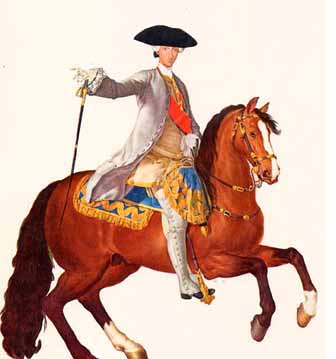 In the
1770s and into the '80s Naples was one of the most open societies in
Italy, well exposed to the ideas of Enlightenment Europe. It had been
a free and independent kingdom since the 1730s and for most of that
time had enjoyed the reign of Charles III of
Bourbon, by all accounts a benevolent monarch. In the
1770s and into the '80s Naples was one of the most open societies in
Italy, well exposed to the ideas of Enlightenment Europe. It had been
a free and independent kingdom since the 1730s and for most of that
time had enjoyed the reign of Charles III of
Bourbon, by all accounts a benevolent monarch.
The Neapolitan
Enlightenment had the likes of Vincenzo Cuoco (1770-1823). He believed in educating
the people towards liberty; he was to take part in the 1799 revolution
and suffer exile. He would write the first account of the revolution,
Saggio Storico sulla Rivoluzione Napoletana nel 1799. There was
Vincenzo Russo, somewhat of a Neapolitan
Rosseau, born in 1770 and who wrote in his Pensieri Politici
[Political Thoughts] (1798) of revolution as the “regenerator
of human virtue.” He would be part of the Neapolitan Republic
and one of those executed with Eleonora in 1799. And, then, Gaetano Filangieri (1752-1788). His 7-volume The
Science of Legislation was widely translated and was of monumental
influence in a Europe on the verge of change. (Filangieri was so enamored
of democracy that, for a short time, he carried on correspondence with
Benjamin Franklin following the American Revolution about the possibility
of emigrating to America, where "certain inalienable rights" had just
been codified into the social contract.)
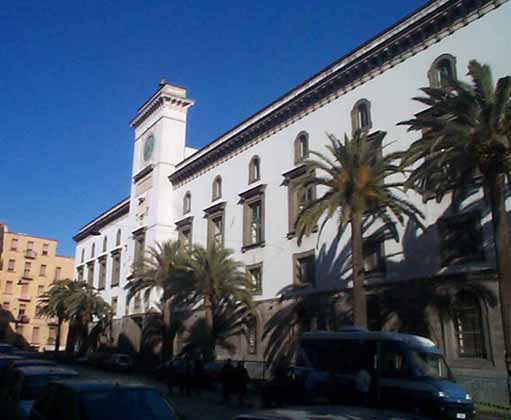 In
short, Naples had the beginnings of an intelligentsia and educated middle-class.
It still had, to be sure, a large underclass—the lazzaroni
(from "Lazarus," the patron saint of lepers —those whom Victor
Hugo called les miserables in France), those largely unaffected
by the social strivings of the Enlightenment. Unlike their Parisian
counterparts—and this was crucial in the ultimate failure of the
Revolution-- they were not the revolutionaries. When the time came in
1799, there would be no peasant rabble storming a Neapolitan bastille.
The peasant rabble remained loyal to their king. (The Neapolitan Bastille,
by the way, was the prison in Castel Capuano, where today's Hall of Justice is
housed [photo].) In
short, Naples had the beginnings of an intelligentsia and educated middle-class.
It still had, to be sure, a large underclass—the lazzaroni
(from "Lazarus," the patron saint of lepers —those whom Victor
Hugo called les miserables in France), those largely unaffected
by the social strivings of the Enlightenment. Unlike their Parisian
counterparts—and this was crucial in the ultimate failure of the
Revolution-- they were not the revolutionaries. When the time came in
1799, there would be no peasant rabble storming a Neapolitan bastille.
The peasant rabble remained loyal to their king. (The Neapolitan Bastille,
by the way, was the prison in Castel Capuano, where today's Hall of Justice is
housed [photo].)
In the
1770s, Eleonora became an important part of literary circles of
the day. She joined discussions of literature, politics and science.
She wrote poetry and carried on the type of correspondence so popular
among intellectuals of that period, the kind destined to wind up in
some distant future anthologized as "The Collected Letters of...".
These groups, themselves, were in imitation of the French salon
of the day, as was the participation of women. It was the beginning
of the age of the liberation of women—education, participation
and, eventually, suffrage.
Ferdinand
IV
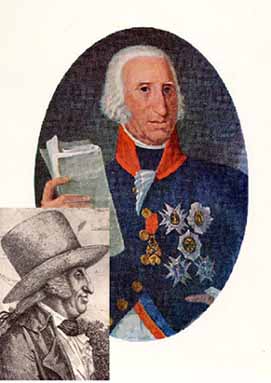 On the political
scene back in Naples, Charles III had returned to Spain in 1759, leaving
his kingdom in the hands of his good-natured, but not very bright son,
Ferdinand, still a minor. Ferdinand ruled through a regent, Tanucci,
until he was old enough to marry, in 1767. He married Maria Carolina
of Habsburg, daughter of the Empress Maria Teresa and sister of Marie
Antoinette. The King eventually became known as King Lazzarone (see
above) —perhaps "Beggar King"—a term of endearment, really,
since it showed how much the people considered him one of them. He was
quite content to wander down to the fish market and sell fish with the
merchants, leaving his young, brilliant wife to rule Naples—which
she did. In 1776, she junked Tannuci, who had ably stayed on as Prime
Minister. Then, she replaced him in 1778 with John
Acton (1736-1811), born in France of English origin and described
as an "admiral" in some sources, but in others as a "freebooter."
She later made him Secretary of State and, apparently, her lover. During
these years, Queen Caroline spared no effort to make Naples another
Vienna and Paris—at least in the glittering, aristocratic sense. On the political
scene back in Naples, Charles III had returned to Spain in 1759, leaving
his kingdom in the hands of his good-natured, but not very bright son,
Ferdinand, still a minor. Ferdinand ruled through a regent, Tanucci,
until he was old enough to marry, in 1767. He married Maria Carolina
of Habsburg, daughter of the Empress Maria Teresa and sister of Marie
Antoinette. The King eventually became known as King Lazzarone (see
above) —perhaps "Beggar King"—a term of endearment, really,
since it showed how much the people considered him one of them. He was
quite content to wander down to the fish market and sell fish with the
merchants, leaving his young, brilliant wife to rule Naples—which
she did. In 1776, she junked Tannuci, who had ably stayed on as Prime
Minister. Then, she replaced him in 1778 with John
Acton (1736-1811), born in France of English origin and described
as an "admiral" in some sources, but in others as a "freebooter."
She later made him Secretary of State and, apparently, her lover. During
these years, Queen Caroline spared no effort to make Naples another
Vienna and Paris—at least in the glittering, aristocratic sense.
History,
in a sense, is made by those who write about it. That is to say, you
get widely disparate views on the same person, depending on who is doing
the telling. One of the least flattering views of Eleonara is to be
found in The Bourbons of Naples (Acton 1957, below—indeed,
related to the aforementioned admiral). She was a writer of "Metastasian
rhapsodies"; she was "that exalted blue-stocking Eleonara Fonseca Pimentel..."
one of those who "longed to deliver [her] country to the French"; one
who "declaimed her latest effusion, a 'Hymn to Liberty'..."; "...an
earnest idealist with little practical experience of mankind".
At one point, in citing Eleonara's declaration that "Democracy and true
liberty render people gentle, indulgent, generous and magnanimous,"
the author simply says that Eleonora looked at the world through "rose-colored
spectacles". All in all, it is a picture of a poor little rich girl,
flightily enamoured of the ideals of the French Revolution but without
the foggiest idea of what really makes the world go round.
At the
other extreme, a recent book entitled, Cara Eleonora [Dear
Eleonora] (Macciocchi 1993), is laudatory but, at the same time, a strange
mish-mash of historical fiction and good investigative journalism. The
former would include a highly implausible (or, at least highly unknowable)
scene of soft-core lesbian pornography between Queen Caroline of Naples
and Lady Hamilton. On the other hand, the author was apparently the
first, at the late date of the 1990s, to dig up the facts of Eleonora's
separation from her husband in 1784, a Neapolitan officer by the name
of Pasquale Tria de Solis. She had borne him a child in 1778, who died
at the age of 8 months. In the course of the next few years, she was
apparently beaten by her husband into the miscarriage of a second child
and suffered the indignity of being forced to sleep in the same room
and often in the same bed as her husband and his mistress. The royal
court was sufficiently outraged to grant a separation. So much for Eleonora
having "little practical experience of mankind." The documentation
of this sordid episode in her life is still on record. The information
either eluded earlier historians or they considered it irrelevant. (Recent
women writers on Eleonora [Urgnani 1998] say that men—even great
historians such as Croce—typically overlook such episodes in the
lives of women. Note, however, that even a woman biographer of Eleonora
[Gurgo 1935] also missed—or ignored—this episode.)
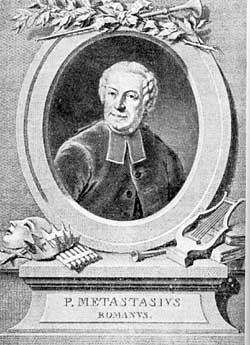 If
there had never been a French revolution and a subsequent Neapolitan
revolution, Eleonora Fonsenca Pimentel would still be remembered as
a minor poet in Italian literature of the 18th century. Her literary
output starts in 1768 with an epithalamium, a nuptial hymn, on the occasion
of the marriage of King Ferdinand and Queen Maria Carolina, some 600
lines of verse praising the accomplishments of the conjoined dynasties,
the Bourbons and Hapsburgs. She was 16 when she wrote it, and it was
so impressive that she was promptly accepted into the Arcadia, the Neapolitan
poets' circle of the day, where she became the new, young voice. She
wrote sonnets and verse in Latin as well as Italian, and she wrote a
number of cantatas and oratorios. Much of her literary output—as
was customary among lettered people of the day—was given over
to voluminous exchanges of letters with other literati. Most
prominent of these is a long correspondence in the 1770s with Pietro
Metastasio (illustration), the Italian court poet in Vienna and greatest
librettist of the 18th century. She had started the exchange by sending
him a copy of her first work, the one written for the king and queen.
Metastasio praised it, and by the end, in his seventies, was writing
her letters calling her the last of the great seductress poets and how
he wished he was younger! If
there had never been a French revolution and a subsequent Neapolitan
revolution, Eleonora Fonsenca Pimentel would still be remembered as
a minor poet in Italian literature of the 18th century. Her literary
output starts in 1768 with an epithalamium, a nuptial hymn, on the occasion
of the marriage of King Ferdinand and Queen Maria Carolina, some 600
lines of verse praising the accomplishments of the conjoined dynasties,
the Bourbons and Hapsburgs. She was 16 when she wrote it, and it was
so impressive that she was promptly accepted into the Arcadia, the Neapolitan
poets' circle of the day, where she became the new, young voice. She
wrote sonnets and verse in Latin as well as Italian, and she wrote a
number of cantatas and oratorios. Much of her literary output—as
was customary among lettered people of the day—was given over
to voluminous exchanges of letters with other literati. Most
prominent of these is a long correspondence in the 1770s with Pietro
Metastasio (illustration), the Italian court poet in Vienna and greatest
librettist of the 18th century. She had started the exchange by sending
him a copy of her first work, the one written for the king and queen.
Metastasio praised it, and by the end, in his seventies, was writing
her letters calling her the last of the great seductress poets and how
he wished he was younger!
Eleonora
even tried her hand at writing original verse in the dialect of Naples,
the language of the people [for a separate item on the Neapolitan dialect,
click here]. The sonnet has survived
and was an expression of Eleonora's approval of the King, in 1777,
abolishing the co-called Chinea (from the Italian word for "to
bow down"), a holdover feudal ritual where the king presented money
to the Pope once a year. It seems trivial today, but at the time, refusing
to pay tribute to the Pontif was revolutionary and provoked friction
between the Vatican and the Kingdom of Naples and actually endeared
King Ferdinand to the social reformers in Naples—at least, for
a while.
Her last
writings, of course, are from 1799, when she wrote most of the material
for, and edited, the Monitore Napoletano, the newspaper of the
Neapolitan Republic. She had started out as the little Portuguese princess
poet, darling of the court, and wound up as the fervent, revolutionary
newspaper editor, writing hymns to liberty and calls for social justice.
If one has to find a point at which Eleonora's efforts turned away from
the lofty classicism of the 18th century literary circle, it would be
in 1785. She became legally separated from her husband and returned
to to her father's house. Her father died in that year, and from then
on she concerned herself with Enlightenment issues—economics,
law, and advancement of the natural sciences. In the years following
the French Revolution, she dedicated herself to translating literature
of social reform and even revolution into the Neapolitan dialect so
that the people she thought she was helping to transform might better
understand the issues. She does truly seem to have been convinced of
her lines (cited above) that "Democracy and true liberty render people
gentle, indulgent, generous and magnanimous."
Eleonora's
best remembered sonnet is a touching and short poem to her child, dead
at 8 months—"...alone, my only joy is that you reign in heaven...
." The verses that helped to get Eleonora executed were undoubtedly
two. One is a "Hymn to Liberty," declaimed at the proclamation of the
Neapolitan Republic in 1799. That hymn has not survived. The other was
written from the Bourbon prison in Castel Capuano in 1798 where Eleonara
had been sent for revolutionary activities, including the possession
of censored books in her library. Times had changed since the days when
Eleonora praised Queen Caroline and wrote nice little ditties,
for example, on the occasion of the birth of the Queen's second child.
The poem from prison starts:
"Rediviva
Poppea, tribade impura,
d'imbecile tiranno empia consorte..."
In just
the first two lines (of 14) she manages to compare Caroline to Poppea
(Nero's wife and a murderess), calls her "impure" and a "lesbian" and
says that she is unfaithful to her husband, an "imbecile tyrant."
Indeed, times had changed.
[A complete
treatment of Eleonora Fonseca Pimentel's writings may be found in Urgnani
1998.]
A short
reminder of what had been going on in France is in order: In 1788, the
Parlement at Paris presents Louis XVI with a list of grievances.
The King calls the Estates-General to assemble in May of 1789 for the
first time since 1614. In July of that year, the Bastille is stormed
and Louis XVI is overthrown. This is the beginning of the French
Revolution. Nobility begins to emigrate. The guillotine is invented.
Radicals are called "Jacobins," so-called from their meetings in the
Domenican convent of St. Jacques in Paris. In 1790 the King, now merely
a figurehead, accepts the constitution drawn up by the revolutionaries.
Support for the idea of even a titular monarchy weakens, however, and
Louis flees to the northeast frontier to gain protection from troops
still loyal to him. He is recognized, captured and returned to Paris.
The Paris Commune takes power under Danton in that same year, and
The French National Convention abolishes the monarchy. It declares September
22, 1792 the first day of the Year One for the French Republic. The
French National Convention offers assistance to all nations that want
to overthrow their governments. (Read that sentence again and let what
it really means sink in.)
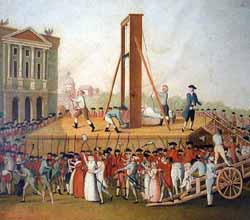 In
1793 the king and his wife, Marie Antoinette (sister of Queen Caroline
of Naples) are beheaded. France declares war on Britain, Holland, and
Spain. They, in turn, form an alliance with Austria against France.
The Reign of Terror in France takes hold and in 3 months, 15,000 people
are guillotined. The counter-revolution in Vandea is put down brutally.
Some 500,000 men, women and children are killed there and 13,000 more
are executed. Napoleon gains notice for the first time as the French
take Toulon from the British. The next year Robespierre crushes his
rivals and has Danton and others executed. Juries may now convict
without hearing evidence or argument. Opposition to Robespierre mounts.
He is overthrown and executed. The Ring of Terror ends. Moderates take
over and the French set about revolutionizing Europe. In
1793 the king and his wife, Marie Antoinette (sister of Queen Caroline
of Naples) are beheaded. France declares war on Britain, Holland, and
Spain. They, in turn, form an alliance with Austria against France.
The Reign of Terror in France takes hold and in 3 months, 15,000 people
are guillotined. The counter-revolution in Vandea is put down brutally.
Some 500,000 men, women and children are killed there and 13,000 more
are executed. Napoleon gains notice for the first time as the French
take Toulon from the British. The next year Robespierre crushes his
rivals and has Danton and others executed. Juries may now convict
without hearing evidence or argument. Opposition to Robespierre mounts.
He is overthrown and executed. The Ring of Terror ends. Moderates take
over and the French set about revolutionizing Europe.
It had
been an exhilarating few years. Neapolitan Jacobins, sympathizers with
the ideals of the French revolution now had solid evidence that a revolution
could work. There were meetings and discussions and mumblings about
the "natural rights of man" and how the monarchy was outmoded and should
be done away with. One such sympathizer was Eleonora Fonseca
Pimentel, that nice little woman who had written all those nice little
poems and who—in the interim—had actually become the Queen's
own librarian! The monarchy in Naples started to crack down on such
sympathy. Indeed, Queen Caroline kept in her study a painting
of the execution of her sister, Marie Antoinette, and wrote
on the picture, "I will have my revenge for this!" Just as in
the poem—
"...When
comets dire shall sweep athwart the sky,
And stars like leaves before the tempest fly."
Stars,
indeed, were starting to fly before the tempest.
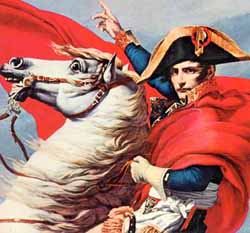 In
quick succession, the French invade Italy in 1796. Napoleon enters Milano
and sets up the Lombard Republic. He advances, declaring a Cisalpine
Republic in Northern Italy and then takes Rome and sets up the Roman
Republic in 1798. The French alienate the populace (revolutionaries
are not known for their diplomacy) by arresting the Pope and taking
him to France, where he dies. France and Naples break off diplomatic
relations because Naples, in violation of a treaty, has supplied British
ships in the port of Naples. The Kingdom of Naples prepares for a French
invasion. In
quick succession, the French invade Italy in 1796. Napoleon enters Milano
and sets up the Lombard Republic. He advances, declaring a Cisalpine
Republic in Northern Italy and then takes Rome and sets up the Roman
Republic in 1798. The French alienate the populace (revolutionaries
are not known for their diplomacy) by arresting the Pope and taking
him to France, where he dies. France and Naples break off diplomatic
relations because Naples, in violation of a treaty, has supplied British
ships in the port of Naples. The Kingdom of Naples prepares for a French
invasion.
It is difficult
to know what would have happened if Naples had not acted first. But
King Ferdinand, in a show of bravado, sets off to liberate Rome from
the French in 1798 and is routed. He flees back to Naples, giving the
local street wags the opportunity to mock him with a paraphrase
of Caesar. "Ferdinand—he came, he saw, he ran."
Horatio
Nelson
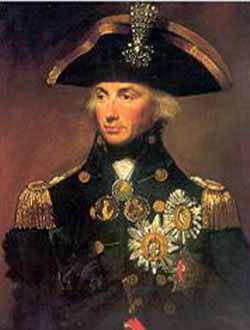 The King
and his army are pursued back to Naples by the French army. This sets
the stage for the overthrow of the monarchy in Naples. With the French
at the gates, Ferdinand and Caroline flee to Sicily, accompanied
by British ships under the command of their English ally, Admiral Horatio
Nelson. The French wait outside the city until the revolutionaries take
the city after a week of utter chaos in the city, horrors that include
manhunts, torture, and, apparently, even cannibalism. The rabble lazzaroni,
seeing their king leave, hunt down and torment and murder as many Jacobins
as possible. The Jacobins, in turn—the middle-class, the teachers,
merchants, lawyers, writers, and rebel officers and troops—take
the city from the last troops loyal to the king. The last scene
is at the Sant'Elmo fortress overlooking the city, where a force
led in person by Eleonora Fonseca Pimentel—now poet turned passionaria—obtain
the capitulation of the royalist forces. The Republic is proclaimed
on January 21, 1799. Liberty, Fraternity and Equality have arrived. The King
and his army are pursued back to Naples by the French army. This sets
the stage for the overthrow of the monarchy in Naples. With the French
at the gates, Ferdinand and Caroline flee to Sicily, accompanied
by British ships under the command of their English ally, Admiral Horatio
Nelson. The French wait outside the city until the revolutionaries take
the city after a week of utter chaos in the city, horrors that include
manhunts, torture, and, apparently, even cannibalism. The rabble lazzaroni,
seeing their king leave, hunt down and torment and murder as many Jacobins
as possible. The Jacobins, in turn—the middle-class, the teachers,
merchants, lawyers, writers, and rebel officers and troops—take
the city from the last troops loyal to the king. The last scene
is at the Sant'Elmo fortress overlooking the city, where a force
led in person by Eleonora Fonseca Pimentel—now poet turned passionaria—obtain
the capitulation of the royalist forces. The Republic is proclaimed
on January 21, 1799. Liberty, Fraternity and Equality have arrived.
The Republic
lasted until late August. During that time, Eleonara dedicated herself
to her newspaper, Monitore Napoletano. The first issue came out
with the date inscribed at the top as "Saturday, the 14th day of Piovoso
in the VII Year of Liberty, Year 1 of the Neapolitan Republic, one and
indivisible, (2 February 1799)." (The changes in the names of the months—Piovoso
means "Rainy"—and in the calendar system were two of those French
revolutionary items that have not survived—unlike the metric system!)
 Eleonora's
lead article began, "We are free at last, and the time has come when
we, too, can utter the scared words "Liberty' and 'Equality."
All in all, from February through August, she wrote and published 35
issues of the Monitore and two extra editions. She was
well aware that the people—the street lazzaroni—had
largely supported the monarchy and now distrusted the Republic. She
was concerned with explaining the revolution to the people and went
so far as to promote a gazette in Neapolitan dialect where social issues
of the day were discussed in the language of the people. She even stood
up for the people in the pages of her newspaper when the Republican
government confiscated property of those who had resisted the revolution,
calling the move "unjust' and illusory." Eleonora's
lead article began, "We are free at last, and the time has come when
we, too, can utter the scared words "Liberty' and 'Equality."
All in all, from February through August, she wrote and published 35
issues of the Monitore and two extra editions. She was
well aware that the people—the street lazzaroni—had
largely supported the monarchy and now distrusted the Republic. She
was concerned with explaining the revolution to the people and went
so far as to promote a gazette in Neapolitan dialect where social issues
of the day were discussed in the language of the people. She even stood
up for the people in the pages of her newspaper when the Republican
government confiscated property of those who had resisted the revolution,
calling the move "unjust' and illusory."
She was
optimistic to the end and, in her last issue in August, referred readers
to the next issue, which of course never came. The French army had pulled
back from Naples on its way to more pressing matters elsewhere. The
Army of the Holy Faith, the counter-revolutionary force led by Cardinal Ruffo had fought its way up from Sicily and
was now at the gates of Naples.
There is
no consensus as to why the revolution failed. No, wait. The revolution
failed because the people didn't support it. By "people," we mean the
lazzaroni, the masses, the Neapolitan equivalent of the
Parisian Bastille stormers a decade earlier. The real question is: Why
didn't they support the revolution? I know of no easy answer. Why did
one of the most miserable masses of population in Europe turn away from—turn
ON(!)—a revolution that had their best interests at heart? Croce,
who has written that the Neapolitan Jacobins transplanted the new ideas
of liberty to Italy, chalks up the failure of the revolution to the
Neapolitans' "sense of false religiosity," carefully avoiding the word
"religion". Be that as it may, the revolution was not as passive
as Vincenzo Cuoco (1820) claimed; it had the support of the nascent
middle-class. But it didn't have the support of the people. That much
is incontrovertible. And perhaps, here, Cuoco is not far off the
mark:
| Since
our revolution was a passive one, the only way for it to be successful
would have been to gain the opinion of the people. But the view
of the patriots was not the same as that of the people; they had
different ideas, different customs, and even two different languages.
The very same admiration for things foreign, which held back our
culture as a kingdom, formed the basis for our republic and was
the greatest obstacle to the establishment of liberty. The Neapolitan
nation was split in two, separated over two centuries into two
very different kinds of people. The educated classes were formed
on foreign models and possessed a culture quite different from
one that the nation needed, one that could come about only through
the development of our own faculties. Some had become French,
and some English; and those that stayed Neapolitan--most of the
people--stayed uneducated. [Cited in Diana. The above translation
is mine.] |
Beyond
that, perhaps the issue is moot; the fact remains that the masses were
on the side of the monarchy.They had not supported an earlier revolution in the 1600s and they didn't support
this one. It doesn't take long even in the Naples of today to notice
a distrust of change, an attitude that can manifest itself in
cynically self-destructive behavior among the people.
The surrender
of Naples to the returning forces of the King involved a staggering
bit of treachery. The royalist forces bargained their way into the city
by guaranteeing safe passage to France—the revolutionary
motherland—for Republican defenders of the city, meaning, largely,
members of the Republican government and prominent revolutionaries,
including Eleonora Fonseca Pimentel. The surrender took place,
and those who were to leave for France were put on ships in the bay
of Naples. At that point, Admiral Horatio Nelson—acting
on orders from the Queen relayed to him apparently by his mistress Lady
Hamilton, good friend of the Queen, went out and took the prisoners
off the ships. They were to be tried. Queen Caroline had said a few
years earlier that she "would like to be Robespierre" (cited in Albanese
1998). At long last, she was going to get her chance. She would have
her revenge.
It is instructive
to read a "Yes, but..." version of this episode. From Acton (1955):
| ...A
few facts may be gleaned from such documents as the records of
the Bianchi Con-fraternity, who ministered to the condemned; a
few anecdotes from contemporary diarists, especially De Nicola.
The rest is hearsay, much bedizened by the rich Neapolitan imagination.
Of 8,000 political prisoners 105 were condemned to death, six
of whom were reprieved, 222 were condemned to life imprisonment,
322 to shorter terms, 288 to deportation, and 67 to exile, from
which many returned: a total of 1,004. The others were set at
liberty.
Nearly
all intellectuals are rebels, and it is deplorable that most
of the condemned were men of culture. The howls and execrations
of the populace crowding to gloat upon their final agony added
a poignant horror to their executions. ‘I have always
desired their welfare, and they are rejoicing at my death!’
said Gennaro Serra before he was beheaded. And De Nicola wrote
that when Eleonora Pimentel was hanged, ‘the shouts of
the populace rose to the very stars'. The masses to whom she
and her colleagues had preached liberty and fraternity, viewed
these scenes with bloodthirsty gusto to which the hangman and
his clownish assistant, the tirapiedi , who clung to
the prisoner’s feet and swung with him into space,
pandered with gruesome relish. But this royalist Reign of Terror
as it has been called, pales into a provincial side-show beside
quite recent and far more systematic pogroms. Granted that the
Court's policy of revenge was cruel and unintelligent,
there is little to be said in favour of the rebels, whatever
their individual talents. To quote Luigi Blanch, the most balanced
of Neapolitan historians, 'they were an almost imperceptible
minority seeking to establish a form of government not wanted
by the country and in the same year so discredited in France
that it ceased amid popular applause on 18 Brumaire [the coup
d’etat of November 9]. Their aims were opposed to liberal
principles, based on national independence externally and on
the consent of the majority internally. They were pleased by
the disastrous campaign of 1798 and irritated by the vigorous
resistance of the people... Had they triumphed, they
they would have been all the more cruel as they were so few.
Sacrificed, they inspired compassion for the individuals and
sympathy for the cause. As executioners they would have inspired
for both.’
Since
then the technique by which a minority could seize power over
a state against the will of the majority has been perfected,
and most of us know where it leads. After a careful examination
of the short-lived Parthenopean Republic one is driven to doubt
whether it could have retained the power it had usurped with
the aid of French troops and civil strife, except by subjecting
the majority to violence and the constant threat of violence.
This would have resulted in a police state far more inhuman
than that of the Bourbons.
|
Whatever
the other merits of Acton's The Bourbons of Naples may be, that
passage is astonishingly glib. First of all, the betrayal, the arrests,
the trials and executions of Republicans were not simply "cruel and
unintelligent." They were illegitimate, and the entire affair took even
other monarchies of Europe by surprise. The Czar of Russia (hardly a
revolutionary sympathizer) reproached the Bourbons for the massacre
of Neapolitan Republicans, saying that he had sent troops to help regain
the kingdom, not “to slaughter the flower of Neapolitan culture.”
And Admiral
Nelson's behavior was reprehensible. He gave his word and then broke
it and participated in the bloodbath. He followed Caroline's instructions
to treat Naples as if it were "a rebellious city in Ireland."
He hanged the Neapolitan Admiral Caracciolo from the yardarm and then
cut the body loose to fall into the sea. (It was recovered by fishermen
and now lies in the small Church of S. Maria della Catena in
the Santa Lucia section of Naples.) [Southey's
Life of Nelson has a passage about the execution of Admiral Caracciolo
that you may read by clicking here.]
The British
admiralty was shocked by Nelson's behavior (Mr Fox, in the House of
Commons, referred to the "horrors" that had taken place in Naples);
if one needs to look for a reason why Britain's greatest naval hero
is not buried in Westminster Abbey, perhaps one need look no further
than his behavior in Naples.
Cardinal
Fabrizio Ruffo
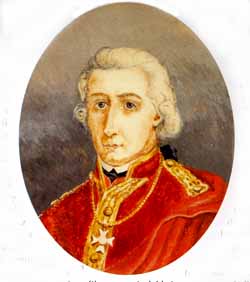 Sympathetic
Nelson biographers, such as Bradford, simply say that Nelson was following
orders: "It is difficult to see what else he could have done under the
circumstances ...His job as a British admiral was to see the Bourbons
restored—that and nothing else." [Bradford 1977] The "purge" (to
use Queen Caroline's word) was carried out over the objections
even of the leader of the royalist forces, Cardinal Ruffo, who had given
his Christian word guaranteeing safe passage to the defenders of the
city. (The Cardinal was a judge on the first trial commission; when
it became evident that they were going to be lenient with the revolutionaries,
they were replaced by tougher judges more to Queen Caroline's liking.) Sympathetic
Nelson biographers, such as Bradford, simply say that Nelson was following
orders: "It is difficult to see what else he could have done under the
circumstances ...His job as a British admiral was to see the Bourbons
restored—that and nothing else." [Bradford 1977] The "purge" (to
use Queen Caroline's word) was carried out over the objections
even of the leader of the royalist forces, Cardinal Ruffo, who had given
his Christian word guaranteeing safe passage to the defenders of the
city. (The Cardinal was a judge on the first trial commission; when
it became evident that they were going to be lenient with the revolutionaries,
they were replaced by tougher judges more to Queen Caroline's liking.)
Also, the
fact that the Bourbon reign of terror pales beside "recent pogroms"
(Acton, writing in the 1950s, is presumably referring to Stalinist Russia
or Nazi Germany) is irrelevant. To say that the Neapolitan Republic,
had it survived, "would have resulted in a police state far more
inhuman than that of the Bourbons" is self-serving speculation. The
Republic lasted for five months, and the upper- and middle-class leaders
of that Republic had every opportunity to repeat the savagery of the
French Reign of Terror of 1793. The fact is that they didn't.
Republican "terror" in Naples consisted of the execution, by firing
squad, of a father and son team found guilty of conspiring to overthrow
the Republic. Two executions in five months.
The outcome
of the trials—including the trial of Eleonora Fonseca Pimentel—was
a foregone conclusion. No one who has ever written about the affair
doubts that the trials were instigated at the will of Queen Caroline.
She sent a message to the trial commission from her residence in Sicily
saying that she wanted a "purge." Her husband, King Ferdinand,
was merely echoing her sentiments when he said that the commission should
turn the revolutionaries into cacicavalli, referring to the cheeses
that are hung up for display. And that is what happened.
Piazza
mercato
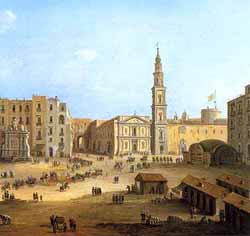 Stendahl,
in Rome, Florence and Naples (1826) , reports at length a conversation
about the Neapolitan Revolution and its grisly conclusion with a young
man he identifies only as T***, an eye-witness to the events,
themselves. Stendahl concludes: "I have been careful to suppress, during
the course of this narrative, all the more gruesome details. Robespierre,
whatever his faults, has this at least to be said in his favor: he did
not count a majority of personal friends among the total number of his
victims. Those whom he sacrificed, he sacrificed to a system,
however ill-founded; not to his petty, personal spite." Stendahl,
in Rome, Florence and Naples (1826) , reports at length a conversation
about the Neapolitan Revolution and its grisly conclusion with a young
man he identifies only as T***, an eye-witness to the events,
themselves. Stendahl concludes: "I have been careful to suppress, during
the course of this narrative, all the more gruesome details. Robespierre,
whatever his faults, has this at least to be said in his favor: he did
not count a majority of personal friends among the total number of his
victims. Those whom he sacrificed, he sacrificed to a system,
however ill-founded; not to his petty, personal spite."
In Piazza
Mercato, the fortunate among those sentenced to death were beheaded
swiftly. The less fortunate, among whom was Eleonora, were hanged. In
her case, as Acton's passage (above) indicates, it was a ghoulish affair.
Her body was left dangling from the gallows for a day, exposed to further
jibes and humiliation, such as the popular verse making the rounds at
the execution (cited in Albanese 1998):
A signora
donna Lionora,
che cantava ncopp' o triato,
mo abballa mmiezo ' o mercato,
viva viva 'u papa santo,
c'ha mannato i cannuncini,
pe scaccià li giacubini!
Viva a' forca 'e Masto Donato
Sant'Antonio sta priato.
Roughly:
To lady
Eleonora
who used to sing upon the stage
and now dances in market square,
long live the Holy Pope,
who sent us the guns
to chase away the Jacobins!
Long live the gallows and Master Donato [a traditional
name for the hangman]
Praise be to Sant'Antonio.
(The last
reference is interesting. The returning royalists felt betrayed by the
traditional Neapolitan patron saint, San Gennaro. From the article,
in this encyclopedia, on San Gennaro):
| On
the first Sunday in May, the other time when the "miracle" is
said to occur, it didn't. This provoked the French commander --desperate
to win popular support for his troops occupying the city-- into
the interesting move of threatening to kill the Archbishop of
Naples if the sign from Heaven were not forthcoming. A short while
later it came, thus lending, at least in the mind of the French
general --and notwithstanding skeptical popular charges of pseudo-divine
hanky-panky-- credence to his claim that God was on the side of
the Revolution. |
Thus, Cardinal
Ruffo's royalist troops got themselves a new saint! (A number of depictions
of the retaking of the kingdom show St. Anthony leading the Army of
the Holy Faith as they advance on the city of Naples.)
Eleonora
was calm at the gallows. She asked for some coffee, and—true to
her intellect to the last—her last words were in Latin: "Forsan
et haec olim meninisse juvabit," a citation from Virgil—"Perhaps
one day this will be worth remembering."
Is it remembered?
In one sense, of course it is. The French Enlightenment values of representative
government and parliamentary democracy are historically remembered;
they have been vindicated throughout Europe. There are no more absolute
monarchies. Democracy and republicanism are facts of life. But that
is not what the question really means. Are the events of 1799, themselves—culminating
in the ghastly execution of Eleonora on August 20 of that year—remembered?
If so, how?
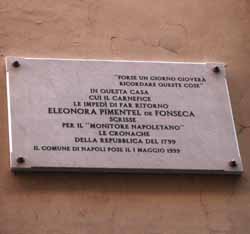 Well,
if you stroll around Naples and know where to look, you see an occasional
memorial plaque. There is one such plaque above the entrance to Eleonora's
home at Salita Sant'Anna di Palazzo 29, put there by the Lions
Club of Naples in May of 1999, reminding us that the "hangman kept her
from returning home." Her final resting place is likewise marked
at the church of the Carmine in Piazza Mercato, where she was executed.
Also, similar memorials dot buildings here and there throughout the
city, commemorating other victims of the Bourbon vendetta. Well,
if you stroll around Naples and know where to look, you see an occasional
memorial plaque. There is one such plaque above the entrance to Eleonora's
home at Salita Sant'Anna di Palazzo 29, put there by the Lions
Club of Naples in May of 1999, reminding us that the "hangman kept her
from returning home." Her final resting place is likewise marked
at the church of the Carmine in Piazza Mercato, where she was executed.
Also, similar memorials dot buildings here and there throughout the
city, commemorating other victims of the Bourbon vendetta.
One of
the most interesting memories of the Revolution is the Palazzo Serra di Cassano, on via Monte di
Dio. It was the home of Giovanni Serra, Duke of Cassano, one of
Eleonora's closest friends. Looking down at the crowd as he was about
to die, he said, "I have always wanted good for them and now they cheer
at my death" [cited in Albanese 1998]. The next day, his father closed
the portal of the building that opens onto the Royal Palace and said
it would remain closed until the ideals his son had died for were realized.
The door is still closed.
The greatest
memorial in recent memory, however, was when Vanessa Redgrave, the English
actress, stepped out on the stage of the San Carlo Theater on
Friday, January 8, 1999, and recited, in magnificent Italian, the title
role in Eleonora, a 3-hour oratorio, an absolute hymn of praise
to Eleonora Fonseca Pimentel. It was composed by Roberto de Simone, prominent Neapolitan composer
and musicologist. The production had had a two-week run-up in the Neapolitan
daily, il Mattino, replete with histories of the Neapolitan revolution,
fragments of Eleonora's poetry, long citations from historical heavyweights
such as Benedetto Croce, and even the news that a descendant of Eleonora's
(through her brother's line), another Fonseca Pimentel, would be at
the premiere. The production, itself, was generally well received. The
next day, the critic from il Mattino called it "an allegory of
all the martyrs in history" (Gargano 1999). "Art is liberty," he wrote,
"and must free itself from the bonds of time like an ever-evolving presepio,"
thus comparing the production to the traditional Neapolitan manger scene
that celebrates the birth of the Savior. Heady praise, indeed.
Yet the
reporter, at some length, quotes criticism, as well. One critic refers
to Eleonora as a "piece of 18th-century theater"; another
says that the Revolution of 1799 was a "deplorable piece of Neapolitan
history...a disgraceful bit of French treachery"; and yet a third said,
simply, "The 1799 Revolution? It never happened. Jacobins in power:
much ado about nothing."
Remarks
like those can be interpreted in various ways. One, it is certainly
easy to find books in any Neapolitan bookshop that glorify the Bourbons.
When they were at their worst (such as in 1799) they were truly awful,
but at their best they were a highpoint in the long history of the kingdom
of Naples: it was a separate and respected member of the community of
nations. So if you read tales about the homegrown lackeys of the French
who wanted to give their nation away and about the glorious Bourbon
counter-revolution that defeated them, you may be reading what amounts
to nostalgia for a better time. (Perhaps this is understandable in a
part of Italy that knows it is socially stigmatized within the nation
as a whole). Or—and this is a bit trickier—maybe there is
some resentment at what appears to be a rewriting of history. If you
see enough plaques and listen to enough oratorios you somehow come away
thinking that all this is "the people" saying, "Eleonora was one of
us and they killed her." That would be false. She wasn't
"one of us" (as much as she might have tried to be) and "they" didn't
kill her—"we" did. I am reminded of the line that Walt Kelly put
in the mouth of his comic strip character, Pogo: "We have met the enemy
and he is us!" Maybe the critics are wary of all the support all
of a sudden. Maybe they're asking, Where were "the people" when Eleonora
needed them?
_________________________________________________________________
Afterword:
Both
King Ferdinand and Queen Caroline lived to have their kingdom taken
from them again, this time in 1806, by the French under Napoleon. The
Bonaparte dynasty in Naples lasted until
1814. Caroline died in that year. The king, upon his return to the throne,
assumed the title of Ferdinand I, King of the Two Sicilies (as opposed
to Ferdinand IV, King of Naples, which he had been for most of life).
He married again. He died in 1825.
__________________________________________________________________
Works Cited:
Acton, Harold. The Bourbons of Naples. London: Prion Books,
1957.
Albanese, Camillo. Cronache di una Rivoluzione, Napoli 1799.
Milan: Franco Angeli, 1998.
Bradford, Ernle. Nelson, The Essential Hero. London: MacMillan,
1977.
Croce, Benedetto. “Eleonora de Fonseca Pimentel.” Monograph.
Rome: Tipografia nazionale, 1887.
Croce, Benedetto , et al. La Rivoluzione Napoletana. 1999
reprint by Tullio Pironti, ed. Naples: Morano, 1899.
Croce, Benedetto. “Eleonora de Fonseca Pimentel e il Monitore
Napoletano” in La Rivoluzione Napoletana di 1799. Bari:
Laterza, 1926.
Cuoco, Vincenzo. Saggio Storico sulla Rivoluzione Napoletana
nel 1799. Milano: 1806.
Diana, Roasario. Forward to Vincenzo Cuoco, Platone in Italia.
Naples: Pagano, 2000.
Gargano, Pietro. “Quei martiri nostri fratelli.” Il
Mattino, January 9, 1999.
Gurgo, Bice. Eleonora Fonseca Pimentel. Napoli: Cooperativa
Libreria, 1935.
Irace, Clorinda. E.F.P. Le tracce, i luoghi. Naples: Lions
Club, 1977.
Macciocchi, Maria Antonietta. Cara Eleonora. Milan: Biblioteca
Universale Rizzoli, 1993.
Stendahl. Rome, Florence and Naples. 1826.(Richard N. Coe,
trans.) London: John Calder, 1959.
Urgnani, Elena. La Vicenda Letteraria e Politica di Eleonora de
Fonseca Pimentel. Il Pensiero e la storia. Ed. Istituto Italiano
per gli Studi Filosofici. Vol. 54. Naples: La Città del Sole,
1998.
Marcellino
and Festo
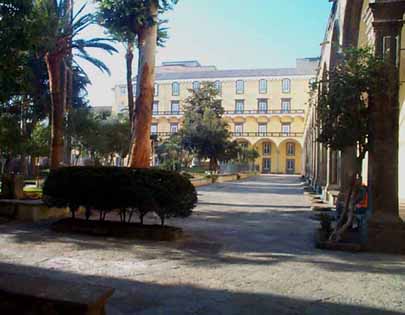 Fortunately, Naples goes on periodic binges of restoration:
a Roman market here, an Angevin castle there—you can do
a lot with 2,500 years of history. One of the delights, then, of walking
around at random is finding such a place. I stepped through the large
portal of a building I had never visited before and got one of
those Wizard of Oz moments (when Dorothy, in the MGM film, opens the
door of her house, which has just bounced down in Oz, and the film suddenly
goes from black and white to color). I didn't start to sing, but I think
I might have gasped briefly. I was in the newly restored courtyard of
the old monastery of Saints Marcellino and Festo. It was tidy and colorful,
newly painted, with a hypnotic series of arches running around the perimeter
of the courtyard. Also—at least when I was there—there were
some very small gardeners tending the ample vegetation. That added to
the Munchkin effect. Fortunately, Naples goes on periodic binges of restoration:
a Roman market here, an Angevin castle there—you can do
a lot with 2,500 years of history. One of the delights, then, of walking
around at random is finding such a place. I stepped through the large
portal of a building I had never visited before and got one of
those Wizard of Oz moments (when Dorothy, in the MGM film, opens the
door of her house, which has just bounced down in Oz, and the film suddenly
goes from black and white to color). I didn't start to sing, but I think
I might have gasped briefly. I was in the newly restored courtyard of
the old monastery of Saints Marcellino and Festo. It was tidy and colorful,
newly painted, with a hypnotic series of arches running around the perimeter
of the courtyard. Also—at least when I was there—there were
some very small gardeners tending the ample vegetation. That added to
the Munchkin effect.
This monastery
was the result of the fusion in 1565 of two older, smaller religious
facilities housing, respectively, a Basilian order and a Benedictine
one, both of which go back to the very hazy times of the independent
Duchy of Naples in the 8th century. It is yet another example of the
many monasteries in Naples that have been
converted to other use; it has been affiliated with the University
of Naples since 1907 and currently houses part of the Paleontology
Department. Recently, funds from the European Foundation for Regional
Development have helped to restore the courtyard to the state shown
in the photo. It is not particularly easy to find, but it's worth the
effort. It is accessible from via Mezzocannone by walking east
behind the main university building down a small street named via
Orilia.
The Arab
Influence on the Italian Renaissance
Beetle Juice,
anyone?
Since
much of it happened by way of southern Italy, I think I can justify
sneaking it in, here.
| This
is an early-15th-century Persian copy of the opening page of Book
Four of Ibn Sina's (Avicenna) Canon of Medicine, written
in the 11th century, parts of which were used in European medical
schools as late as the 19th century. |
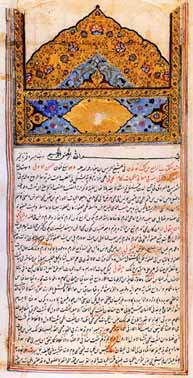 Dangling
in the southern winter sky and very visible from my balcony in Naples
is the great equatorial constellation of Orion. The second brightest
star in that constellation is the red supergiant, Betelgeuse. (This
is the first of a few familiar names coming up that no one knows how
to pronounce. Another one is "Averroës.") Betelgeuse is 390 light
years from my balcony and, thus, remote from the various fields of human
conflict that are responsible for my knowing neither the pronunciation
nor the original name of the star—thus, our high school
astronomy club's cutesy mnemonic of "Beetle Juice." I don't recall ever
learning that the name came from the Arabic bayt al jauza, meaning
"in the house of the twins," referring to the Heavenly Twins, Castor
and Pollux, hanging out right above Orion. Dangling
in the southern winter sky and very visible from my balcony in Naples
is the great equatorial constellation of Orion. The second brightest
star in that constellation is the red supergiant, Betelgeuse. (This
is the first of a few familiar names coming up that no one knows how
to pronounce. Another one is "Averroës.") Betelgeuse is 390 light
years from my balcony and, thus, remote from the various fields of human
conflict that are responsible for my knowing neither the pronunciation
nor the original name of the star—thus, our high school
astronomy club's cutesy mnemonic of "Beetle Juice." I don't recall ever
learning that the name came from the Arabic bayt al jauza, meaning
"in the house of the twins," referring to the Heavenly Twins, Castor
and Pollux, hanging out right above Orion.
Speaking
of high school, I did not do well in mathematics, but I am willing to
give Al-Khwarizmi (known to us as Algorizm!) (770 - 840) his credit
if he takes a bit of my blame. I will take all the blame for not knowing
who Chaucer was talking about in the Canterbury Tales,
when, in praising the knowledge of the doctor on the trip, he reminded
us that ye olde pilgrim sawbones was familiar not only with Hippocrates
and Galen, but "Rhazes, Hali, Averroës and Avicenna."
It is convenient—but
not a good idea—to pigeonhole our own cultural history
into tidy episodes: The Renaissance, The Age of Reason, The Enlightenment,
The This & That, as if they had happened all of a sudden with
no connection to anything else—as if Leonardo woke up one
fine morning in 1500, looked at his homemade (obviously) hour-glass
and said "Gee, it's the Renaissance; I'd better design a helicopter."
The point of this entry, then, is simply to draw your attention to how
interconnected European and Arabic culture used to be, and how there
is a link between the glorious age of Arab science and culture (800-1100)
and the beginnings of the Italian Renaissance. (I am not making the
post hoc, ergo propter hoc mistake of saying that that which
comes first necessarily causes that which comes second. I am simply
saying it's a good idea to know what came before you—Bonum
est quod ante te evenit scire (I think) .
After Islam's
rapid spread from Spain to India, Muslims founded the city of Baghdad
in 800, and it is here that the Muslim quest for knowledge begins, the
manifestation of an insatiable curiosity (to use Einstein's choice
phrase from many centuries later) "to figure out how the Old Man runs
the universe." It is in Baghdad that the Muslims founded their
great school of translation, the incredible ambition of which was to
translate as much as they could find of science, astronomy, mathematics,
music, geography and philosophy—whatever remained of Classical
Greek knowledge. It meant going even further afield—to
India—to study the mathematics and philosophy of those
who had written in classical Sanskrit centuries earlier.
In 800
this was by no means an easy task. Much classical Greek writing had
not survived the centuries of neglect by Christians inimical to "pagan"
thought. As early as the year 500, the great library at Alexandria was
a ruin and, a few years later, Justinian closed Plato's Academy in Athens
because it was a hotbed of pagan (non-Christian) philosophy. Arab scholars,
then, translated into Arabic the few Greek texts that remained, or translated
from languages into which the Greek originals had previously been translated
by scholars who had left Greece for parts east. These were mainly exiled
Nestorian Christians from Greece, and Classical Greek scholars from
Plato's academy who had fled to Persia, where they founded a great center
of learning at Jundishapur (before the coming of Islam) and translated
much of their material into Aramaic, the lingua franca of the Middle
East at the time. After Baghdad, the Arabs later started equally fine
centers of scholarship in Spain at Cordoba and Toledo.
Transmission
of this glorious knowledge from The Muslim world into Italy happened
primarily through Spain and Sicily; that is, the great courts of learning
in Cordoba and the pre-Crusades court of Norman Sicily in the 12th century. It is in Sicily,
particularly, that Norman tolerance provided for the coexistence of
Byzantine Greek, Italian Christian, and Arab scholars. It was, perhaps,
the last great period of human tolerance in European history.
Medicine
One of
the great medical translators from Arabic into Latin was Constantine
of Carthage (known as "The African"). In the middle of the 11th century,
he came to teach at the medical school in Salerno
, the first of its kind in Europe, bringing with him his vast library
of Arabic medical works, including, no doubt, Avicenna's Canon of
Medicine. That work was translated into Latin and used as
a text in European medical schools well into the 17th century, and parts
of it were current as late as the early 19th century! In 1127, a European
translator, Stefano of Pisa, reported that scholars of medicine
were all still found in Sicily and Salerno, and were generally persons
who knew Arabic. Again, we shouldn't set up a necessary chain of cause
and effect; yet, there is surely a link between earlier Muslim medical
thought (the view that "God has provided a cure for all disease"; therefore,
it is our rational duty to find those cures) and the final abandoning
by the Christian west of the view that prayer and mortification of the
flesh cured illness.
Frederick
II
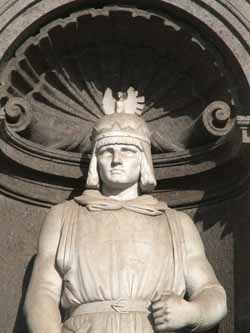 In
Palermo, Emperor Frederick II (1194-1250),
in spite of the Crusades, was driven by his own enormous intellectual
curiosity to explore Arabic culture. He is known for his exchanges of
letters on philosophy and science with Arab scholars. A prominent member
of the court of Frederick in Palermo was the great Italian mathematician,
Leonardo Fibonacci, the inventor of the arithmetic series that bears
his name. (Quick! what is the next number in this series: 4, 1, 5, 6,
11, 17...)? He had studied with Arab mathematicians, and
he is also the reason you don't have to do that last problem as "IV,
I, V, VI, XI, XVII..."; that is, he introduced "Arabic" numerals
into Europe (they were really Indian numerals that the Arabs had picked
up in their wanderings). In
Palermo, Emperor Frederick II (1194-1250),
in spite of the Crusades, was driven by his own enormous intellectual
curiosity to explore Arabic culture. He is known for his exchanges of
letters on philosophy and science with Arab scholars. A prominent member
of the court of Frederick in Palermo was the great Italian mathematician,
Leonardo Fibonacci, the inventor of the arithmetic series that bears
his name. (Quick! what is the next number in this series: 4, 1, 5, 6,
11, 17...)? He had studied with Arab mathematicians, and
he is also the reason you don't have to do that last problem as "IV,
I, V, VI, XI, XVII..."; that is, he introduced "Arabic" numerals
into Europe (they were really Indian numerals that the Arabs had picked
up in their wanderings).
Frederick’s
court is also responsible for giving us a Latin translation (from the
Arabic translation of the Greek) of Ptolemy's Almagest, and for
translating the original works of the great Arab astronomer, Al-Farghini.
Frederick
II's interests are so wide ranging that it is no wonder he was well
read in Arab philosophy and science. He expanded the medical school
in Salerno and started the University of Naples, which, today, still
bears his name.
Michael
Scot (1217-1240) was perhaps the finest mind at the court of Frederick
in Palermo. From Scotland, he had worked at the great Arab translation
center in Toledo and is responsible for giving us Latin versions of
the philosophical works of Avicenna and Averroës, particularly
the latter's commentaries on Aristotle. From royal courts to fledgeling
universities, Italy in the 1100s and 1200s, then, seems to be a scene
of Europeans scurrying to read the next installments of Arab works,
particularly in philosophy, medicine and astronomy.
Philosophy
Muslim
religious philosophy is of particular interest. Al-Kindi (d. after
870) was the first important Muslim philosopher. He held and taught
that revealed truth (religion) and rational truth were not in conflict,
but were complementary—even identical. Then, Al-Farabi
(874-950) elevated philosophy even above the revealed truth of
the sharia, the religious law of Islam, and held that our goal
is to develop our rational faculty.
Ibn Sina
(981-1037), known in the west by the Latin name, Avicenna, is often
called by Westerners the "Arab Leonardo" for the amazing breadth of
his knowledge in medicine, philosophy, mathematics, and astronomy. In
addition to his Canon of Medicine (mentioned above), he is certainly
one of the most remarkable thinkers of the Middle Ages and the most
important and original of all Muslim philosophers. His held that religion
was a kind of philosophy for the masses; the goal of all revealed truth
(including his own Islam) was to lead us to our highest state—one
of philosophic contemplation. He held the particularly original
idea that intellectual discovery implies an intuitive act of knowledge.
The idea of the intuitive intellect working outside of the methodical
process of collecting facts and deduction has again become quite modern.
Averroes
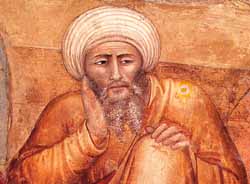 Perhaps
Ibn-Rushid (Averroës) 1128 -1198 is also of great interest
to us. He wrote many commentaries on Aristotle and is known in Arab
philosophy simply as "The Commentator." His works in religious philosophy
were widely read in Europe, especially by Thomas Aquinas, the point,
of course, being not that one was right and the other wrong, but that
one of the greatest of European medieval philosophers honed his own
sharp intellect by dealing with his Muslim predecessor. Averroës'
work in law, medicine, and astronomy were also highly regarded. Perhaps
Ibn-Rushid (Averroës) 1128 -1198 is also of great interest
to us. He wrote many commentaries on Aristotle and is known in Arab
philosophy simply as "The Commentator." His works in religious philosophy
were widely read in Europe, especially by Thomas Aquinas, the point,
of course, being not that one was right and the other wrong, but that
one of the greatest of European medieval philosophers honed his own
sharp intellect by dealing with his Muslim predecessor. Averroës'
work in law, medicine, and astronomy were also highly regarded.
Literature
Hardly
mentioned at all when you read about the Arab influence in European
thought is the extent to which Arab literature might have had any influence
on European medieval literature. There are a number of possibilities.
It may be that the Arab habit of composing popular poetry in vernacular
Arabic in Sicily and Spain had some influence on the subsequent "vernacularization"
of not only European court poetry and song in the Provence (the Troubadours)
and Sicily, but even in the beginnings of great European vernacular
literature.
In A
History of Islamic Sicily, Aziz Ahmad dwells on the controversial
connection between Dante's Divine Comedy and prior Islamic works
of the same nature. There is no real conclusion to be drawn, except
the possibility that our great originator of non-Latin Romance literature
got some inspiration from somewhere. Dante certainly knew of Avicenna
and Averroës through Latin translation; in the Divine Comedy,
he places them both in Purgatory with the great pre-Christian scholars
of ancient Greece. (Dante was not so kind to Mohammed, himself, though,
who, in Canto 28, is in Hell as a Sower of Discord). Did Dante also
know (through its Latin or Early French translations) of The Book
of the Scale, an earlier Arab eschatological work that has interesting
parallels in the Divine Comedy? Again, we should beware of post
hoc reasoning,but it is an intriguing possibility.
It was
the contributions of minds such as those mentioned, above, that prompted
Robert Briffault (in The Making of Humanity) to write:
| It
was under the influence of the Arabs and Moorish revival of culture
and not in the 15th century, that a real renaissance took place...
After steadily sinking lower and lower into barbarism, it [Europe]
had reached the darkest depths of ignorance and degradation when
cities of the Saracenic world, Baghdad, Cairo, Cordova, and Toledo,
were growing centers of civilization and intellectual activity.
It was there that the new life arose which was to grow into a
new phase of human evolution. From the time when the influence
of their culture made itself felt, began the stirring of new life. |
Those are
strong words that I do not entirely accept. Yet they remind us that
our ethnocentric view of our own cultural history as a straightforward
chain of events is not very helpful. Perhaps we should step back
and view all of culture as a vast web of ideas; they may spring forth
in different places at different times—or many of them
at the same time, unnoticed elsewhere.
Here,
read these.
Ahmad,
Aziz. A History of Islamic Sicily. New York: Columbia Univ. Press,
1979.
Briffault, Robert. The Making of Humanity. London: 1938.
Gutas, Dimitri. Greek Thought, Arabic Culture. London: Routledge,
1998.
Lunde, Paul. “Ishbiliyah: Islamic Seville.” Aramco
World 44.1 (Jan/Feb) 1993.
Marmura, Micahel E. "Avicenna." The Encyclopedia of Philosophy.
New York: MacMillan, 1967.
Rahman, Fazlur. "Islamic Philosophy." The Encyclopedia of Philosophy.
New York: MacMillan, 1967.
Rosenthal, Franz. The Classical Heritage in Islam. Trans.
Emile and Jenny Marmorstein. In series: Arabic Thought and Culture.
London: Routledge, 1992.
Sarton George. Introduction to the History of Science, Vol. I-III.
Baltimore: Wilkins and Wilkens, 1950
Tschanz, David W. “The Arab Roots of European Medicine.”
Aramco World May/June 1997.
Unesco Courier, The. September, 1986. Title of issue: "Averroes
and Maimonides: Two Master Minds of the 12th Century". Paris:
Unesco, 1986.
Wilson, N.G. From Byzantium to Italy; Greek Studies in the Italian
Renaissance. London: Duckworth, 1992.
Geology
of the Bay of Naples
(I acknowledge
the kind comments and suggestions of a dear friend,
Peter Humphrey, geologist and member of the U.S. Foreign Service, for
his revisions and his particular ability to make science accessible.
Any mistakes are, of course, mine.)
I recommend
that you read this the beginning, but you may also click through to
the following subheadings:
general
geology
Italy in particular
Volcanoes
Vesuvius
Pozzuoli
The "Ring of Fire"
Monte Nuovo
The Islands in the Bay
On Predicting Eruptions and Earthquakes
Introduction
There are
a number of obvious features of the landscape here in the Bay of Naples
that are of extreme geological interest. In order of "obviousness,"
the ones that stand out are:
1) Mt.
Vesuvius; (a chart of the Somma/Vesuvius volcano is here)
2) The
intense geothermal activity at the western end of the bay, centered
near the town of Pozzuoli in an area called The Flegrean Fields ("Fiery
Fields”);
3) The
presence in that same area of Monte Nuovo, (literally, "New Mountain,"
so-called because it appeared in a single week in the mid-1500s, just
yesterday on the clock of geologic time);
4) The
on-going small changes in sea level in that area, caused by so-called
"bradiseisms" (the ground is bouncing up and down);
5) The
presence in the Bay of the islands of Capri, Ischia, and Procida, two
of which were formed by volcanic activity; and, finally,
6) The
cliffs along the Sorrentine peninsula, which give you, the spectator,
a good view of how mountains are thrust up above the surface by subterranean
activity and then worn away and eroded into the shapes we see today.
General
Geology
All of
the above items, except erosion, are manifestations on the surface of
activity below us. For the last forty years, geologists have been refining
the theory of "plate tectonics" to describe the phenomena of "sea-floor
spreading," and "continental drift," phenomena that are the direct cause
of earthquakes and volcanoes.
The outer
solid mineral crust of the earth is called the "lithosphere". It is
a rocky layer underlying the continents and ocean basins, varying in
thickness from almost zero at the mid-ocean ridge crest to over 100
km when carrying an imbedded continent. It is helpful to visualize this
layer as relatively thinner compared to the earth than the skin of an
orange is to the fruit, itself. Below the crust lies the mantle, a layer
of rock extending to a depth of about 3,000 km, or halfway to the center
of the Earth. Parts of the mantle get so hot that rock becomes molten
and moves slowly in vertically rotating currents. This is convection,
the force that drives continental drift. Below the mantle is the core
of the Earth, a ball about 2,500 km in diameter consisting of a fluid
outer layer and a solid center, both mostly of iron and some nickel.
The continents
and ocean basins are the upper portion of the lithosphere. The lithosphere
is fractured at various points around the planet, giving us a global
jigsaw puzzle of tectonic plates. There are about a dozen major tectonic
plates and several dozen small—even tiny—
ones (some of them are only the size of a big county and are often called
“mobile terrenes”).
The continental
configuration that we see today on the surface of the Earth is the result
of these broad, thick rafts of oceanic crust and mantle shifting slowly
to come together into a single primordial super-continent (nicknamed
"Pangaea" by geologists) and then to start breaking apart again about
200 million years ago, first into two chunks ("Laurasia" and "Gondwana")
and then into the configuration that is familiar to us today. (Young
geology students are occasionally seen sporting t-shirts with messages
calling for the “Reunification of Gondwanaland”. These kids
need more homework.)
When tectonic
plates move, they do so along fracture lines, the borders of each
plate that define the actual pieces of the gigantic jigsaw puzzle. The
plates move apart undersea and form large mid-oceanic rifts and then
ridges, true undersea mountain ranges, formed over the course of millions
of years as hot magma flows from below the lithosphere up into the rift.
It is this sea-floor spreading—driven by the convective
movement of the internal heat of the earth—that drives
the entire process of continental drift.
Tectonic
plates have existed since Earth's molten inception 4.65 billion years
ago. It was the cooling of the crusts that made for the first
tectonic plates, a model that can be seen on any cooling lava lake.
(I have been told that it is great fun to put on a good pair of hiking
boots and go running across the cooling crust of a lava lake. I have
also been told that it is important not to trip and fall.) A particularly
dramatic example of very ancient tectonics is the Ural Mountains, a
classic collision plate boundary. Likewise, the Appalachians mark
a very ancient closure of a proto-Atlantic; the continents then severed
again, shearing the old Appalachian plate boundary between the US and
Scotland.
The heat
within the earth—the heat that drives continental drift—is
due to three things:
(1) Heat
from when our planet formed and accreted, and which has not yet been
lost; the amount of heat that can arise through simple accretionary
processes, bringing small bodies together to form the proto-Earth, is
large (on the order of 10,000 kelvins—about 18,000 degrees
Fahrenheit);
(2) Frictional
heating, caused by denser core material sinking to the center of the
planet; descent of the dense iron-rich material that makes up the core
of the planet to the center would produce heating on the order of 2,000
kelvins (about 3,000 degrees F);
(3) Heat
from the decay of radioactive elements; the magnitude of this third
main source of heat—radioactive heating—is
uncertain. The precise amount of radioactive elements (primarily potassium,
uranium and thorium) in the deep earth is poorly known.
In other
words, there was no shortage of heat in the early earth, and the planet's
inability to cool off quickly results in the continued high temperatures
of the Earth's interior. In effect, the earth's plates act as a blanket
on the interior, and even convective heat transport in the solid mantle
does not provide a particularly efficient mechanism for heat loss. Our
planet does lose some heat through the processes that drive plate tectonics,
especially at mid-ocean ridges. For comparison, smaller bodies such
as Mars and the Moon show little evidence of recent tectonic activity
or volcanism.
Meanwhile,
back on Earth, as new material is pumped into the rifts formed by sea-floor
spreading, adjacent plates shift along the fracture lines causing the
global jigsaw puzzle to slowly reassemble itself into ever-different
configurations. Important in this view of the dynamics of the earth's
surface is the fact that during the process of sea-floor spreading and
rift formation, spread to both sides then causes some plates to come
together elsewhere with varying results. The most important force in
this spread is the pull of old, thick, relatively cold lithosphere into
the trenches, with a little help from drag along the bottom of the plate.
Ridges start as passive cracks opened by plates being dragged away to
either side. Nature, abhorring a vacuum, then fills the cracks
with lava. Again, the entire process of plate tectonics and continental
drift is driven by convection --the enormous heat within the earth drives
molten material towards the surface. Some of this material may escape
to the seafloor, itself, to add to the great undersea mountain ranges;
the rest cools and sinks to be recycled into a later round of convection.
When a
relatively new (and therefore thinner) oceanic plate hits an older oceanic
or a continental plate (both thicker than the youngster), a trench forms
along the tectonic fault. Then, one of two plates coming into contact
can subduct—go into the trench and under the other plate—forcing
it up and producing great mountain ranges such as the Rockies, Andes,
Alps, and Himalayas. (It is helpful to think of tectonic collisions
as agonizingly slow car crashes!) (Note that some mountains, however,
are caused also by direct volcanic activity, huge bursts of solid and
molten material vented through fault lines at great pressure onto the
surface.) The heavier subducting layer will eventually cycle back down
into the hot magma below the lithosphere. The process of spreading on
one end and subduction on the other suggests the picture of a continuously
manufactured, one-way conveyor belt.
Plates
can also "strike and slip," i.e., rub together along the fault lines
(faults are surface manifestations, often visible on the surface, of
the actual plate boundaries far below), and cause considerable earthquakes.
The San Andreas Fault is one example of "strike-slip" movement.
One-half of California is moving north, and the other south, as two
plates slide past each other. Western California will one day be off
the coast of Alaska, which is fine with me. (Note: There is a fortunate
item called "afterslip," movement along a tectonic fault that causes
little or no perceived surface quake, but dissipates energy.)
This relatively
new theory of "plate tectonics" is a beautiful one, because it explains
so much at once, which is what good science is supposed to do. The theory
takes sea-floor spreading, continental drift, mountain building, earthquakes
and volcanic activity and ties them together. Indeed, the theory explains
why the continents exist at all. Without plate tectonics creating
rock piles, most of our planet would erode below sea level in a few
tens of millions of years.
Though
mid-oceanic ridges were discovered through primitive string soundings
by the H.M.S. Challenger in the late 1800s, refining a theory of plate
tectonics depended on figuring out what kind of powerhouse energy source
could possibly drive continents around the globe. That problem was solved
with the development of underwater mapping techniques in the 1960s and
the actual observation of planetary convection at work, basaltic magma
flowing up onto the seabed from below. Remember that two-thirds of the
surface of the earth is sea floor, made up entirely of sediment-covered
basalt. Water conceals from our direct view such wonders as the great
mid-ocean ridges, the combined lengths of which are some forty-thousand
miles long. In places the ridge is 600 miles wide and two miles high,
an uninterrupted, mammoth line of magma venting up to the seafloor for
hundreds of millions of years. To get an idea of that, go out and look
at Mt. Vesuvius; imagine it twice as high, then twice as wide as Italy
—and stretching almost twice around the world!
Superswells:
A new wrinkle in the surface of the earth
As if plate
tectonics and shifting continents weren’t enough, current research
is probing what are termed “superswells” in order to explain
some of the planet’s most massive surface features. Southern Africa
for example, has an expansive plateau, more than 1,000 miles across
and almost a mile high. Geologic evidence shows that southern Africa
and the surrounding ocean floor have been rising slowly for the past
100 million years, even though that part of Africa has not experienced
a tectonic collision for nearly 400 million years. Such vertical movement
of continents requires other explanations than standard plate tectonics.
Research is focusing on, among other things, the existence of “superplumes,”
massive blobs of molten material that rise faster than surrounding heavier
material, moving upwards with enough power to lift the landmasses, themselves.
(Further information on this particular topic can be found in “Sculpting
the Earth from Inside Out” by Michael Gurnis in Scientific
American, March 2001.)
Italy
in Particular
Much earthquake
and volcanic activity on the surface of the earth is found along the
lines of tectonic fractures. Italy is at the meeting point of a few
of these tectonic plates. The movement below has formed the Italian
peninsula and is the source of Italy’s great natural beauty and
much of its considerable history of natural catastrophe.
In broad
terms, the entire Mediterranean Sea was brought into existence about
ten million years ago by the coming together of the African tectonic
plate and the plate that makes up the greater Eurasian landmass
to the north. In the case of Italy, the prominent mountain range, the
Apennines, the "backbone" of Italy, resulted from the collision of the
smaller Apulian plate with the Iberian plate. The mountains formed,
and islands such as Sardinia and Sicily surfaced. The entire fault line
that runs the length of Italy was then primed to produce volcanoes and
geothermal activity on the surface along the line of the tectonic fracture,
an obviously weak chink in the earth's armor and a natural place for
internal energy and heat from the inner earth to vent to the surface.
Today’s earthquake and volcanic woes along the west coast of Italy,
on the Aeolian Islands, and on Sicily are a direct result of on-going
subterranean activity as the great African Plate, which contains the
Mediterranean and Italy, subducts below Europe via movement somewhat
slower than the growth of a fingernail. The Alps mark the collision
of Africa and Europe. Putting additional crunch on Italy is the plate
that bears the Balkans; it is subducting beneath the eastern side of
the Italian peninsula, yea, even as we speak.
Volcanoes
A volcano
is a conical mountain built up around a vent in the crust of the earth.
Imagine the structure of a large tree below the surface; it is rooted
below the crust of the earth in a magma chamber and vents through the
main trunk up to the surface. This magma chamber is the bulge of molten
material from below the lithosphere that has worked its way up into
the actual crust, forming a deposit close to the surface, from whence
it will ultimately vent. The trunk vents and forms the main crater;
also, there are side branches coming off to form what are called "parasite
cones." (Other types of volcanoes, such as "fissure" volcanoes, don't
fit that conical configuration, but the principle of venting from a
magma chamber through the lithosphere to the surface is the same).
Here, a
word about "lava." Though it is a synonym for “magma,” it
generally refers to the flow of magma from a volcano and not to
the stored magma in the chamber beneath a volcano. Apparently, Neapolitans
were the first to use the word “lava” in its volcanic sense.
The magma issuing forth from Vesuvius offered the analogy to a flow
of water (lavare means "to wash"). Again, magma is the
molten mineral material stored below the lithosphere in a stratum called
the asthenosphere, a few hundred miles thick, material that is then
ejected by an erupting volcano. The viscosity of magma and the speed
and surface appearance of a lava flow are determined by the silica and
water content. A high silica content makes the lava very thick so that
it flows very slowly or just piles up above the vent to form a “dome”.
Geologists take great care to measure the minute changes in a volcanic
dome in order to determine the swelling that is often a harbinger of
impending eruption. Less viscous lava flows more rapidly, such as Ol
Doinyo in Tanzania, which erupts like muddy water. Thus, lava types
vary greatly from place to place on earth and, indeed, throughout our
solar system. The dominant type of lava flow underwater is called “pillow”
lava and is characterized by long tube-like structures that in cross-section
look like elliptical pillows. It is this kind of lava that forms the
great mid-ocean ridges.
Types
of Volcanoes
Volcanoes
can be classified in various ways: e.g., as extinct, dormant, or active;
or according to the viscosity of magma that they eject. One convenient
classification is based on the way they erupt: explosive, effusive,
or intermediate.
Explosive
volcanoes are those which give us great catastrophes: the eruption on
the island of Santorini, which destroyed the ancient Minoan civilization
on nearby Crete in the second millennium before Christ; the famous eruption
of Vesuvius, which destroyed Pompeii and Herculaneum in the first century,
a.d; that of Krakatoa in the 1880s; the recent eruptions of Mt.
St. Helens in the 1980s and Pinatubo in the Philippines in 1991; and
the recent eruption on the island of Montserrat. These eruptions are
sudden, throwing up massive amounts of magma and solid material quite
rapidly. The volcanoes do, literally, explode, often tearing off the
top of the volcano, itself.
Explosive
volcanoes typically have steep cones due to the rapid settling of the
great amount of heavy material onto the surface. In the cases of very
large explosive volcanoes, you may even wind up with a "caldera": i.e.,
the explosion is so massive and forceful that it collapses the cone
of the volcano down into the magma chamber deep below, producing a gigantic
rim on the surface. If such an explosion occurs on an island, such as
Thera (Santorini), the sea may rush in and fill the crater, producing
a characteristically shaped "rim" island above the surface. Encrusted
with coral and submerged (by plate tectonic movement downhill, or just
slow sea level rise), these rims form the atolls of the world's warm
oceans. (Fresh rainwater produced a similar body of water in Crater
Lake, Oregon.)
Effusive
volcanoes, such as those on the island of Hawaii, give off a constant
slow flow of magma. Over the course of many eruptions, the lava flows
build up and, little by little, produce a large, gradual slope. Mt.
Etna on Sicily is another volcano of this kind.
Some volcanoes
are termed "intermediate" because in the course of their history they
have been both explosive and effusive. Vesuvius is now classified as
an intermediate volcano because the most recent eruptions—going
back to 1631—have been effusive. Before that, Vesuvius
had a more violent history. There were, for example, explosive eruptions
in much of the 1600s, a century of such considerable seismic activity
that a mountain, Monte Nuovo (New Mountain) surfaced in nearby
Pozzuoli.
Atmospheric
Effects
Large volcanic
eruptions have significant effects on the atmosphere and on global climate.
It is true that eruptions produce major quantities of carbon dioxide
(CO2), a gas that contributes to the greenhouse effect, but human activities
generate more CO2 than do volcanic eruptions—about 10,000
times as much! By far the greatest climatic effect from volcanoes comes
from the production of atmospheric haze.
Large eruptions
inject ash particles and sulfur-rich gases into the atmosphere; these
clouds can circle the globe within weeks—even days—of
an eruption. The ash particles decrease the amount of sunlight reaching
the surface of the earth and lower average global temperatures. The
Krakatau eruption on August 26 and 27, 1883 put about 20 cubic kilometers
of material in an eruption column almost 40 kilometers high, and by
the next day the haze had reached South Africa; two days later it had
circled the globe.
Global
temperatures are affected, not so much by the volume of ash in the atmosphere
as by the chemical composition of the gases thrown up by the eruption.
A smaller eruption in terms of explosiveness and volume of ash produced
can have a longer-lasting effect if it injects more sulfur into the
air. These so-called "sulfate aerosols" can take several years to settle
out of the atmosphere, thus producing greater global cooling. A sulphur-rich
eruption such as El Chichòn in 1982 can lower the temperature
by half a degree centigrade in the entire hemisphere for a number years.
The Indonesian
volcano Tambora erupted in 1815 and gave North America and Europe a
"year without a summer" with snowfalls as late as August and massive
crop failures, all of which inspired Lord Byron to write:
"The bright
Sun was extinguish’d, and the stars
Did wander darkling in the eternal space
Rayless and pathless, and the icy earth
Swung blind and blackening in the moonless air;
Morn came and went—and came,
And brought no day…"
And the
great explosion of Krakatoa in Java in 1883 produced atmospheric effects
on a global scale and even more poetry -- this time by Tennyson in a
poem entitled "St. Telemachus", from 1892:
"Had the
fierce ashes of some fiery peak
Been hurl'd so high they ranged about the globe?
For day by day, thro' many a blood-red eve,
In that four-hundredth summer after Christ,
The wrathful sunset glared against a cross…"
Vesuvius
The most
famous volcano in the world is known to geologists as the Somma-Vesuvius
volcanic complex. It is a composite, really made up of an
older volcano, Monte Somma, the activity of which ended with a summit
caldera collapse, and of a more recent cone, Vesuvius, contained within
the caldera.
In a generally
accepted chronology of the volcanic history of this area, eight main
eruptive cycles of Vesuvius within the last 17,000 years are recognized.
Each cycle started with a highly explosive eruption that occurred after
a long quiescent period measured in centuries. The a.d. 79 "Pompeii"
eruption opened the last cycle, which went up to 1944, the year of the
last eruption of Vesuvius. The period between 1631 (the year of the
last explosive-type eruption) and 1944 is characterized by relatively
mild activity (lava fountains, gases, and vapor emissions from the crater),
frequently interrupted by short quiet periods never longer than seven
years.
There have
been so many documentaries about the eruption that doomed Pompeii and
Herculaneum that what follows may not be new information to you. Simply
note, however, that the victims were not overrun by lava. Although
people have been killed by very liquid lava flowing very fast, most
of the time that is not what kills victims of volcanic eruptions. Indeed,
Pompeiians were killed by what is now called the "surge and flow" of
an exploding volcano.
The eruption
of Mt. Vesuvius in 79 a.d. was highly explosive. This type of eruption
is caused (1) by the enormous pressure from the magma chamber, and (2)
by the relatively high water content of the magma (3-5% by mass), itself.
The high pressure and the rapid decompression of the water cause
the erupting mixture to burst from the vent at 300-700 feet per second,
a true explosion compared to effusive volcanoes, which vent at speeds
as slow as one foot per second and not more than 150 feet per second.
As the dense mixture of ash, pumice (bits of cooled lava) and gas rises
from a Vesuvius-type eruption, the surrounding air will heat and expand.
Thus, the rising column of vented material becomes so much heavier
than the atmosphere that it will eventually collapse
When Pompeii
"blew,” it did so for about eleven hours, first exploding its
top into oblivion and then venting a 12-mile high column of noxious
gas and pumice into the stratosphere. The column hung in the air and
then collapsed back down onto the slopes and "surged,” producing
a very fast (in excess of 100 mph) avalanche of superheated gases, pumice,
and rock rushing down the slopes.
Behind
that surge came the somewhat more slowly moving "pyroclastic flow,"
a ground-hugging mass of more solid molten material and gasses. Vesuvius
surged and flowed at least four times within a few hours after the eruption.
The inhabitants of Pompeii and Herculaneum suffocated, many of them
because they figured they were safe. It is almost common sense that
if the eruption doesn't get you —if a hot boulder doesn't land
on you— then you're safe, right? Wrong. You cannot outrun
a surge. Bear in mind that this description of the lethal surge and
flow after a main eruption is a recently arrived at (19th century) description
of the dynamics of volcano behavior, a scientific topic the ancient
Romans knew little about.
Long before
the ideas of wandering continents and sea-floor spreading became accepted,
the connection between volcanic activity and earthquakes was recognized.
Volcanic eruptions are often preceded and accompanied by earthquake
activity. The eruption of Vesuvius that destroyed Pompeii was preceded
by years of earthquakes. One of them apparently started a fire in nearby
Pozzuoli and destroyed portions of the city, a fact that has only recently
come to light though excavation of the old city. (More on Pozzuoli,
below.)
Interestingly
and very recently (late 2001), archaeology around Vesuvius near the
town of Nola has shed light on the fate of a so-called “Bronze
Age Pompei.” In about 1800 b.c. —roughly about the
same time as Hammurabi was formulating his exemplary Code in far-off
Babylon—a little village on the slopes of the volcano was
buried by an eruption. The site is already recognized as one of the
world's best-preserved prehistoric villages, found only because
someone decided to build a supermarket with an underground parking structure.
Thus far, no human remains have been uncovered, indicating that the
inhabitants had enough time to avoid the fate of the some 2,000 victims
of the Pompeii eruption.
Again,
when tectonic plates move, various things can happen on the surface.
Mountains can form as subduction occurs; also, when plates rub together,
or strike and slip, energy is released upward along fault lines. This
produces earthquakes and volcanic eruptions. Most volcanoes erupt
along or near tectonic lines. The rest, far from tectonic zones, result
from still mysterious and relatively fixed "hot spots" (like Hawaii)
which scar the moving plate with mountains while hiding their deep-seated
roots (much deeper than 100 km, possibly even a core-mantle boundary
source). To add to the complexity, deep hotspots can erupt through tectonic
zones, themselves (Iceland, for example, is the result of such activity).
Pozzuoli
(click
here to link to a separate item on the the town of Pozzuoli)
Moving
around the bay to the west, we come to Pozzuoli and the aptly named
Campi Flegrei —Phlegrean ("Fiery") Fields. That part of
the Bay of Naples is pock-marked with extinct volcano craters from millions
of years ago and some craters from as little as 35,000 years ago (the
great Pozzuoli caldera). It is also the site of venting fumaroles, hot
springs and thermal baths, and one big bubbling sulfur pit called Solfatara,
all signs of geothermal activity. Heat from below the surface—either
by conduction through the rock or by direct infusion of magma—heats
the groundwater contained in reservoirs below the surface. Depending
on the make-up of the surface rock—how permeable it is, for example—surface
activity will manifest itself as bubbly hot springs, or venting steam,
or even slight seismic shifts as the ground rides up and down on the
geothermal activity below it.
These slight
shifts are called "bradiseisms," meaning "slow shaking." Though we say
"slight," these small tremors are enough to raise or drop the ground
surface by as much as a few meters in a single decade and cause considerable
shift in sea level. The port facility of Pozzuoli has had to be rebuilt
in the last few years to adjust to the perceived drop in local sea level
—the ground rose, actually— caused by bradiseismic activity
in the early 1970s. The famous tourist site, the Roman market in Pozzuoli,
which was partially under water in 1970, is now totally on dry land.
The bradiseisms in the area came at about the same time as the big Naples
quake of 1980, so presumably they are geologically connected. For example,
the same energy release that triggers a quake along a fault might also
vent heat energy into adjacent groundwater reservoirs, raising the temperature,
increasing the bubbling, and causing the ground on top to jiggle.
The
"Ring of Fire"
The extinct
craters in Pozzuoli are part of an enormous chain, now undersea, which
runs out to the south on the seabed in the direction of Sicily. The
entire sea between the Bay of Naples and Sicily thus contains its own
"Ring of Fire," so-called in analogy to the mammoth ring of active volcanoes
that perch on the perimeter of the great Pacific tectonic plate.
Mt. Vesuvius has four undersea cousins to the south: Palinuro, Vavilev,
Marsili, and Magnaghi. The last three were discovered in the 1950s and
bear the names of the geologists who discovered them. Palinuro was known
earlier. At present, there is some concern about the state of "dormancy"
of Marsili. It is 3,000 meters high with the cone reaching to 500 meters
from the surface of the water. Satellite cones of recent origin have
been detected on Marsili.
The entire
"Ring of Fire" includes, then, Vesuvius; the extinct volcanoes of the
Pozzuoli area (mentioned above); the volcano Epomeo on the island of
Ischia; the four above-mentioned undersea volcanoes to the south; the
active island volcanoes of Ustica, Stromboli, and Vulcano off the north
coast of Sicily; the largest active volcano in Europe, Mt. Etna, on
Sicily; and, finally, the volcanic island of Pantelleria, to the south
of Sicily. It last erupted in 1891.
That area
of the "Ring of Fire" has at least one comic-opera-type episode connected
with it. During the night of June 27, 1831, a small island surfaced
off the coast of Sciacca, near Agrigento in southern Sicily. English,
French and Neapolitan vessels raced to the scene to claim the island.
The Neapolitans won and hoisted the flag of the Kingdom of the Two Sicilies,
naming the new acquisition "Ferdinandea" for their King Ferdinand. Unfortunately
for the bureaucrats and would-be colonizers, the island disappeared
a few months later. Fortunately for 21st-century scuba divers, however,
the island didn't sink that far, and now a good-sized underwater nature
reserve thrives about 30 feet below the surface. The "Ferdinandea" episode
made the papers in the summer of 2002 due to recent rumblings and small
"seismic events" in the area. Active fumaroles are venting from the
slopes of the sunken island. Is the island about to resurface? Probably
not, say local geologists -- but these are the same people who call
earth- and seaquakes "seismic events." Time will tell.
One still
significant feature of the Pozzuoli area is the famous Lake Averno,
where Virgil accompanies Dante into Hell in the Divina Commedia.
Mythology held the lake to be the descent into the underworld. It stank
then of sulfur, as it does today, though the real stench of rotten eggs
is a mile or so away at the nearby Solfatara pit. It is a bubbling brew
of sulfur, and the venting fumaroles in the area are believed to possess
medicinal properties. Pozzuoli and the offshore island of Ischia are
also the sites of numerous thermal spas.
To take
a long view, much of this volcanic activity certainly took place when
the Mediterranean dried up about seven million years ago. Continental
drift had actually created a large enclosed sea, which then evaporated,
leaving thick deposits of salt between Italy and Spain. Oceanologists
have now seen how the rivers of France carved deeply into such deposits
at the bottom of the great, empty pre-Mediterranean bathtub, proving
that it was indeed empty. With only rivers flowing in, this inland sea
(like the Black Sea which evaporated at the same time) did, indeed,
disappear.
When the
land bridge of Gibraltar gave way, it is estimated that a volume of
water equal to three or four hundred Niagaras started flowing into the
basin, refilling the Mediterranean in about a century. It must have
been quite a show for our hominid ancestors grunting around for roots
and berries on the slopes of the Atlas Mountains in North Africa —("Holy
Archaeopteryx! Look at all that wet stuff! I'd better evolve some brains,
learn how to use tools and start building a raft!")
Since the
time of the Romans, volcanic and geothermal disturbances in the area,
as well as the general worldwide rise in sea level have changed the
Bay of Naples. Remnants of Roman villas have been found offshore, and
the docks of the Roman port facility, Portus Iulius (near Pozzuoli),
are now underwater. At the height of the Empire, it was the main port for the Western Roman "Praetorian" fleet.
This facility connected the sea, by manmade canal, with the two nearby
lakes, Averno and Lucrino, as well as with the small Bay of Miseno at
the western end of the gulf.
Monte
Nuovo
The recent
(1538) volcanic appearance of Monte Nuovo destroyed much of Lake Lucrino.
Some slipshod, recent maps of Roman Pozzuoli show the anachronism of
Monte Nuovo, making it impossible today to realize that at the time
of the Romans no such mountain existed. Instead, there was a much larger
lake, now little more than a pleasant puddle, which was a training lake
for Roman ships. Also, some Roman roads in the area can no longer be
traced along their entire length. The via Domiziana, for example,
a main artery from Rome to Naples, tunneled beneath the Posillipo hill
on the west end of the Bay of Naples; then, it came out and ran along
the sea again. That seaside stretch of road is now covered by water.
The
Islands in the Bay
The island
of Ischia, the first Greek settlement in the bay, is dominated by Mt.
Epomeo, a dormant volcano that last erupted in the 1300s; the eruption
destroyed villages and forced inhabitants to flee to the mainland. Volcanic
activity on Ischia is what presumably drove the original Greek settlers
away in the first place, forcing them to move to the mainland, where
they founded Cuma half a millennium before Christ. Also volcanic
in origin, the nearby, low-lying island of Procida has its own small
satellite isle of Vivara, obviously part of the rim of a crater. (It
was also the site of a Mycenean Greek trading post, founded centuries
before the "original" Greeks got to the area!)
Capri is
not volcanic, but was formed by the same general tectonic plate upthrust
that formed the Sorrentine peninsula. When times and sea levels were
much different, Capri was an extension of the Sorrentine peninsula.
The presumed land bridge may account for the remains of mammoth elephants
on Capri. (The alternative is swimming elephants. Pay your money and
take your choice.) Finally, have a look at the cliff face as you drive
along the peninsula. Note how the strata of the rock face angle up out
of the sea and make a mountain. That's all part of a tectonic plate.
On
Predicting Eruptions and Earthquakes
It's simple.
There are about 500 active volcanoes on the land surface of the Earth;
also, the tectonic plates that fragment that surface are in constant
movement. Thus, your crystal ball can be made of low-grade zirconium
oxide and you will still be reasonably accurate if you "foresee" a major
eruption or earthquake "sometime this year". What most people mean by
prediction, however, is something different. They want: (1) "This particular
volcano is about to erupt," and (2) "a 7.2 on the Richter scale is imminent
at this particular spot."
First,
the good news. The outlook for predicting volcanic eruptions is not
all that bleak. The United States Geological Survey uses ground-based
sensors and high-orbit satellites in its attempts to keep up with volcanic
behavior. The sensors pick up underground noises and, thus, know that
something is moving. The frequency of the rumblings tells what those
materials are. The sensors are tuned to a Global Positioning Satellite
(GPS), pinpointing the position of the sensors and allowing a computer
to tell precisely where those materials are. This system provides a
good picture of the anatomy of a volcano. As a volcano swells with magma,
the deformation—as calculated by the GPS—can
help determine whether or not an eruption is about to take place.
"Sniffing"
volcanic gas is another way to keep tabs on high-risk volcanoes. As
magma rises in a volcano, light molecules such as carbon dioxide bleed
off more than do heavier gases such as sulfur dioxide. The higher the
CO2 levels, the likelier an eruption. Currently being tested is a remote
gas sensor that detects changes in the infrared energy caused by different
gases in the volcanic plume. Being able to gather this information from,
say, 20 miles away is much safer than having to climb down inside a
crater. So, there is considerable new technology dedicated to the study
of at least some well-known volcanoes near major centers of population.
This makes it increasingly unlikely that unsuspecting people near these
monitored volcanoes will be caught napping by a major unpredicted eruption.
A good example of successful forecasting occurred in 1991. Volcanologists
from the U.S. Geological Survey accurately predicted the eruption of
the Pinatubo Volcano in the Philippines, allowing for the timely evacuation
of Clark Air Base and saving thousands of lives. Similarly, new satellite
maps of the precise topography around volcanoes are helping in the prediction
of “lahars” (a Javanese term), those disastrous monsoon-soaked
slurries of mud and rock that can surge downhill weeks or months after
a volcanic eruption, often causing more damage at lower elevations than
the original eruption.
The bad
news is that earthquake prediction is staggeringly more difficult—and
that is an understatement. There is, of course, the Star Trek
scenario: ("Captain, our long-range sensors indicate that this planet
will undergo a major earthquake within the next 4-6 hours with the epicenter
at 52 degrees north and 12 degrees east"). If that is the kind of predictive
abilities you expect, you have a long, long wait—if ever.
Predicting
earthquakes requires, first, a good knowledge of the geologic history
of an area. Then—much more difficult—it takes
the ability to isolate what potential "predictors" might precede an
earthquake. For example, certain things do happen to rock under stress.
Among other things, permeability to water changes, as does electrical
conductivity. Also, certain gases might escape before an earthquake,
and there might be a slight crustal uplift beforehand. Is it possible
to measure any or all of these predictors and come up with some kind
of a yardstick—a profile—that might tell us
reliably when and where an earthquake is about to happen?
The history
of science has certainly shown us that those who say that something
"will never happen” often turn out to be wrong. In practice,
however, such powers of earthquake prediction would require a great
number of sensors of incredible sophistication and a knowledge of how
predictors correspond to the behavior of rock as it is subjected to
the force of tectonic movement. Such powers of prediction would require
the ability to model geological phenomena across many orders of magnitude
in size from meters to thousands of kilometers and in time from seconds
to the speed at which mountains move–eons. In other words, you
need a multidisciplinary approach using computational mathematics, computer
programming and geology on an imaginable scale –if you have a
good imagination. So, while "never" is a long time, the gap between
theory and practice is vast.
Is it possible,
as some have claimed, that certain animals sense an impending earthquake?
Well, dogs do hear and smell things we don't, so maybe we shouldn't
discount the possibility that they are tipped off a few minutes before
an earthquake. On the other hand, until we can figure out a way to ask
Fido exactly why he is chasing his tail over there, it is best not to
rely too heavily on animal behavior as portents of seismic events. Thus,
at present, no reputable geologist will take a greater predictive leap
than, perhaps, to say: "Given what we know about the history of this
area, there is a 75% chance of a major quake within 10-15 years somewhere
in this area." Right now, maybe that’s about the best you can
expect.
On the
other hand, there are recent technological advances that make
the Star Trek scenario ever less fantastic. A group of NASA and university
scientists at JPL released a study in April 2003 on the feasibility
of forecasting earthquakes from space. Their report outlines a 20-year
plan to deploy a network of satellites—the Global Earthquake
Satellite System (GESS). The system would use Interferometric-Synthetic
Aperture Radar (InSAR) to monitor fault zones around the world. InSAR
combines two radar images of a given tectonic area in a process called
"data fusion" in order to detect changes in ground motion at the surface.
This technique is sensitive enough to detect slow ground motions as
tiny as 1 mm per year, letting scientists see the tiny motions and contortions
of land around a fault line in detail, figure out where points of high
strain are building up, and infer when stresses in the Earth's crust
have reached a dangerous level.
Other potential
uses of satellite technology involve looking for surges in infrared
(IR) radiation. Such surges indicate thermal anomalies, changes in ground
temperature, that have been detected before earthquakes. Also, there
appear to be fluctuations in the earth's magnetic field in the area
of earthquakes that are about to happen. Both of these phenomena are
potentially detectable using statellite-based sensors of sufficient
sophistication. Of the three—tectonic motion, IR surges,
and magnetic fluctuation—the first seems to be the most
reliable, at least so far.
back to subject index
back
to napoli.com
|